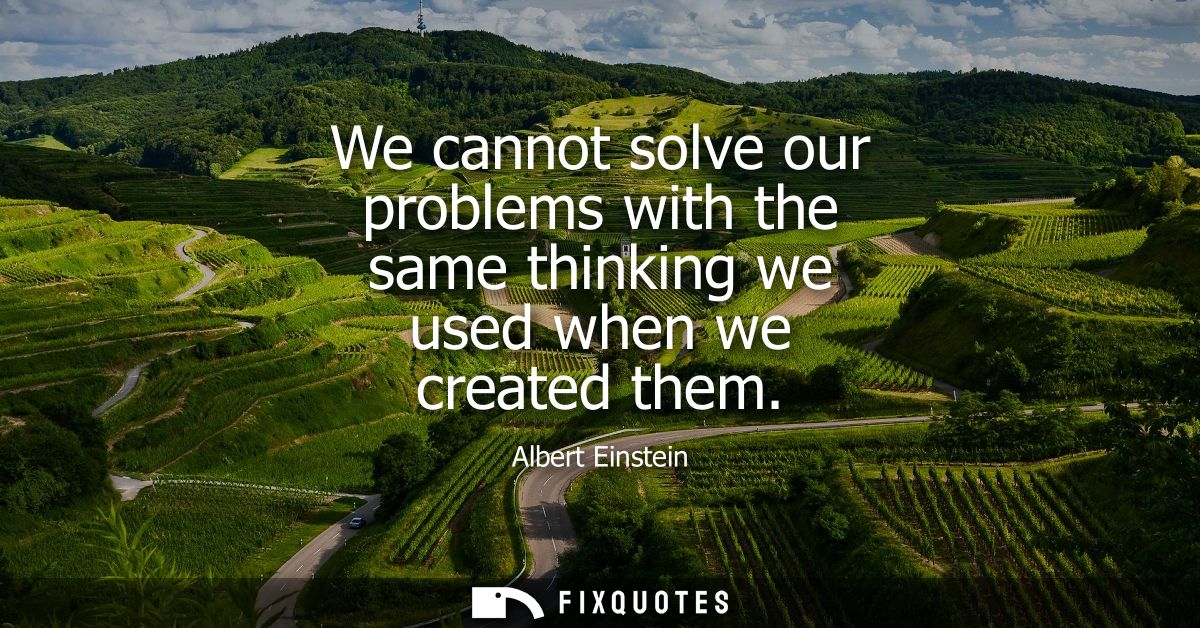
"We cannot solve our problems with the same thinking we used when we created them"
About this Quote
The intent is strategic, not mystical. Einstein isn’t praising novelty for novelty’s sake; he’s arguing for a shift in underlying assumptions, the kind of conceptual pivot that turned Newtonian certainty into relativity’s conditional truths. It’s a reminder that “better answers” can be a decoy when the real work is asking different questions. That’s why the phrasing matters: “the same thinking” suggests a patterned habit, not an isolated mistake. Problems persist because they’re produced by systems of thought that feel natural precisely because they’re familiar.
Contextually, the quote gets invoked for everything from corporate innovation to climate policy, but it gains bite when you remember Einstein lived through world wars, nationalism, and the dawn of nuclear reality - an era when technical brilliance and moral myopia coexisted uncomfortably. Read that way, it’s also an ethical warning: progress in method without progress in mindset can scale harm faster. The line’s durability comes from its sting: it flatters you as a rational actor while insisting that rationality itself may need an upgrade.
Quote Details
| Topic | Wisdom |
|---|---|
| Source | Help us find the source |
| Cite |
Citation Formats
APA Style (7th ed.)
Einstein, Albert. (2026, January 17). We cannot solve our problems with the same thinking we used when we created them. FixQuotes. https://fixquotes.com/quotes/we-cannot-solve-our-problems-with-the-same-25347/
Chicago Style
Einstein, Albert. "We cannot solve our problems with the same thinking we used when we created them." FixQuotes. January 17, 2026. https://fixquotes.com/quotes/we-cannot-solve-our-problems-with-the-same-25347/.
MLA Style (9th ed.)
"We cannot solve our problems with the same thinking we used when we created them." FixQuotes, 17 Jan. 2026, https://fixquotes.com/quotes/we-cannot-solve-our-problems-with-the-same-25347/. Accessed 19 Mar. 2026.