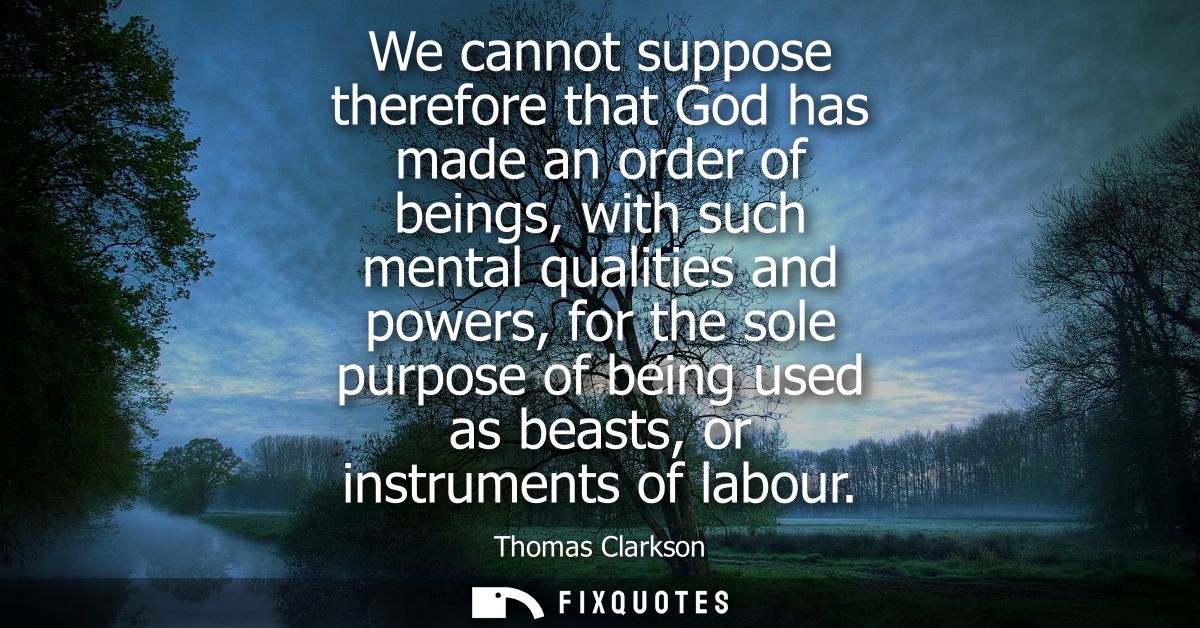
"We cannot suppose therefore that God has made an order of beings, with such mental qualities and powers, for the sole purpose of being used as beasts, or instruments of labour"
About this Quote
Clarkson’s line is doing a careful, strategic kind of moral judo: it takes the era’s most socially authoritative language - Christian providence - and turns it against the economic logic of slavery. “We cannot suppose” isn’t timid; it’s a rhetorical trap. He frames the pro-slavery position as not just cruel but theologically incoherent. If you accept the premise that God creates with purpose, then reducing human beings to “beasts” or “instruments of labour” becomes an affront not only to the enslaved, but to the Creator. That’s a powerful move in a Britain where moral legitimacy was routinely litigated in religious terms.
The phrasing matters. “Order of beings” sounds like natural history, classification, the Enlightenment’s tidy hierarchies - the same intellectual toolkit often used to rationalize racial domination. Clarkson borrows that register, then flips its conclusion: whatever “mental qualities and powers” humans possess, they signal personhood, not property. He’s arguing on terrain his opponents claim to own: reason, religion, and “nature.”
The subtext is political as much as spiritual. Clarkson knows Parliament can be persuaded by a case that makes slavery look like an engine of national sin and national hypocrisy. Calling people “instruments of labour” exposes the ugly modernization of bondage: humans rendered into technology, a profit mechanism with a pulse. The intent isn’t abstract compassion; it’s delegitimization. He’s trying to make slavery intellectually indefensible to the respectable middle - not by pleading, but by insisting that the very moral worldview that props up British society collapses if slavery stands.
The phrasing matters. “Order of beings” sounds like natural history, classification, the Enlightenment’s tidy hierarchies - the same intellectual toolkit often used to rationalize racial domination. Clarkson borrows that register, then flips its conclusion: whatever “mental qualities and powers” humans possess, they signal personhood, not property. He’s arguing on terrain his opponents claim to own: reason, religion, and “nature.”
The subtext is political as much as spiritual. Clarkson knows Parliament can be persuaded by a case that makes slavery look like an engine of national sin and national hypocrisy. Calling people “instruments of labour” exposes the ugly modernization of bondage: humans rendered into technology, a profit mechanism with a pulse. The intent isn’t abstract compassion; it’s delegitimization. He’s trying to make slavery intellectually indefensible to the respectable middle - not by pleading, but by insisting that the very moral worldview that props up British society collapses if slavery stands.
Quote Details
| Topic | Human Rights |
|---|
More Quotes by Thomas
Add to List