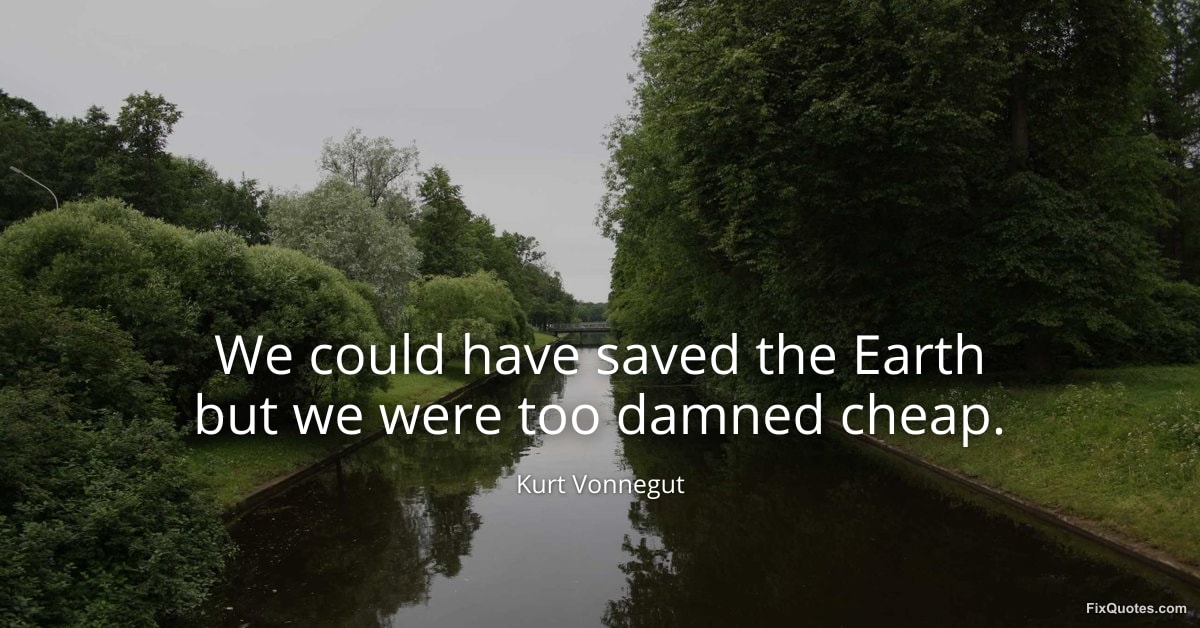
"We could have saved the Earth but we were too damned cheap"
About this Quote
A whole apocalypse, blamed not on ignorance or malice, but on penny-pinching. Vonnegut’s line lands because it shrinks the end of the world down to a familiar vice: the small, everyday reflex to cut corners, postpone repairs, and call it “practical.” The profanity isn’t decoration; it’s the snap of disgust at how unserious we are about consequences when the bill isn’t due today.
Vonnegut’s intent is less to scold individuals than to indict a culture that treats survival as an optional upgrade. “Could have saved” suggests the tragedy isn’t technical impossibility; it’s refusal. The subtext is brutal: we knew enough, we had enough, and we still chose the cheaper option, not once but as a governing habit. That cheapness isn’t just financial. It’s moral thrift, a stinginess of imagination that can’t picture future people as real enough to spend money on.
The line also carries Vonnegut’s signature dark comedy: the Earth, a planet, framed like a salvageable appliance we declined to fix. That’s the joke and the accusation. In the postwar American context Vonnegut wrote out of, “cheap” reads as the shadow side of consumer triumphalism: endless purchases for comfort now, paralyzed austerity for public goods later. He’s pointing at the absurdity of a society willing to bankroll spectacle, war, and convenience while bargaining down the price of its own continued livability.
Vonnegut’s intent is less to scold individuals than to indict a culture that treats survival as an optional upgrade. “Could have saved” suggests the tragedy isn’t technical impossibility; it’s refusal. The subtext is brutal: we knew enough, we had enough, and we still chose the cheaper option, not once but as a governing habit. That cheapness isn’t just financial. It’s moral thrift, a stinginess of imagination that can’t picture future people as real enough to spend money on.
The line also carries Vonnegut’s signature dark comedy: the Earth, a planet, framed like a salvageable appliance we declined to fix. That’s the joke and the accusation. In the postwar American context Vonnegut wrote out of, “cheap” reads as the shadow side of consumer triumphalism: endless purchases for comfort now, paralyzed austerity for public goods later. He’s pointing at the absurdity of a society willing to bankroll spectacle, war, and convenience while bargaining down the price of its own continued livability.
Quote Details
| Topic | Ethics & Morality |
|---|---|
| Source | Later attribution: A Revolution Is Coming (Mark A. Roberts, 2013) modern compilationISBN: 9781434932549 · ID: YcA8xmftIoIC
Evidence:
... We could have saved the Earth but we were too damned cheap . " Kurt Vonnegut , Jr. " The magnificence of mountains , the serenity of nature – nothing is safe from the idiot marks of man's passing . " Loudon Wainwright " They kill good ... |
| Cite |
Citation Formats
APA Style (7th ed.)
Vonnegut, Kurt. (2026, February 25). We could have saved the Earth but we were too damned cheap. FixQuotes. https://fixquotes.com/quotes/we-could-have-saved-the-earth-but-we-were-too-15803/
Chicago Style
Vonnegut, Kurt. "We could have saved the Earth but we were too damned cheap." FixQuotes. February 25, 2026. https://fixquotes.com/quotes/we-could-have-saved-the-earth-but-we-were-too-15803/.
MLA Style (9th ed.)
"We could have saved the Earth but we were too damned cheap." FixQuotes, 25 Feb. 2026, https://fixquotes.com/quotes/we-could-have-saved-the-earth-but-we-were-too-15803/. Accessed 1 Apr. 2026.
More Quotes by Kurt
Add to List