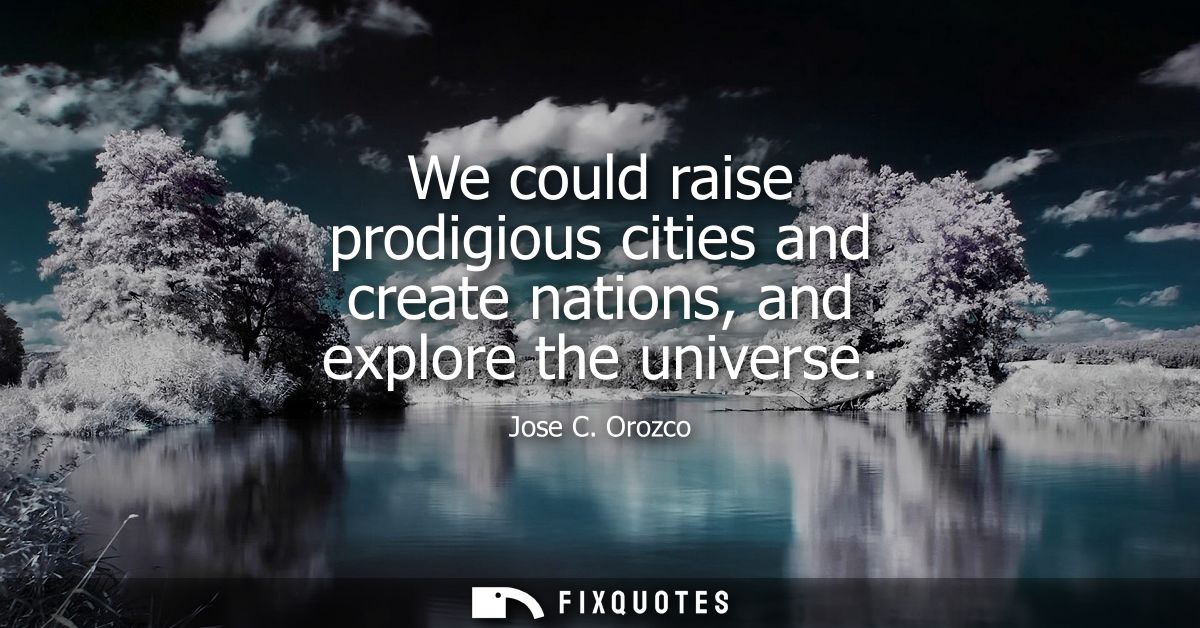
"We could raise prodigious cities and create nations, and explore the universe"
About this Quote
Orozco wasn't a detached dreamer. As a Mexican muralist shaped by revolution, industrial modernity, and the spectacle of state power, he watched "progress" become both public promise and public theater. His paintings often frame modern society as a machine that can liberate or pulverize the human body. Read through that lens, the quote functions less as techno-utopian hype than as an inventory of human scale and human risk. The grand verbs - raise, create, explore - are all collective actions, and their collective nature is the pressure point. If "we" can do this, "we" can also choose to do something uglier with the same tools.
The subtext is about misaligned ambition: we pour genius into monuments, borders, and conquest of distance, while remaining oddly incompetent at the smaller task of living together without cruelty. In Orozco's world, the future isn't blocked by imagination; it's blocked by what power does to imagination once it becomes architecture, ideology, and spectacle.
Quote Details
| Topic | Vision & Strategy |
|---|---|
| Source | Help us find the source |
| Cite |
Citation Formats
APA Style (7th ed.)
Orozco, Jose C. (2026, January 16). We could raise prodigious cities and create nations, and explore the universe. FixQuotes. https://fixquotes.com/quotes/we-could-raise-prodigious-cities-and-create-112429/
Chicago Style
Orozco, Jose C. "We could raise prodigious cities and create nations, and explore the universe." FixQuotes. January 16, 2026. https://fixquotes.com/quotes/we-could-raise-prodigious-cities-and-create-112429/.
MLA Style (9th ed.)
"We could raise prodigious cities and create nations, and explore the universe." FixQuotes, 16 Jan. 2026, https://fixquotes.com/quotes/we-could-raise-prodigious-cities-and-create-112429/. Accessed 12 Feb. 2026.