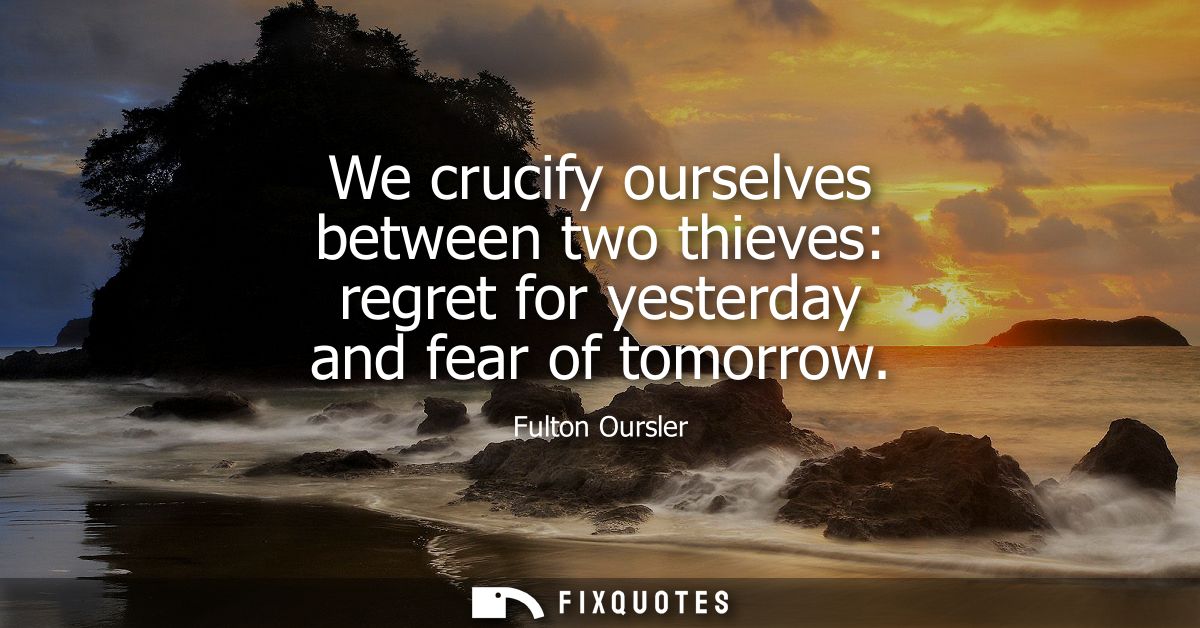
"We crucify ourselves between two thieves: regret for yesterday and fear of tomorrow"
About this Quote
The specific intent feels pastoral without being pious. Oursler, a midcentury American writer steeped in a culture where biblical literacy was common, uses religious shorthand as a psychological intervention. He’s not trying to win a theological argument; he’s trying to snap readers out of rumination and dread by making those habits look ridiculous and self-destructive. The subtext is modern and almost cognitive-behavioral: your suffering is real, but the mind is also a machine for replay and projection, and you’re letting that machine run your life.
Context matters. In the decades around the Great Depression and World War II, “fear of tomorrow” wasn’t an abstract anxiety; it was a national atmosphere. Pairing it with “regret for yesterday” creates a full trap: nostalgia curdled into guilt on one side, uncertainty weaponized on the other. Oursler’s line works because it doesn’t flatter the reader. It grants the pain, then insists we’re the ones keeping it holy.
Quote Details
| Topic | Live in the Moment |
|---|---|
| Source | Later attribution: The Book of Positive Quotations (Steve Deger, Leslie Ann Gibson, 2024) modern compilationISBN: 9781493089192 · ID: WuYPEQAAQBAJ
Evidence:
... We crucify ourselves between two thieves : regret for yesterday and fear of tomorrow . -Fulton Oursler Every saint has a past , and every sin- ner has a future . -Oscar Wilde these . Our ignorance of history makes us libel our own times ... |
| Cite |
Citation Formats
APA Style (7th ed.)
Oursler, Fulton. (2026, February 8). We crucify ourselves between two thieves: regret for yesterday and fear of tomorrow. FixQuotes. https://fixquotes.com/quotes/we-crucify-ourselves-between-two-thieves-regret-170913/
Chicago Style
Oursler, Fulton. "We crucify ourselves between two thieves: regret for yesterday and fear of tomorrow." FixQuotes. February 8, 2026. https://fixquotes.com/quotes/we-crucify-ourselves-between-two-thieves-regret-170913/.
MLA Style (9th ed.)
"We crucify ourselves between two thieves: regret for yesterday and fear of tomorrow." FixQuotes, 8 Feb. 2026, https://fixquotes.com/quotes/we-crucify-ourselves-between-two-thieves-regret-170913/. Accessed 31 Mar. 2026.