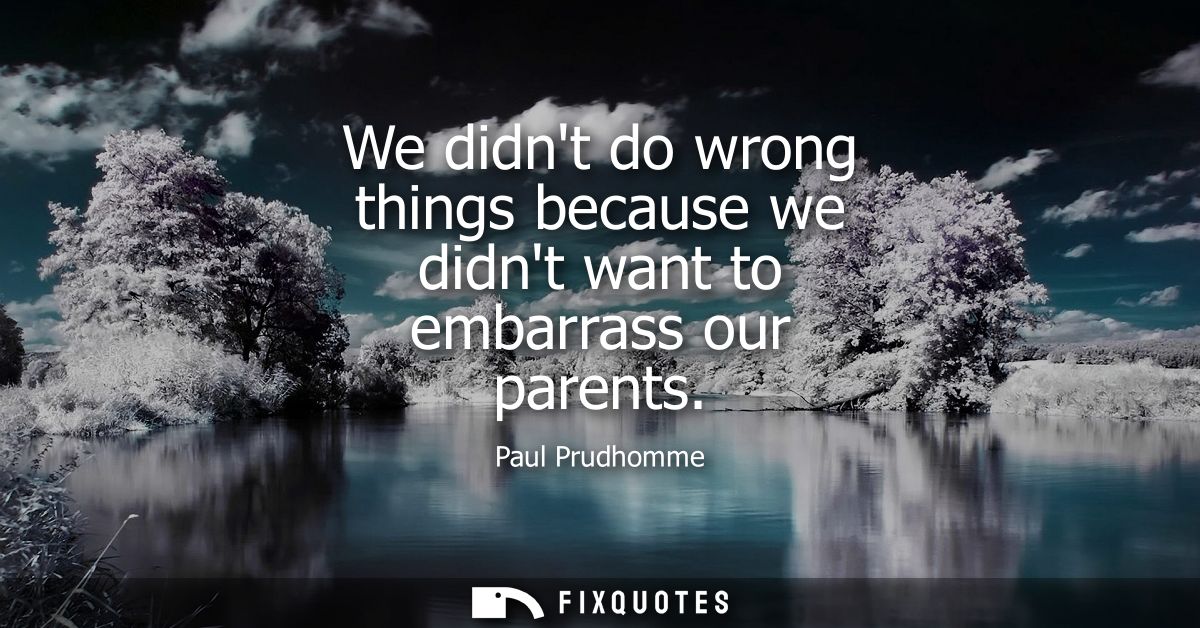
"We didn't do wrong things because we didn't want to embarrass our parents"
About this Quote
Coming from Prudhomme - a chef who became a celebrity - the quote also doubles as origin myth. It paints his upbringing as a training ground for discipline: you behave because someone is watching, and because your actions reflect back on others. That maps neatly onto restaurant culture, where your station is a public stage and mistakes aren’t just technical; they’re humiliations. The “we” is important, too: it’s communal, sibling-ish, crew-like. He’s not claiming personal purity so much as describing a shared social technology that kept kids in line.
The subtext is bittersweet. “Embarrass” is softer than “betray,” but it carries a sting: the parent-child bond becomes both shelter and surveillance. Prudhomme isn’t romanticizing strictness; he’s admitting that love often works through pressure, and that the desire to make your people proud can be the most effective deterrent of all.
Quote Details
| Topic | Family |
|---|---|
| Source | Help us find the source |
| Cite |
Citation Formats
APA Style (7th ed.)
Prudhomme, Paul. (2026, January 17). We didn't do wrong things because we didn't want to embarrass our parents. FixQuotes. https://fixquotes.com/quotes/we-didnt-do-wrong-things-because-we-didnt-want-to-73129/
Chicago Style
Prudhomme, Paul. "We didn't do wrong things because we didn't want to embarrass our parents." FixQuotes. January 17, 2026. https://fixquotes.com/quotes/we-didnt-do-wrong-things-because-we-didnt-want-to-73129/.
MLA Style (9th ed.)
"We didn't do wrong things because we didn't want to embarrass our parents." FixQuotes, 17 Jan. 2026, https://fixquotes.com/quotes/we-didnt-do-wrong-things-because-we-didnt-want-to-73129/. Accessed 27 Mar. 2026.