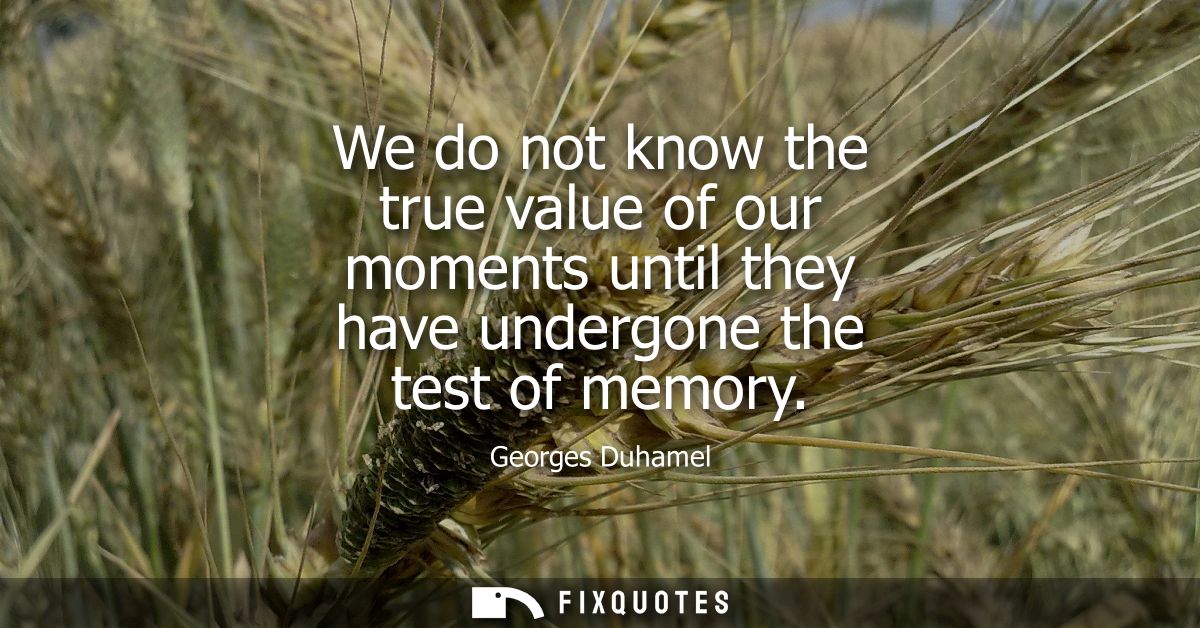
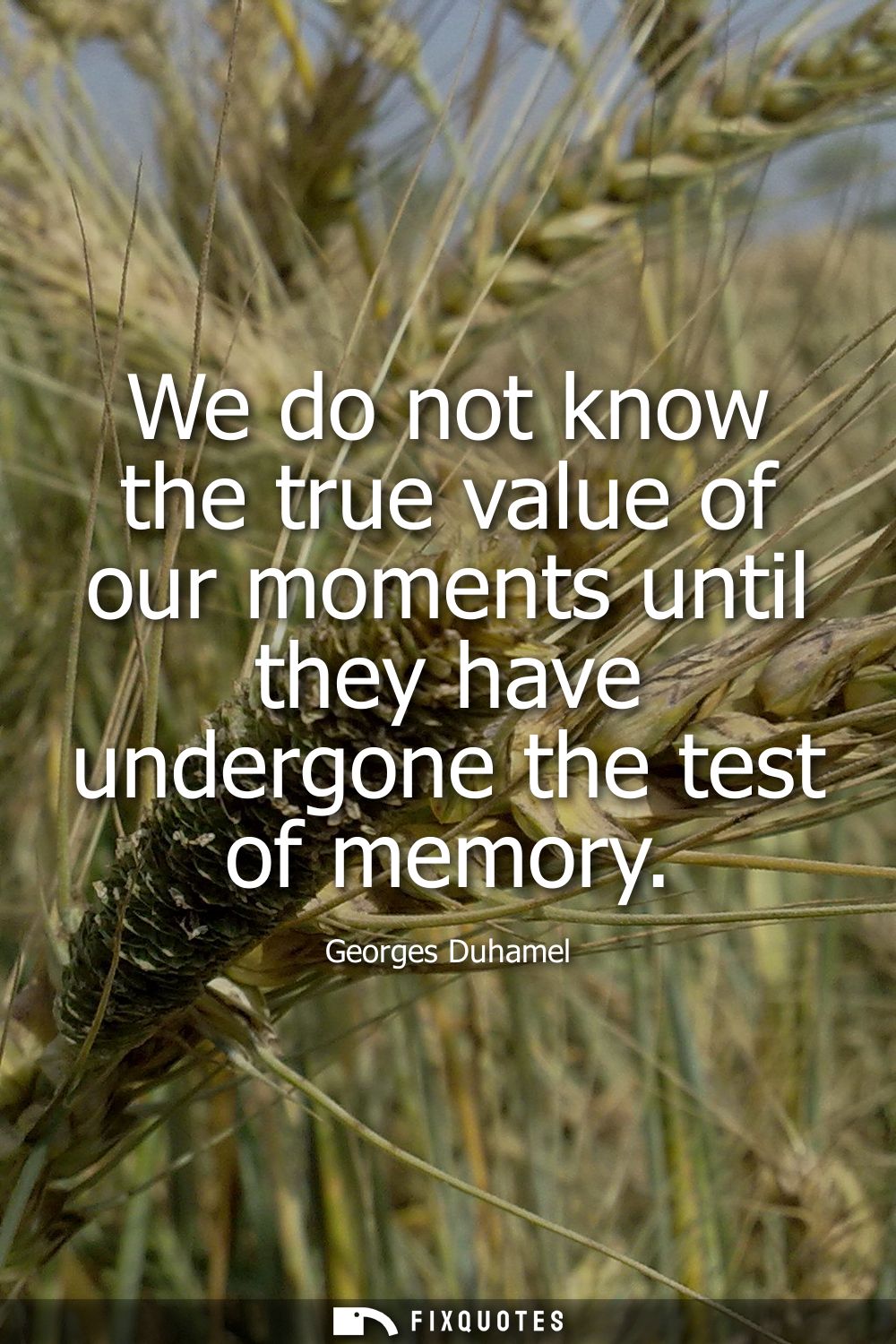
"We do not know the true value of our moments until they have undergone the test of memory"
About this Quote
The intent is almost diagnostic. Duhamel suggests that value is not an intrinsic property of an event but a verdict delivered later, after time has introduced contrast, loss, and consequence. “Test of memory” is doing heavy work: memory isn’t a scrapbook, it’s a tribunal. It cross-examines our hours, discards most of them, and keeps a few as evidence of love, failure, or becoming. That process can flatter us (turning chaos into narrative) or indict us (revealing what we ignored).
The subtext carries a faint moral pressure: if we can’t accurately appraise the present, we should be humbler about our certainty and more attentive to the supposedly small. It also hints at tragedy. The most valuable moments may be precisely the ones we’re least equipped to recognize while they’re alive.
Context matters: Duhamel wrote in a Europe scarred by industrial acceleration and the psychic wreckage of World War I. For a novelist shaped by that rupture, memory isn’t a cozy return; it’s the medium through which meaning gets rebuilt after events have broken it. The sentence works because it turns sentiment into structure: time doesn’t just pass - it judges.
Quote Details
| Topic | Nostalgia |
|---|---|
| Source | Help us find the source |
| Cite |
Citation Formats
APA Style (7th ed.)
Duhamel, Georges. (2026, January 18). We do not know the true value of our moments until they have undergone the test of memory. FixQuotes. https://fixquotes.com/quotes/we-do-not-know-the-true-value-of-our-moments-4204/
Chicago Style
Duhamel, Georges. "We do not know the true value of our moments until they have undergone the test of memory." FixQuotes. January 18, 2026. https://fixquotes.com/quotes/we-do-not-know-the-true-value-of-our-moments-4204/.
MLA Style (9th ed.)
"We do not know the true value of our moments until they have undergone the test of memory." FixQuotes, 18 Jan. 2026, https://fixquotes.com/quotes/we-do-not-know-the-true-value-of-our-moments-4204/. Accessed 7 Apr. 2026.