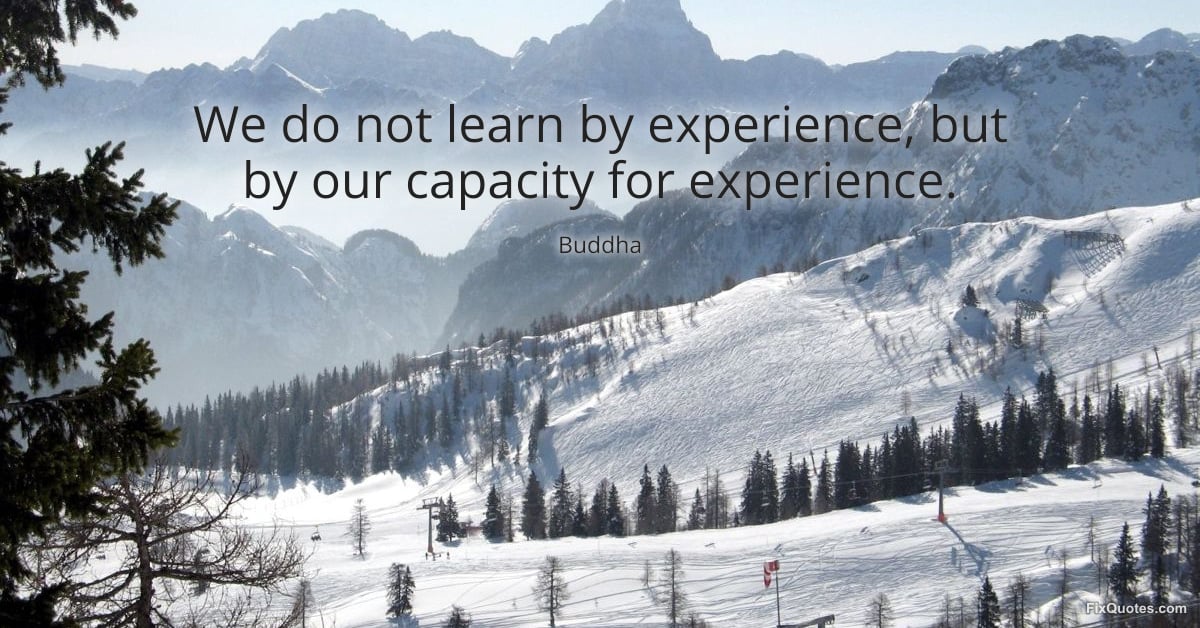
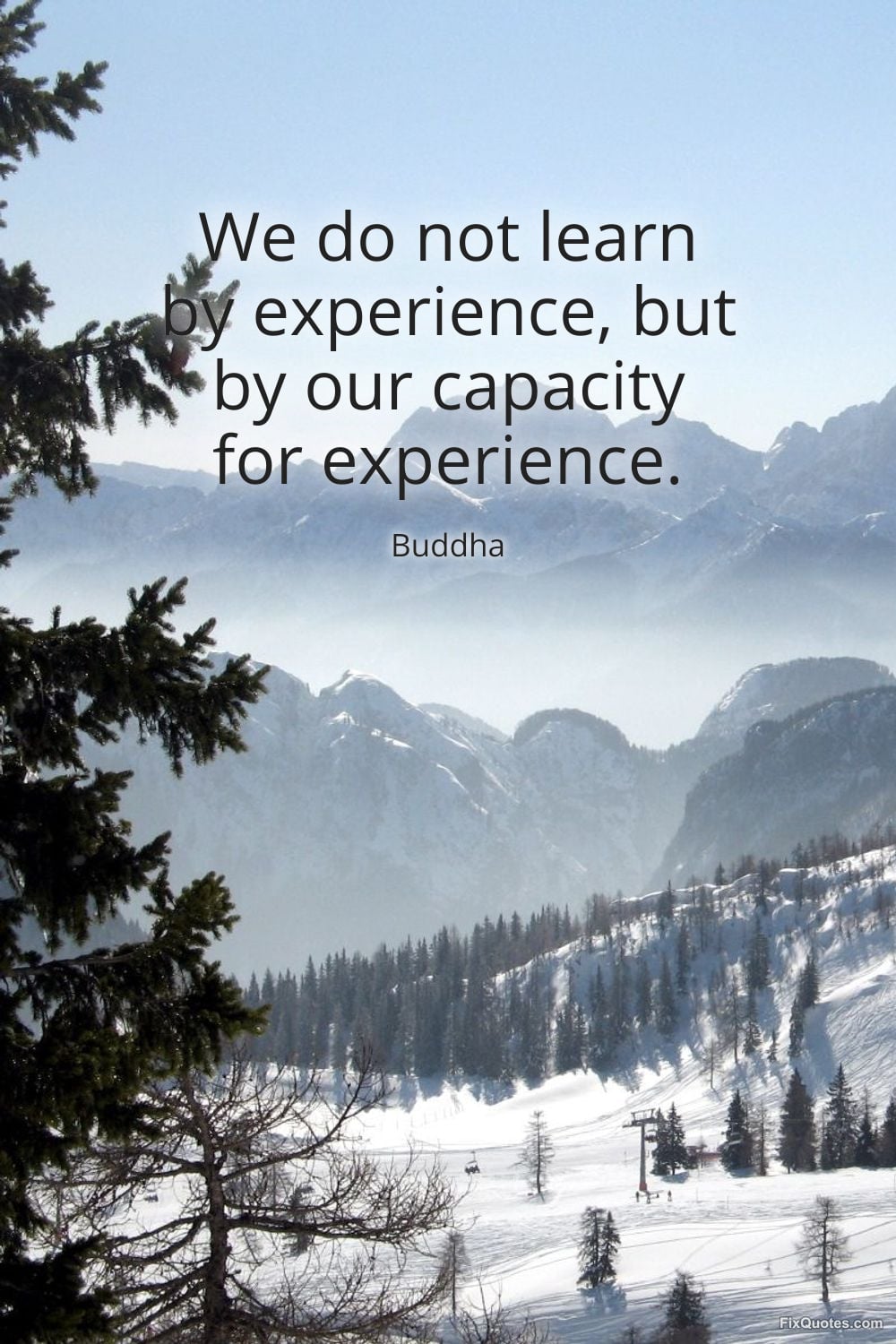
"We do not learn by experience, but by our capacity for experience"
About this Quote
The line lands with the force of a correction. It rejects one of modern culture's favorite myths: that time, struggle, or sheer exposure automatically make people wiser. Buddha's point is harsher and more demanding. Experience alone does nothing. What matters is the mind that receives it: its openness, discipline, and willingness to be altered.
That is why the phrase "capacity for experience" is doing the real work here. Capacity suggests an inner instrument, not a passive record of events. Two people can endure the same loss, the same joy, the same failure, and emerge with entirely different understandings. One hardens into repetition; the other turns the event into insight. The quote shifts authority away from circumstance and back onto consciousness itself, which is central to Buddhist thought. Suffering is not merely something that happens to us; it becomes meaningful, or remains meaningless, through attention.
The subtext is almost anti-heroic. Buddha is not glorifying adventure, age, or worldly mileage. He is quietly undermining the prestige of having "been through things". Without awareness, experience is just accumulation, a pile of impressions mistaken for wisdom. With awareness, even ordinary moments become sites of transformation.
As a statement from a spiritual leader, the rhetoric is spare but radical. It asks listeners to stop outsourcing growth to fate. The challenge is inward: refine perception, or life will keep teaching the same lesson without ever being learned.
That is why the phrase "capacity for experience" is doing the real work here. Capacity suggests an inner instrument, not a passive record of events. Two people can endure the same loss, the same joy, the same failure, and emerge with entirely different understandings. One hardens into repetition; the other turns the event into insight. The quote shifts authority away from circumstance and back onto consciousness itself, which is central to Buddhist thought. Suffering is not merely something that happens to us; it becomes meaningful, or remains meaningless, through attention.
The subtext is almost anti-heroic. Buddha is not glorifying adventure, age, or worldly mileage. He is quietly undermining the prestige of having "been through things". Without awareness, experience is just accumulation, a pile of impressions mistaken for wisdom. With awareness, even ordinary moments become sites of transformation.
As a statement from a spiritual leader, the rhetoric is spare but radical. It asks listeners to stop outsourcing growth to fate. The challenge is inward: refine perception, or life will keep teaching the same lesson without ever being learned.
Quote Details
| Topic | Learning |
|---|---|
| Source | Help us find the source |
| Cite |
Citation Formats
APA Style (7th ed.)
Buddha. (2026, March 10). We do not learn by experience, but by our capacity for experience. FixQuotes. https://fixquotes.com/quotes/we-do-not-learn-by-experience-but-by-our-capacity-185926/
Chicago Style
Buddha. "We do not learn by experience, but by our capacity for experience." FixQuotes. March 10, 2026. https://fixquotes.com/quotes/we-do-not-learn-by-experience-but-by-our-capacity-185926/.
MLA Style (9th ed.)
"We do not learn by experience, but by our capacity for experience." FixQuotes, 10 Mar. 2026, https://fixquotes.com/quotes/we-do-not-learn-by-experience-but-by-our-capacity-185926/. Accessed 3 Apr. 2026.
More Quotes by Buddha
Add to List