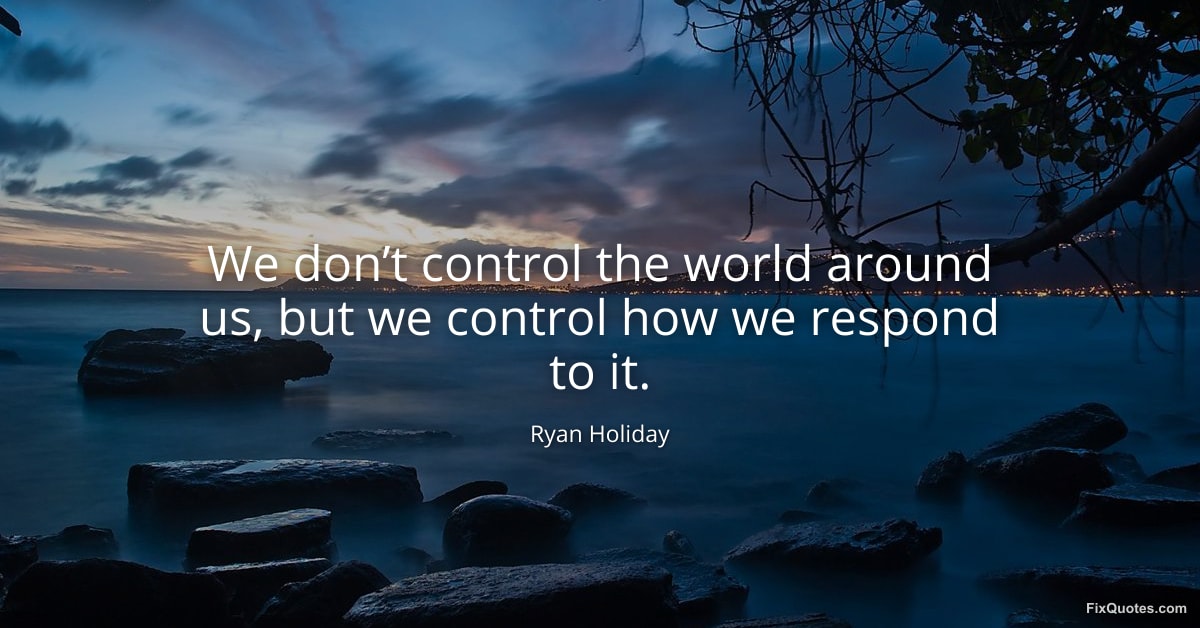
"We don't control the world around us, but we control how we respond to it"
About this Quote
The intent is explicitly Stoic, but the subtext is very 21st century: stop bargaining with the universe, start managing your inputs. Holiday’s brand of Stoicism is less marble-statue austerity than cognitive-behavioral minimalism. You can’t control the news cycle, the market, your ex’s opinion, the diagnosis, the weather; you can control the story you tell yourself about it, the next action, the tone, the refusal to spiral. That’s empowering, and it’s also a quiet rebuke to the modern habit of outsourcing responsibility to systems even when the system is real.
Context matters because “control your response” can slide into a kind of respectable detachment that suits high-pressure productivity culture: accept the chaos, stay optimized. Read generously, it’s a prescription for dignity under constraint. Read cynically, it can sound like a self-help way to accommodate injustice by relocating the problem from the world to your attitude. The line works because it holds both truths in tension: you’re not sovereign over outcomes, but you’re not nothing, either.
Quote Details
| Topic | Self-Improvement |
|---|---|
| Source | The Daily Stoic (2016) |
| Cite |
Citation Formats
APA Style (7th ed.)
Holiday, Ryan. (2026, February 16). We don't control the world around us, but we control how we respond to it. FixQuotes. https://fixquotes.com/quotes/we-dont-control-the-world-around-us-but-we-184138/
Chicago Style
Holiday, Ryan. "We don't control the world around us, but we control how we respond to it." FixQuotes. February 16, 2026. https://fixquotes.com/quotes/we-dont-control-the-world-around-us-but-we-184138/.
MLA Style (9th ed.)
"We don't control the world around us, but we control how we respond to it." FixQuotes, 16 Feb. 2026, https://fixquotes.com/quotes/we-dont-control-the-world-around-us-but-we-184138/. Accessed 2 Apr. 2026.