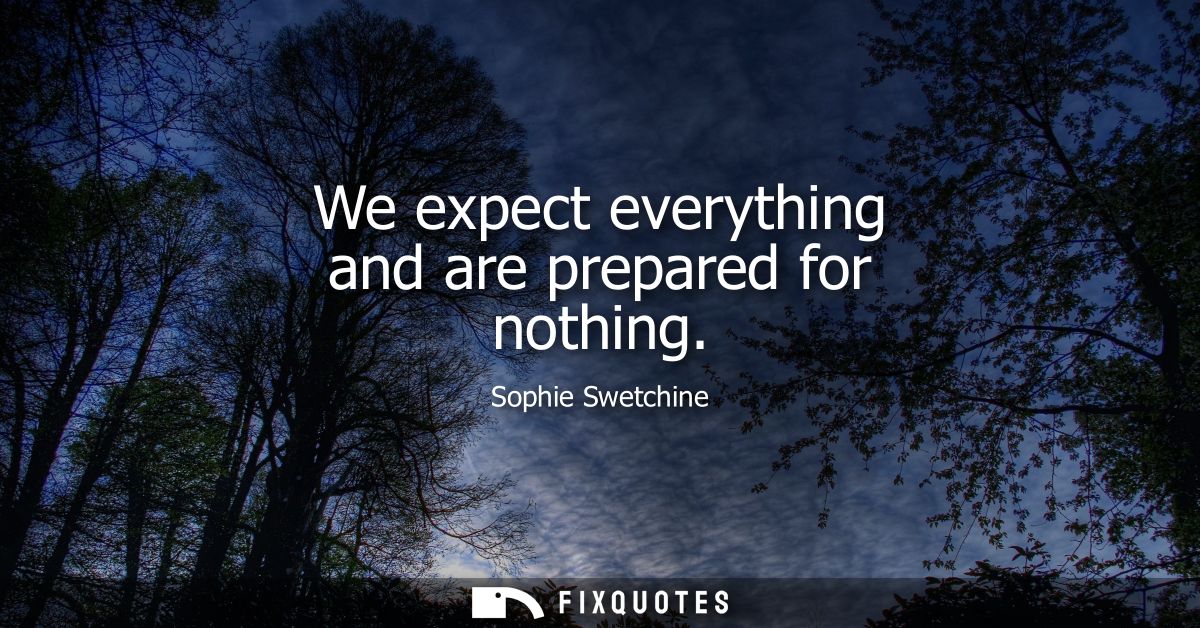
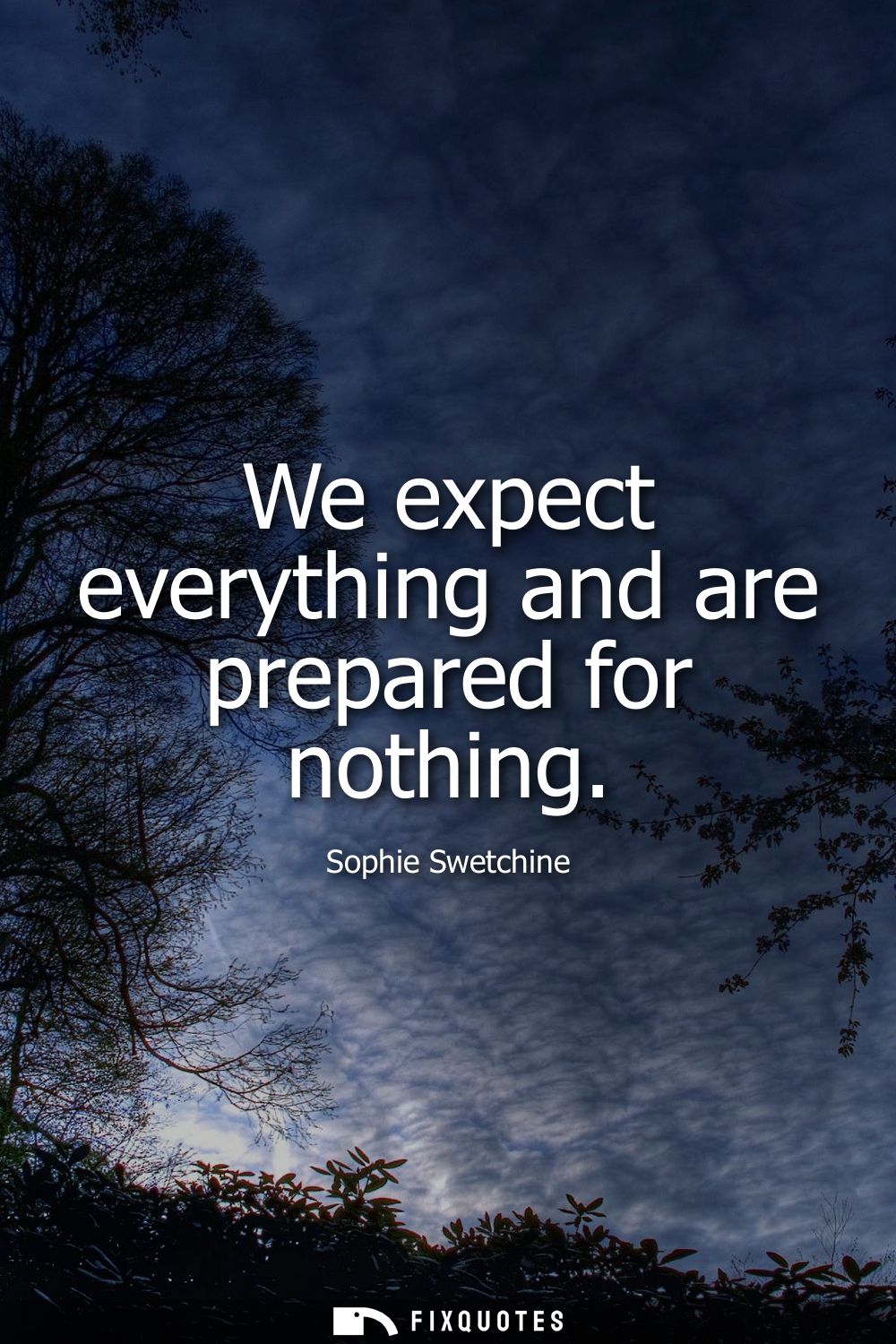
"We expect everything and are prepared for nothing"
About this Quote
A whole psychology of modern entitlement fits inside Swetchine's neat little contraption: boundless expectation paired with zero rehearsal for consequence. "We expect everything" isn't just optimism; it's appetite. The phrase suggests a culture of imagined outcomes - success, love, justice, comfort - treated less as earned possibilities than as default settings. Then she snaps the trap shut with "prepared for nothing", exposing the laziness hiding under that appetite: wanting the world to deliver while refusing the disciplines (patience, planning, moral stamina) that make disappointment survivable.
The line works because it shifts the target from individual failure to collective self-deception. The "we" is accusatory but also intimate; Swetchine is indicting her own class and milieu, not scolding from a safe pedestal. As a Russian-born salon figure in post-Revolutionary Europe, she lived amid societies reordering themselves with grand promises - political, religious, romantic - while daily life remained stubbornly contingent. In that context, expectation becomes a kind of secular faith: a belief that history, progress, or Providence will tidy up the mess without asking much of us.
The subtext is moral: preparation isn't just practical, it's character. To be prepared is to admit uncertainty, to accept limits, to do the unglamorous work before the curtain rises. Swetchine's sting is that expecting "everything" flatters the ego; preparing for something forces humility.
The line works because it shifts the target from individual failure to collective self-deception. The "we" is accusatory but also intimate; Swetchine is indicting her own class and milieu, not scolding from a safe pedestal. As a Russian-born salon figure in post-Revolutionary Europe, she lived amid societies reordering themselves with grand promises - political, religious, romantic - while daily life remained stubbornly contingent. In that context, expectation becomes a kind of secular faith: a belief that history, progress, or Providence will tidy up the mess without asking much of us.
The subtext is moral: preparation isn't just practical, it's character. To be prepared is to admit uncertainty, to accept limits, to do the unglamorous work before the curtain rises. Swetchine's sting is that expecting "everything" flatters the ego; preparing for something forces humility.
Quote Details
| Topic | Wisdom |
|---|---|
| Source | Help us find the source |
| Cite |
Citation Formats
APA Style (7th ed.)
Swetchine, Sophie. (2026, January 16). We expect everything and are prepared for nothing. FixQuotes. https://fixquotes.com/quotes/we-expect-everything-and-are-prepared-for-nothing-95485/
Chicago Style
Swetchine, Sophie. "We expect everything and are prepared for nothing." FixQuotes. January 16, 2026. https://fixquotes.com/quotes/we-expect-everything-and-are-prepared-for-nothing-95485/.
MLA Style (9th ed.)
"We expect everything and are prepared for nothing." FixQuotes, 16 Jan. 2026, https://fixquotes.com/quotes/we-expect-everything-and-are-prepared-for-nothing-95485/. Accessed 4 Mar. 2026.
More Quotes by Sophie
Add to List