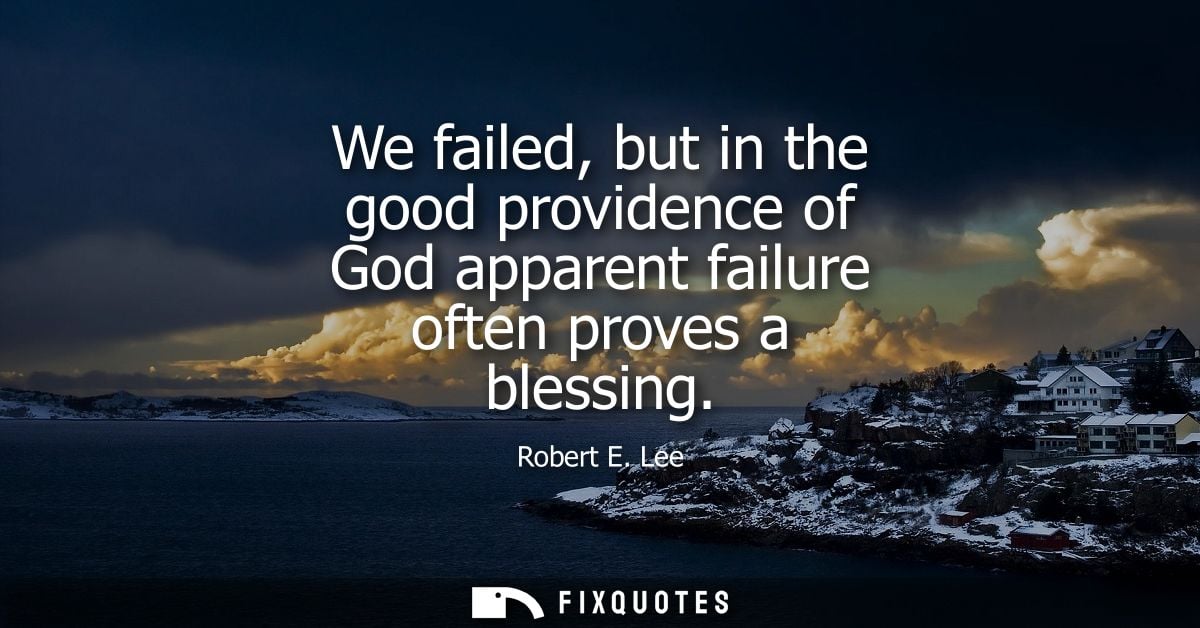
"We failed, but in the good providence of God, apparent failure often proves a blessing"
About this Quote
In context, Lee’s voice carries the authority of a defeated commander in a nation-shattering war, speaking to an audience hungry for meaning after the Confederacy’s collapse. Providence talk was familiar 19th-century rhetoric, but here it functions as psychological triage. It steadies the wounded pride of a military culture built on honor and certainty. If the outcome can be refiled as a "blessing", then responsibility can be dispersed upward, away from human agency and away from the ethical stakes of what was being fought to preserve.
That’s the subtext: resignation masquerading as faith, healing that also protects the self-image of the defeated. The sentence is elegantly constructed for consolation - short, plain, scriptural in rhythm - and it performs a cultural pivot. It helps transform loss into a usable story, one that can soothe grief while quietly insulating a contested legacy from the blunt clarity that defeat might otherwise impose.
Quote Details
| Topic | Failure |
|---|---|
| Source | Help us find the source |
| Cite |
Citation Formats
APA Style (7th ed.)
Lee, Robert E. (2026, February 20). We failed, but in the good providence of God, apparent failure often proves a blessing. FixQuotes. https://fixquotes.com/quotes/we-failed-but-in-the-good-providence-of-god-20815/
Chicago Style
Lee, Robert E. "We failed, but in the good providence of God, apparent failure often proves a blessing." FixQuotes. February 20, 2026. https://fixquotes.com/quotes/we-failed-but-in-the-good-providence-of-god-20815/.
MLA Style (9th ed.)
"We failed, but in the good providence of God, apparent failure often proves a blessing." FixQuotes, 20 Feb. 2026, https://fixquotes.com/quotes/we-failed-but-in-the-good-providence-of-god-20815/. Accessed 7 Apr. 2026.