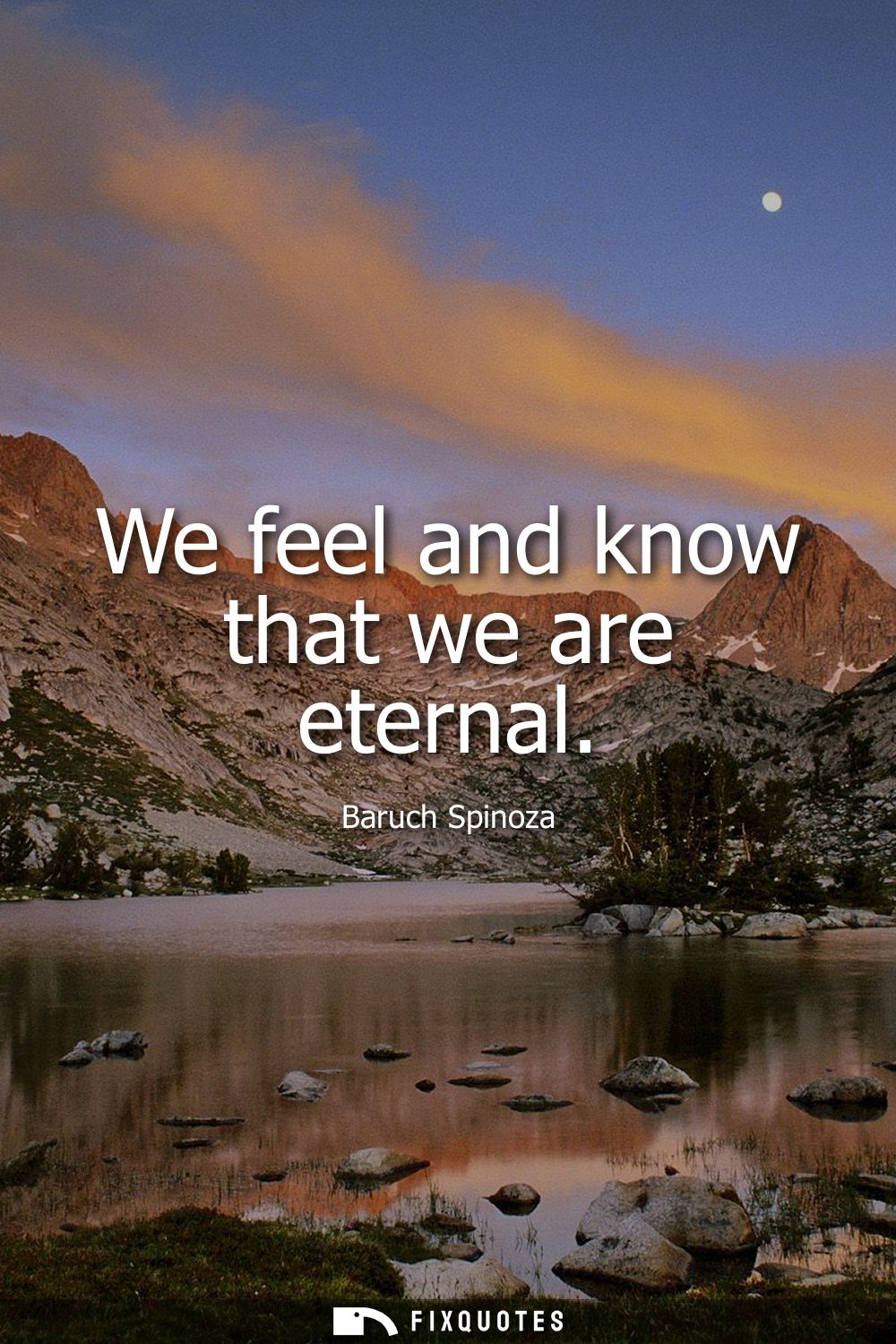
"We feel and know that we are eternal"
About this Quote
Spinoza’s “We feel and know that we are eternal” is a provocation disguised as calm reassurance. He’s not promising an afterlife where your personality gets a sequel. He’s trying to reroute the reader away from religious consolation and toward a colder, cleaner kind of permanence: eternity as a mode of understanding, not a timeline that stretches on forever.
In the Ethics, “eternal” doesn’t mean “endless.” It means sub specie aeternitatis, under the aspect of eternity. When the mind grasps reality adequately, it participates in something that isn’t measured by clocks at all. The trick is that Spinoza fuses feeling with knowledge. He refuses the modern split where emotion is suspect and reason is sterile. That pairing is strategic: if eternity is only a concept, it stays brittle; if it’s only a sensation, it becomes mystical. Spinoza wants both, because his project is to naturalize the sacred without draining it of force.
The subtext is a quiet revolt against the fear economy of his era: churches and states trading on anxiety about death, sin, and judgment. Spinoza, excommunicated and politically precarious, offers a different antidote. Freedom comes not from pleading with a personal God but from recognizing that you are a part of Nature’s necessary order. The line works because it’s simultaneously intimate and impersonal: “we” are eternal not as special souls, but as expressions of a reality that cannot be born or buried.
In the Ethics, “eternal” doesn’t mean “endless.” It means sub specie aeternitatis, under the aspect of eternity. When the mind grasps reality adequately, it participates in something that isn’t measured by clocks at all. The trick is that Spinoza fuses feeling with knowledge. He refuses the modern split where emotion is suspect and reason is sterile. That pairing is strategic: if eternity is only a concept, it stays brittle; if it’s only a sensation, it becomes mystical. Spinoza wants both, because his project is to naturalize the sacred without draining it of force.
The subtext is a quiet revolt against the fear economy of his era: churches and states trading on anxiety about death, sin, and judgment. Spinoza, excommunicated and politically precarious, offers a different antidote. Freedom comes not from pleading with a personal God but from recognizing that you are a part of Nature’s necessary order. The line works because it’s simultaneously intimate and impersonal: “we” are eternal not as special souls, but as expressions of a reality that cannot be born or buried.
Quote Details
| Topic | Wisdom |
|---|---|
| Source | Help us find the source |
| Cite |
Citation Formats
APA Style (7th ed.)
Spinoza, Baruch. (2026, January 15). We feel and know that we are eternal. FixQuotes. https://fixquotes.com/quotes/we-feel-and-know-that-we-are-eternal-62888/
Chicago Style
Spinoza, Baruch. "We feel and know that we are eternal." FixQuotes. January 15, 2026. https://fixquotes.com/quotes/we-feel-and-know-that-we-are-eternal-62888/.
MLA Style (9th ed.)
"We feel and know that we are eternal." FixQuotes, 15 Jan. 2026, https://fixquotes.com/quotes/we-feel-and-know-that-we-are-eternal-62888/. Accessed 7 Apr. 2026.
More Quotes by Baruch
Add to List