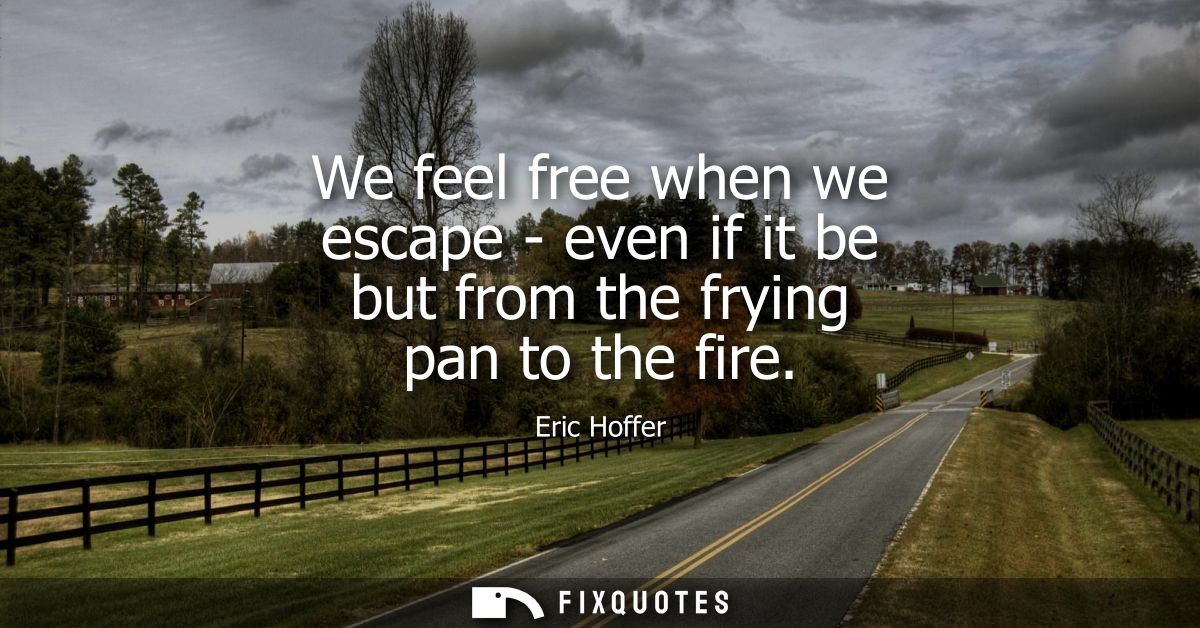
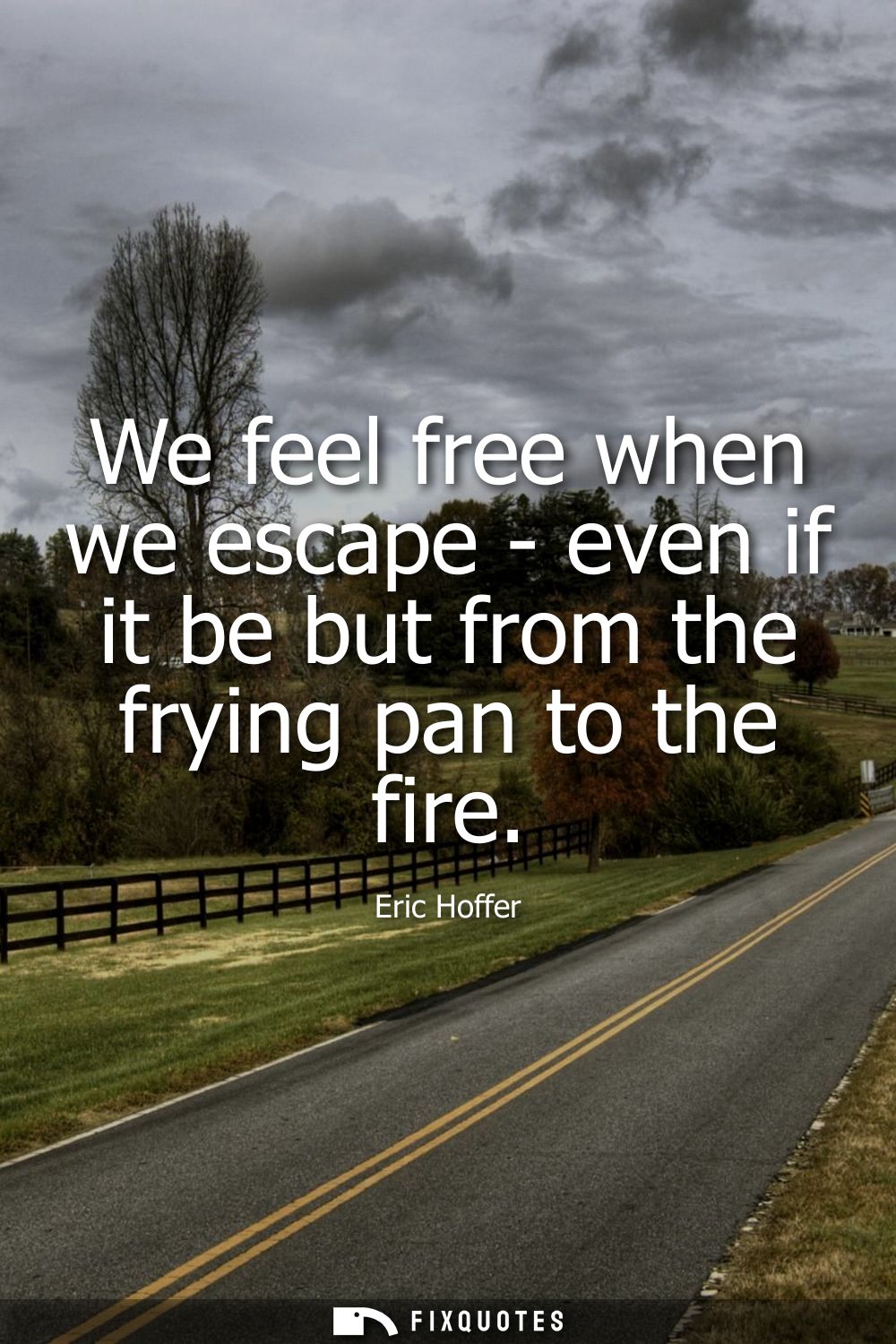
"We feel free when we escape - even if it be but from the frying pan to the fire"
About this Quote
The line carries the hard-earned skepticism of a writer who spent years as a migrant laborer and longshoreman before becoming an unlikely public intellectual. He watched people chase deliverance in real time - in ideology, in unions, in nation, in a new job, in a new leader - and he understood how the body confuses change with improvement. The specific intent is to warn against the romanticism of escape narratives. Leaving a bad situation can be necessary; it can also be the beginning of a worse one, and the early adrenaline masks that fact.
Subtext: many movements sell themselves as exits. Revolutions, cults, extremist politics, even self-help reinventions often begin as "finally, I'm out". Hoffer's point is that the appetite for freedom is exploitable because it's easily triggered by contrast. You don't have to offer people a better world; you can offer them a door. The quote works because it treats freedom as a perception problem, not a moral banner - a bracing demystification that lands like a cold cloth on the forehead of every "anything but this" impulse.
Quote Details
| Topic | Wisdom |
|---|---|
| Source | Verified source: The Passionate State of Mind and Other Aphorisms (Eric Hoffer, 1955)
Evidence: WE FEEL free when we escape, even if it be but from the frying pan into the fire. (Aphorism 242 (printed page 137 in the scanned text)). This line appears as aphorism #242 in Eric Hoffer’s book "The Passionate State of Mind and Other Aphorisms." The scan’s front matter shows the title and publisher imprint (Harper & Row) and indicates copyright years 1954 and 1955, consistent with first publication in the mid-1950s. Because the accessible verification here is via an uploaded scan (not an official publisher-hosted copy), confidence is set to medium even though the text itself is clearly shown in-context with the book’s title and imprint. Other candidates (1) The Comedian’s Bible (R.J.P. Marks, 2025) compilation95.0% ... Eric Hoffer We feel free when we escape even if it be but from the frying pan to the fire . - Eric Hoffer What a ... |
| Cite |
Citation Formats
APA Style (7th ed.)
Hoffer, Eric. (2026, February 10). We feel free when we escape - even if it be but from the frying pan to the fire. FixQuotes. https://fixquotes.com/quotes/we-feel-free-when-we-escape-even-if-it-be-but-137451/
Chicago Style
Hoffer, Eric. "We feel free when we escape - even if it be but from the frying pan to the fire." FixQuotes. February 10, 2026. https://fixquotes.com/quotes/we-feel-free-when-we-escape-even-if-it-be-but-137451/.
MLA Style (9th ed.)
"We feel free when we escape - even if it be but from the frying pan to the fire." FixQuotes, 10 Feb. 2026, https://fixquotes.com/quotes/we-feel-free-when-we-escape-even-if-it-be-but-137451/. Accessed 11 Mar. 2026.