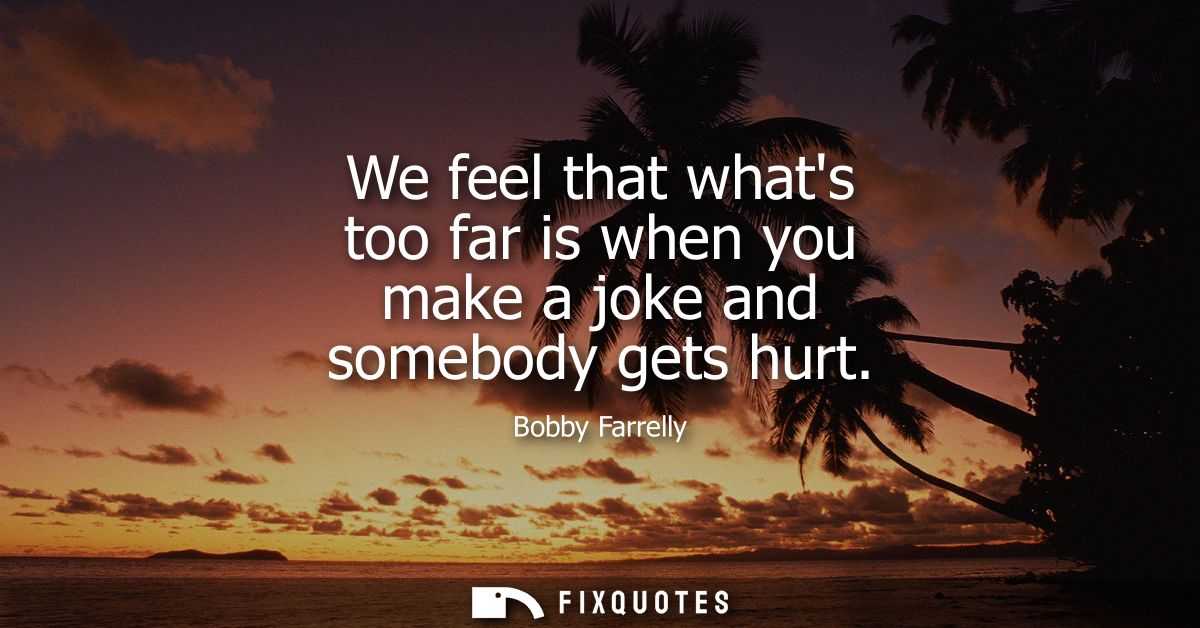
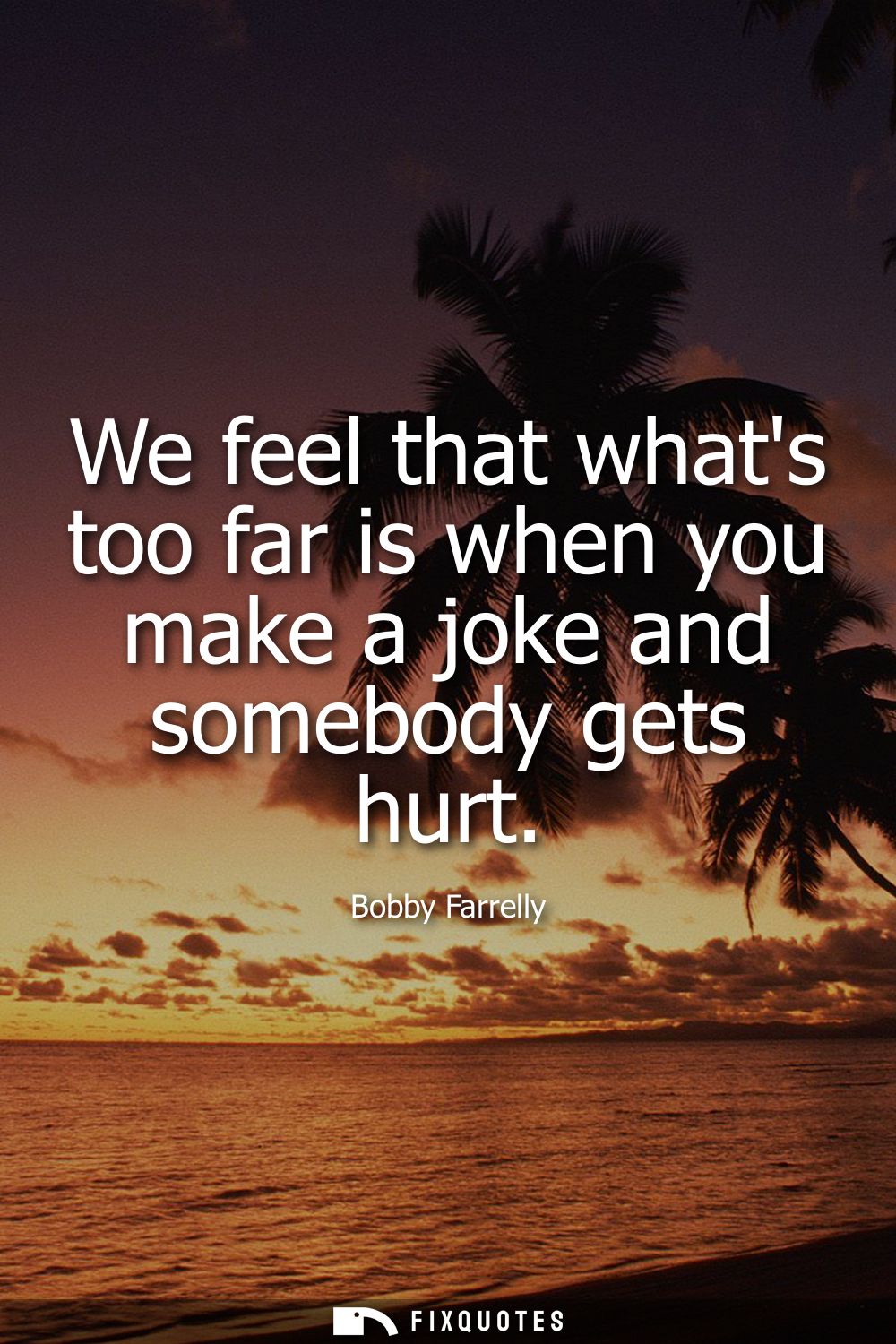
"We feel that what's too far is when you make a joke and somebody gets hurt"
About this Quote
The subtext is strategic. “Somebody gets hurt” reads as an objective metric, but it quietly smuggles in a question: who gets to decide what “hurt” is? A pratfall injury on set is obvious. Humiliation, stereotyping, or a joke that reinforces a social hierarchy is harder to tally, which is exactly why the definition is convenient. It frames the comedian as a responsible craftsman who cares about consequences, while insulating the work from critiques about punching down or normalizing cruelty.
Context matters: Farrelly comes from a 1990s studio-comedy tradition where shock and embarrassment were the engine, and audiences were asked to laugh at the extremity, not interrogate the collateral damage. His “line” isn’t really a line; it’s a reframing. The real claim is that comedy remains innocent until it produces measurable harm, a standard that protects the joke-maker more than the joke’s target.
Quote Details
| Topic | Kindness |
|---|---|
| Source | Help us find the source |
| Cite |
Citation Formats
APA Style (7th ed.)
Farrelly, Bobby. (2026, January 15). We feel that what's too far is when you make a joke and somebody gets hurt. FixQuotes. https://fixquotes.com/quotes/we-feel-that-whats-too-far-is-when-you-make-a-157838/
Chicago Style
Farrelly, Bobby. "We feel that what's too far is when you make a joke and somebody gets hurt." FixQuotes. January 15, 2026. https://fixquotes.com/quotes/we-feel-that-whats-too-far-is-when-you-make-a-157838/.
MLA Style (9th ed.)
"We feel that what's too far is when you make a joke and somebody gets hurt." FixQuotes, 15 Jan. 2026, https://fixquotes.com/quotes/we-feel-that-whats-too-far-is-when-you-make-a-157838/. Accessed 12 Feb. 2026.