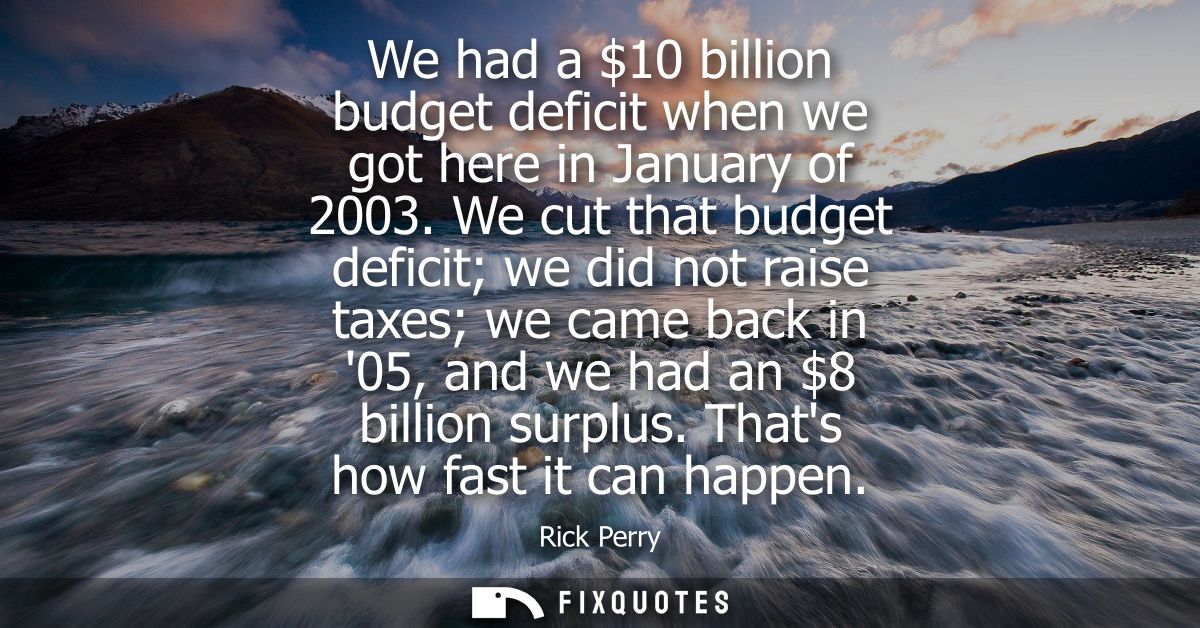
"We had a $10 billion budget deficit when we got here in January of 2003. We cut that budget deficit; we did not raise taxes; we came back in '05, and we had an $8 billion surplus. That's how fast it can happen"
About this Quote
The subtext is a familiar conservative equation: deficits are the product of bad management, not structural realities, and “we did not raise taxes” is the moral credential that makes the turnaround feel virtuous rather than merely lucky. By pairing “cut that budget deficit” with “did not raise taxes,” he frames spending restraint as both practical and principled, implying that opponents only know one solution: take more from taxpayers.
Context matters, though, because this kind of fiscal testimonial often rides on conditions the speaker doesn’t name: commodity cycles, one-time revenues, federal transfers, population growth, or budget maneuvers that shift costs off the headline ledger. The precision of “January of 2003” signals a takeover moment - we arrived, chaos existed, order returned - a narrative that personalizes what is usually impersonal.
Rhetorically, it works because it compresses complexity into a simple arc of redemption. Politically, it works because it invites listeners to generalize Texas’s alleged turnaround into a broader ideological claim: elect our team, and prosperity follows on schedule.
Quote Details
| Topic | Money |
|---|---|
| Source | Help us find the source |
| Cite |
Citation Formats
APA Style (7th ed.)
Perry, Rick. (2026, January 18). We had a $10 billion budget deficit when we got here in January of 2003. We cut that budget deficit; we did not raise taxes; we came back in '05, and we had an $8 billion surplus. That's how fast it can happen. FixQuotes. https://fixquotes.com/quotes/we-had-a-10-billion-budget-deficit-when-we-got-20708/
Chicago Style
Perry, Rick. "We had a $10 billion budget deficit when we got here in January of 2003. We cut that budget deficit; we did not raise taxes; we came back in '05, and we had an $8 billion surplus. That's how fast it can happen." FixQuotes. January 18, 2026. https://fixquotes.com/quotes/we-had-a-10-billion-budget-deficit-when-we-got-20708/.
MLA Style (9th ed.)
"We had a $10 billion budget deficit when we got here in January of 2003. We cut that budget deficit; we did not raise taxes; we came back in '05, and we had an $8 billion surplus. That's how fast it can happen." FixQuotes, 18 Jan. 2026, https://fixquotes.com/quotes/we-had-a-10-billion-budget-deficit-when-we-got-20708/. Accessed 12 Feb. 2026.