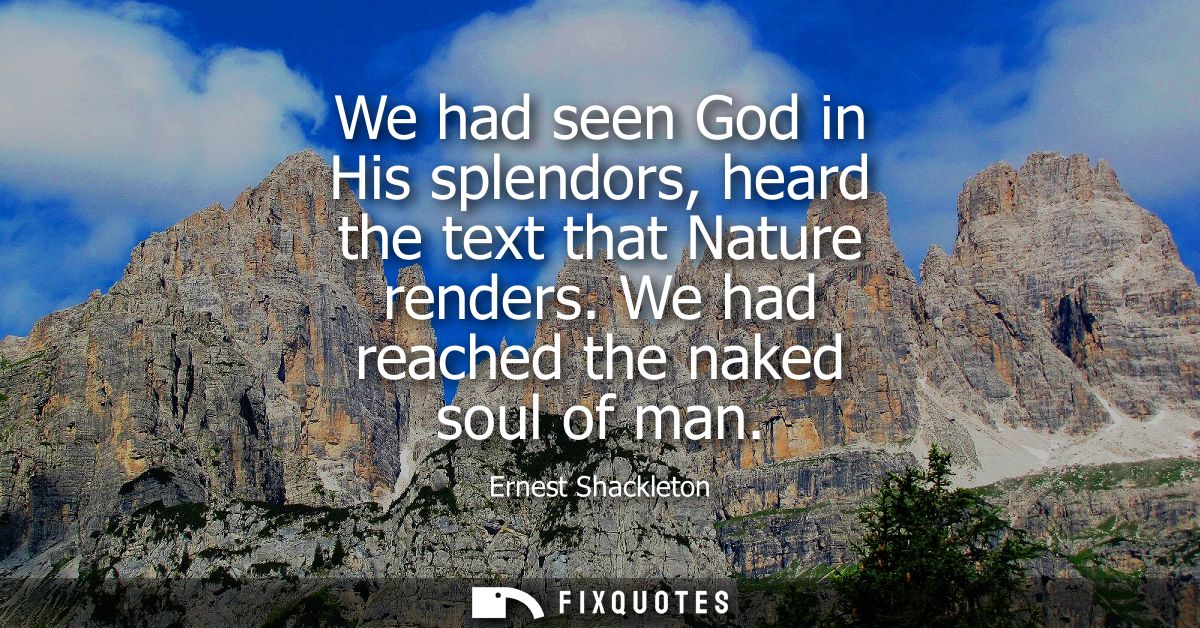
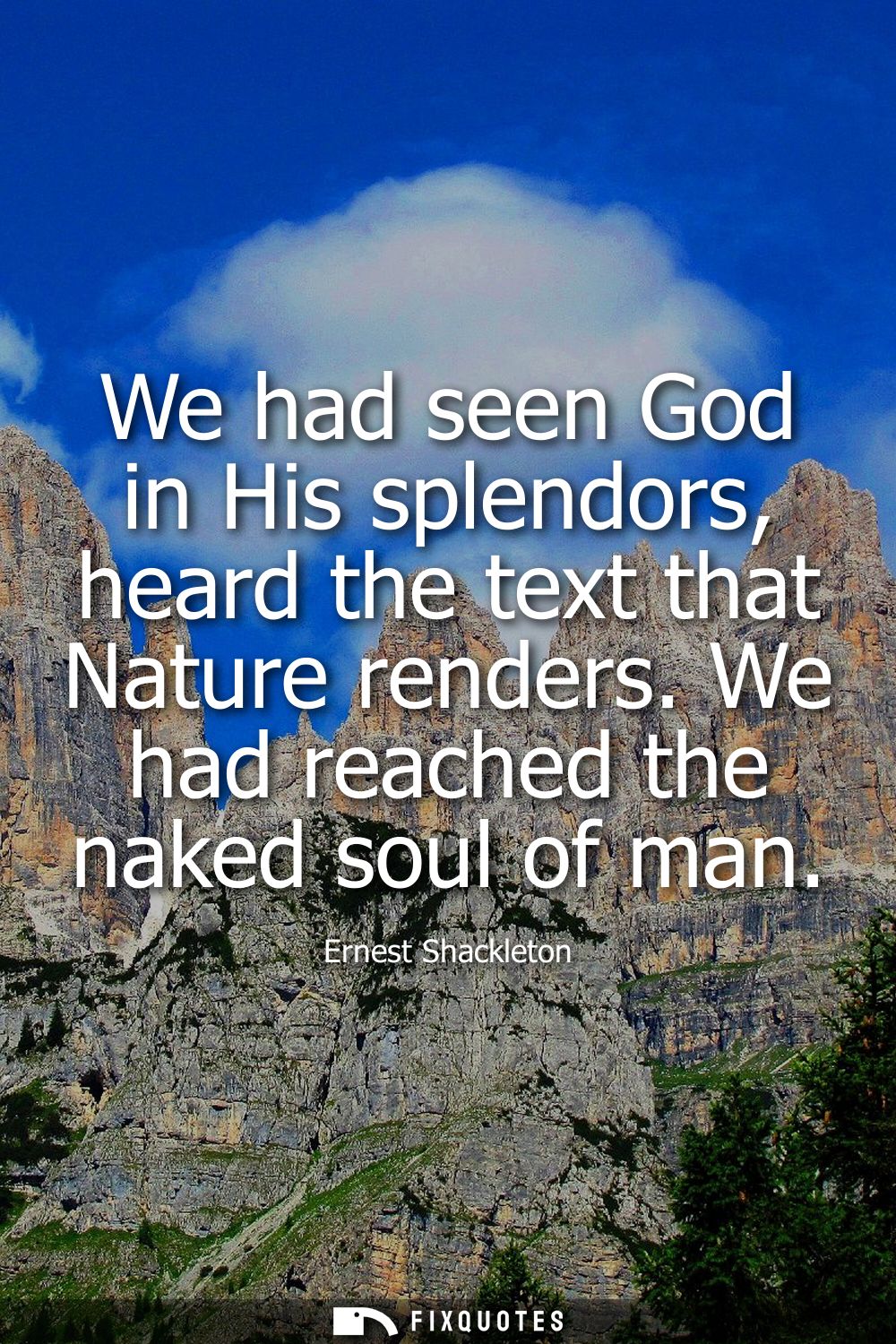
"We had seen God in His splendors, heard the text that Nature renders. We had reached the naked soul of man"
About this Quote
Then comes the real pivot: “We had reached the naked soul of man.” The subtext is that the Antarctic doesn’t merely test gear, planning, or masculine bravado - it strips away the social person. “Naked” implies deprivation and shame as much as purity: hunger, fear, boredom, pettiness, solidarity. Shackleton’s rhetoric elevates the ordeal, but it also smuggles in a confession that the true frontier is psychological. The ice becomes a machine for producing honesty.
Context matters: Shackleton’s public legend was built on endurance and leadership under catastrophe, especially the Endurance expedition’s survival narrative. This sentence participates in that myth-making, but it’s not simple propaganda. It frames suffering as revelation, a way to justify the risk and retroactively dignify failure. The brilliance is how it turns extremity into a moral instrument: not “we mastered Nature,” but “Nature mastered us into clarity.”
Quote Details
| Topic | God |
|---|---|
| Source | Verified source: South (Ernest Shackleton, 1919)
Evidence:
We had pierced the veneer of outside things. We had “suffered, starved, and triumphed, grovelled down yet grasped at glory, grown bigger in the bigness of the whole.” We had seen God in His splendours, heard the text that Nature renders. We had reached the naked soul of man. (Near the end of the South Georgia crossing narrative; Project Gutenberg lines 1679-1680 (page varies by edition)). This is from Shackleton's own primary account of the Endurance expedition, South: The Story of Shackleton's Last Expedition, 1914-1917, first published in London by William Heinemann in 1919. The wording commonly circulated online is a shortened excerpt from this longer passage. The Project Gutenberg text preserves the British spelling 'splendours.' I found the passage in the body text of Shackleton's book, describing the conclusion of the overland journey across South Georgia. Library/catalog records also identify the 1919 Heinemann edition as the original publication. |
| Cite |
Citation Formats
APA Style (7th ed.)
Shackleton, Ernest. (2026, March 16). We had seen God in His splendors, heard the text that Nature renders. We had reached the naked soul of man. FixQuotes. https://fixquotes.com/quotes/we-had-seen-god-in-his-splendors-heard-the-text-119133/
Chicago Style
Shackleton, Ernest. "We had seen God in His splendors, heard the text that Nature renders. We had reached the naked soul of man." FixQuotes. March 16, 2026. https://fixquotes.com/quotes/we-had-seen-god-in-his-splendors-heard-the-text-119133/.
MLA Style (9th ed.)
"We had seen God in His splendors, heard the text that Nature renders. We had reached the naked soul of man." FixQuotes, 16 Mar. 2026, https://fixquotes.com/quotes/we-had-seen-god-in-his-splendors-heard-the-text-119133/. Accessed 28 Mar. 2026.