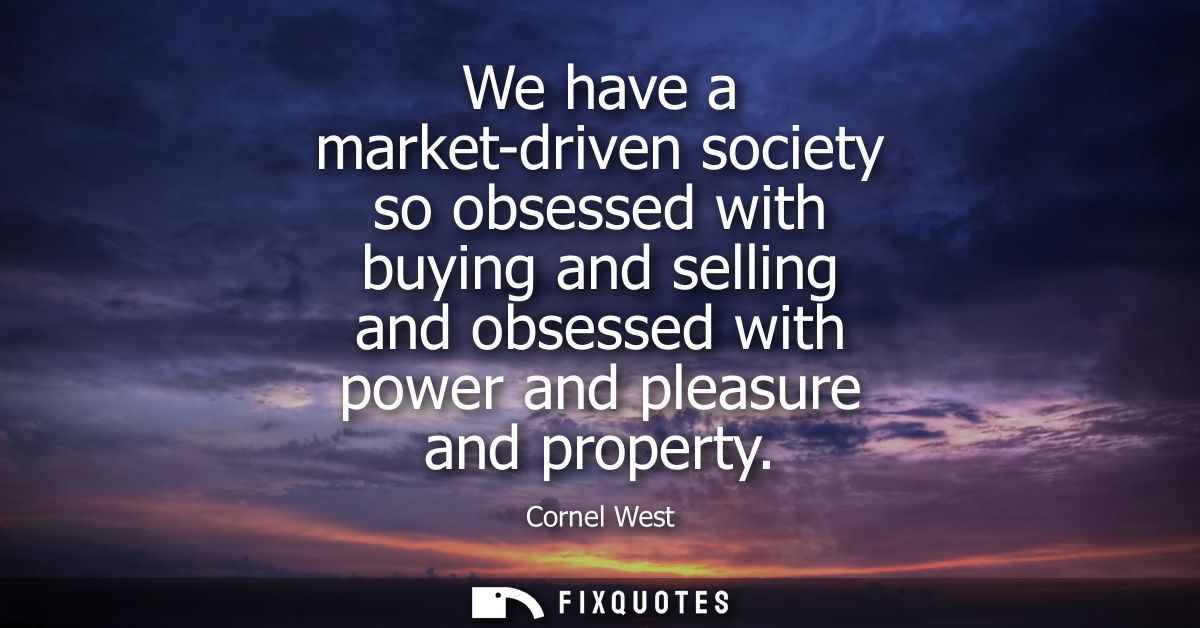
"We have a market-driven society, so obsessed with buying and selling, and obsessed with power and pleasure and property"
About this Quote
The specific intent is to reframe “the market” from neutral mechanism to moral environment. When West links power, pleasure, and property, he’s mapping how consumer logic seeps into everything: politics becomes branding, intimacy becomes performance, citizenship becomes a transaction. The subtext is that this isn’t merely about greed; it’s about deformation. A society trained to shop for meaning will eventually shop for people, too - treating labor, attention, even suffering as assets to be managed.
Context matters: West’s work sits in the lineage of Black prophetic critique, where capitalism isn’t analyzed only by outputs and growth curves but by the souls it chews up and the solidarities it dissolves. His target is the spiritual vacancy that can follow affluence, especially in an America that sells “freedom” while quietly narrowing it to purchasing power. The repetition of “obsessed” functions like a diagnosis: addiction, not preference. He’s asking the listener to hear the hunger underneath the abundance - and to consider who benefits when everyone is too busy consuming to organize, care, or refuse.
Quote Details
| Topic | Justice |
|---|---|
| Source | Help us find the source |
| Cite |
Citation Formats
APA Style (7th ed.)
West, Cornel. (2026, February 19). We have a market-driven society, so obsessed with buying and selling, and obsessed with power and pleasure and property. FixQuotes. https://fixquotes.com/quotes/we-have-a-market-driven-society-so-obsessed-with-46353/
Chicago Style
West, Cornel. "We have a market-driven society, so obsessed with buying and selling, and obsessed with power and pleasure and property." FixQuotes. February 19, 2026. https://fixquotes.com/quotes/we-have-a-market-driven-society-so-obsessed-with-46353/.
MLA Style (9th ed.)
"We have a market-driven society, so obsessed with buying and selling, and obsessed with power and pleasure and property." FixQuotes, 19 Feb. 2026, https://fixquotes.com/quotes/we-have-a-market-driven-society-so-obsessed-with-46353/. Accessed 3 Apr. 2026.