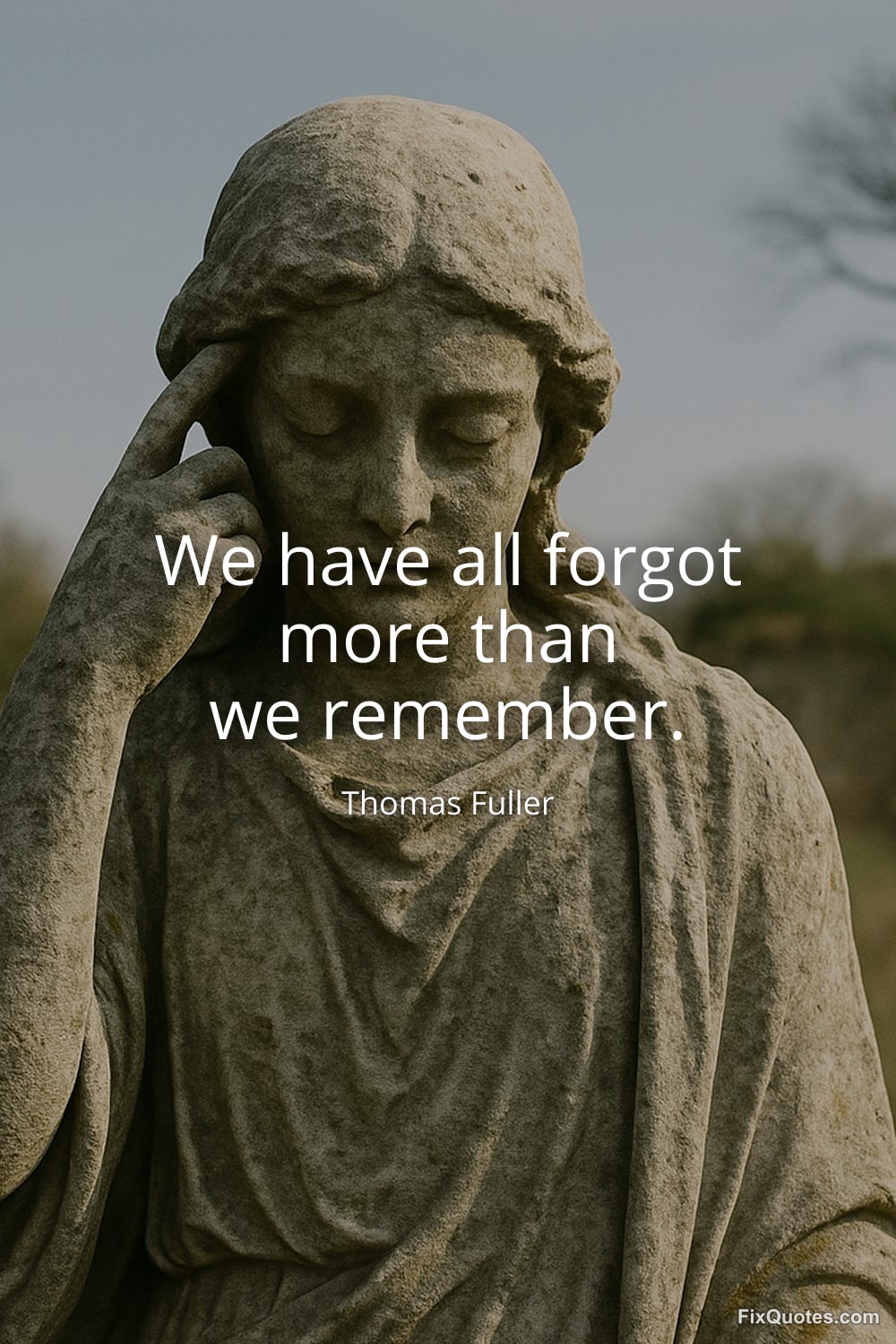
"We have all forgot more than we remember"
About this Quote
A clergyman admits a scandalous truth: your mind is a graveyard of vanishing certainties. Thomas Fuller’s line, “We have all forgot more than we remember,” isn’t a cozy proverb; it’s a quiet rebuke to human arrogance, delivered with the understated punch of a sermon that knows its audience. The grammar itself (“forgot” instead of “forgotten”) keeps it blunt, almost conversational, as if Fuller wants the point to land in the chest rather than the footnotes.
The intent is moral and social. Fuller is warning against the ego that treats memory as proof of mastery: the scholar who confuses a well-stocked bookshelf with wisdom, the witness who believes their recollection is a reliable court, the believer who mistakes familiarity with doctrine for actual spiritual steadiness. The subtext is humbling and communal: “we have all” collapses hierarchy. No one is exempt - not the educated, not the pious, not the powerful. If forgetting dwarfs remembering, then certainty should be worn lightly.
In Fuller’s clerical context, the line also doubles as a theological nudge. Christian teaching prizes humility, confession, and dependence on grace - a posture that makes sense if human perception is so leaky. Memory’s limits become an argument for charity: if you’re constantly losing parts of your own story, you should hesitate before condemning someone else’s. The quote works because it turns a universal weakness into a disciplined ethic: less swagger, more mercy.
The intent is moral and social. Fuller is warning against the ego that treats memory as proof of mastery: the scholar who confuses a well-stocked bookshelf with wisdom, the witness who believes their recollection is a reliable court, the believer who mistakes familiarity with doctrine for actual spiritual steadiness. The subtext is humbling and communal: “we have all” collapses hierarchy. No one is exempt - not the educated, not the pious, not the powerful. If forgetting dwarfs remembering, then certainty should be worn lightly.
In Fuller’s clerical context, the line also doubles as a theological nudge. Christian teaching prizes humility, confession, and dependence on grace - a posture that makes sense if human perception is so leaky. Memory’s limits become an argument for charity: if you’re constantly losing parts of your own story, you should hesitate before condemning someone else’s. The quote works because it turns a universal weakness into a disciplined ethic: less swagger, more mercy.
Quote Details
| Topic | Wisdom |
|---|---|
| Source | Later attribution: Civilization's Quotations (2002) modern compilation
Evidence: ... We have all forgot more than we remember . ” — Thomas Fuller " Can anybody remember when the times were not hard and money not scarce ? ” Emerson “ The world does not require so much to be informed as to be reminded . ” More Hannah " A ... Other candidates (2) The holy and profane states: By Thomas Fuller (Thomas Fuller, 1841) primary50.0% hesils should have more soldiers or richer armour and artillery than we wherefor Thomas Fuller (Thomas Fuller) compilation33.8% ood be the best sauce for victory yet must it not be more than the meat the hist |
| Featured | This quote was our Quote of the Day on November 6, 2025 |
| Cite |
Citation Formats
APA Style (7th ed.)
Fuller, Thomas. (2026, February 7). We have all forgot more than we remember. FixQuotes. https://fixquotes.com/quotes/we-have-all-forgot-more-than-we-remember-10345/
Chicago Style
Fuller, Thomas. "We have all forgot more than we remember." FixQuotes. February 7, 2026. https://fixquotes.com/quotes/we-have-all-forgot-more-than-we-remember-10345/.
MLA Style (9th ed.)
"We have all forgot more than we remember." FixQuotes, 7 Feb. 2026, https://fixquotes.com/quotes/we-have-all-forgot-more-than-we-remember-10345/. Accessed 1 Apr. 2026.
More Quotes by Thomas
Add to List