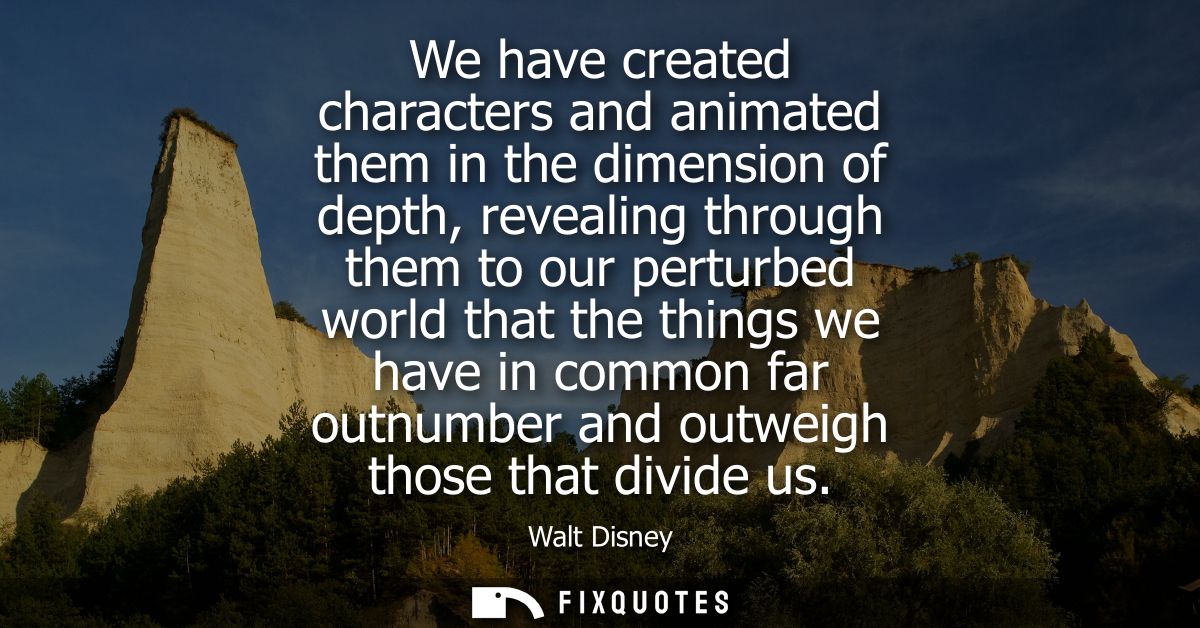
"We have created characters and animated them in the dimension of depth, revealing through them to our perturbed world that the things we have in common far outnumber and outweigh those that divide us"
About this Quote
The phrase “our perturbed world” matters. Disney is talking from the midcentury: depression, war, ideological sorting, then the anxious calm of the Cold War. In that climate, animation could look like escapism, even frivolity. He reframes it as soft diplomacy. The characters become intermediaries between strangers, a shared vocabulary when politics and geography fail. It’s not “art for art’s sake”; it’s entertainment with an export strategy.
The subtext is also corporate, and shrewd. “Things we have in common” doubles as a theory of mass culture: the widest possible audience is reached by sanding down specifics into legible feelings - fear, longing, loyalty, slapstick humiliation, sentimental reunion. That universality can be generous, but it can also be homogenizing, a brand of togetherness that prizes consensus over conflict.
Still, the line captures Disney’s central wager: that fabricated people can produce real social effects, that empathy can be engineered, and that a camera trick called “depth” can make the inner life feel three-dimensional enough to unite viewers who otherwise share very little.
Quote Details
| Topic | Art |
|---|---|
| Source | Help us find the source |
| Cite |
Citation Formats
APA Style (7th ed.)
Disney, Walt. (2026, January 15). We have created characters and animated them in the dimension of depth, revealing through them to our perturbed world that the things we have in common far outnumber and outweigh those that divide us. FixQuotes. https://fixquotes.com/quotes/we-have-created-characters-and-animated-them-in-10740/
Chicago Style
Disney, Walt. "We have created characters and animated them in the dimension of depth, revealing through them to our perturbed world that the things we have in common far outnumber and outweigh those that divide us." FixQuotes. January 15, 2026. https://fixquotes.com/quotes/we-have-created-characters-and-animated-them-in-10740/.
MLA Style (9th ed.)
"We have created characters and animated them in the dimension of depth, revealing through them to our perturbed world that the things we have in common far outnumber and outweigh those that divide us." FixQuotes, 15 Jan. 2026, https://fixquotes.com/quotes/we-have-created-characters-and-animated-them-in-10740/. Accessed 12 Feb. 2026.