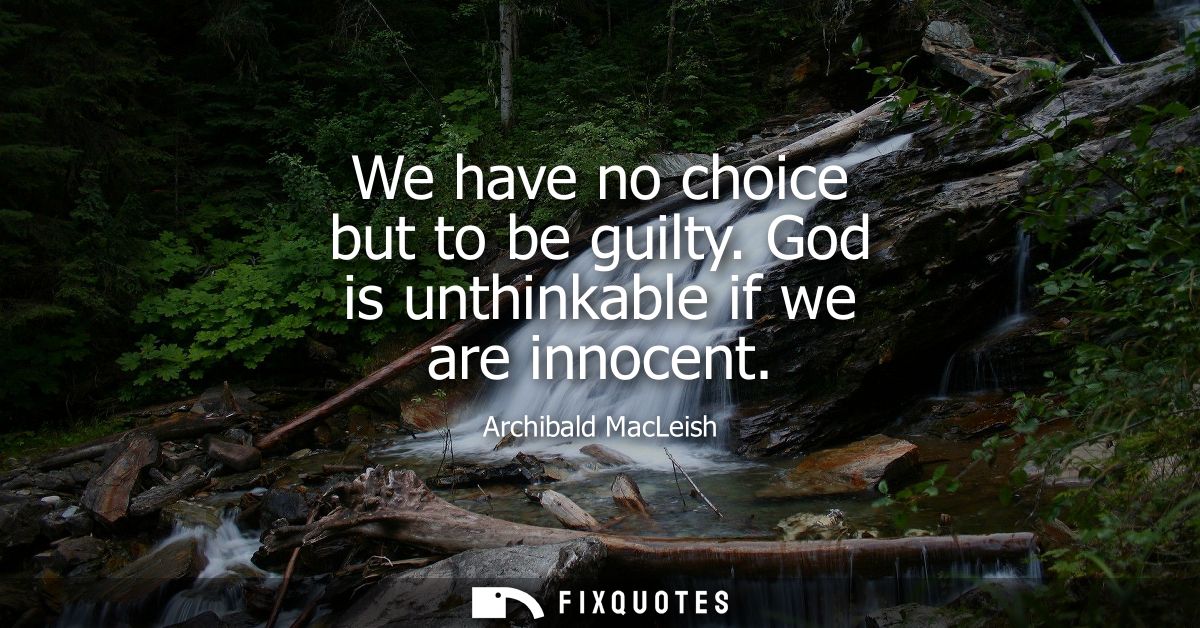
"We have no choice but to be guilty. God is unthinkable if we are innocent"
About this Quote
MacLeish’s line doesn’t just flirt with paradox; it treats contradiction as a moral necessity. “We have no choice but to be guilty” lands like a refusal of the clean conscience. It’s not confessional guilt (I did something bad) so much as existential guilt: the sense that being human means being implicated, entangled, responsible beyond what you can neatly prove in court. The phrasing “no choice” is doing heavy work. It frames guilt as an condition of awareness, not a personal kink for self-reproach.
Then comes the dare: “God is unthinkable if we are innocent.” MacLeish ties the idea of God to a world where innocence has been shattered. If we were innocent, we wouldn’t need metaphysical accounting. No judge, no mercy, no redemption economy. The subtext is bracingly modern: God persists less as a comforting parent than as the conceptual structure that makes suffering, failure, and complicity narratable. Innocence would make God redundant; guilt makes God legible.
Context matters. MacLeish wrote in the long shadow of two World Wars and the mid-century crisis of liberal optimism, when “I didn’t know” started to sound like a luxury. As a poet and public intellectual, he’s pushing back against the fantasy that decency equals blamelessness. The line insists that moral seriousness begins when you admit you’re not outside the damage. The provocation isn’t “feel bad”; it’s “stop pretending you’re exempt.”
Then comes the dare: “God is unthinkable if we are innocent.” MacLeish ties the idea of God to a world where innocence has been shattered. If we were innocent, we wouldn’t need metaphysical accounting. No judge, no mercy, no redemption economy. The subtext is bracingly modern: God persists less as a comforting parent than as the conceptual structure that makes suffering, failure, and complicity narratable. Innocence would make God redundant; guilt makes God legible.
Context matters. MacLeish wrote in the long shadow of two World Wars and the mid-century crisis of liberal optimism, when “I didn’t know” started to sound like a luxury. As a poet and public intellectual, he’s pushing back against the fantasy that decency equals blamelessness. The line insists that moral seriousness begins when you admit you’re not outside the damage. The provocation isn’t “feel bad”; it’s “stop pretending you’re exempt.”
Quote Details
| Topic | God |
|---|
More Quotes by Archibald
Add to List