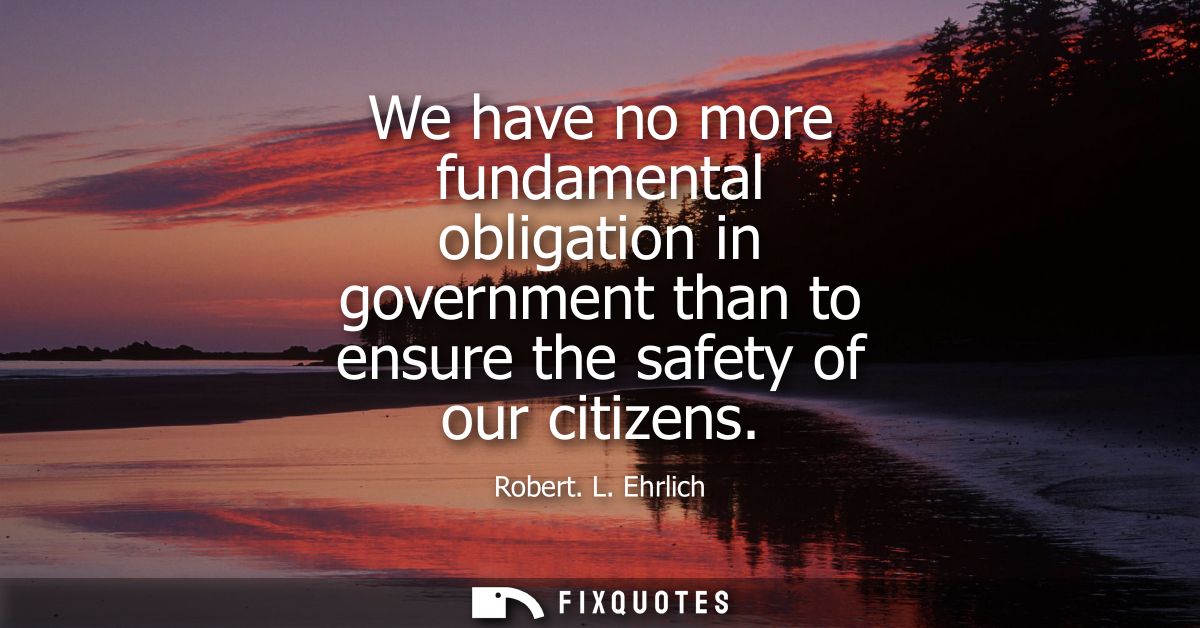
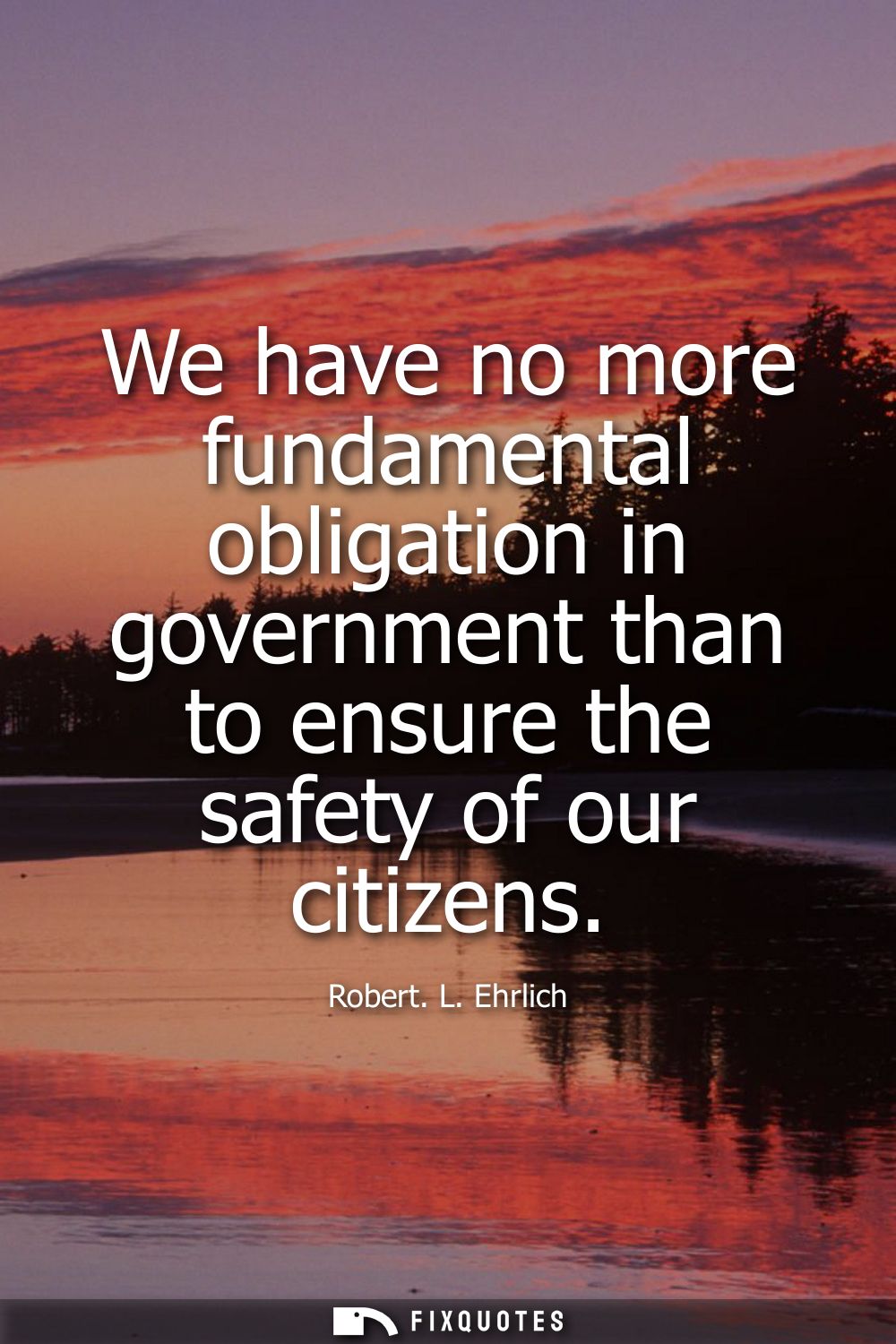
"We have no more fundamental obligation in government than to ensure the safety of our citizens"
About this Quote
The intent is clarity with a built-in shield. Few voters will argue against "safety of our citizens" in the abstract, and the word "citizens" quietly narrows the moral circle. It implies an us to be secured, which can make hard policies feel like housekeeping rather than ideology. That’s the subtext doing its real work: it authorizes force, surveillance, tougher sentencing, immigration crackdowns, emergency powers - whatever the moment demands - while casting dissent as naive at best, irresponsible at worst.
Contextually, this is the language of post-crisis governance: the rhetorical posture leaders take when selling unpopular trade-offs. Safety talk thrives on asymmetry. If a policy fails quietly, no one notices; if a threat succeeds spectacularly, leaders get blamed. So the sentence is also a preemptive alibi: prioritize safety now, and any collateral costs can be framed as necessary.
The craft here is its moral simplicity. It offers a clean story about why government exists, then dares you to complicate it.
Quote Details
| Topic | Justice |
|---|---|
| Source | Help us find the source |
| Cite |
Citation Formats
APA Style (7th ed.)
Ehrlich, Robert. L. (2026, January 15). We have no more fundamental obligation in government than to ensure the safety of our citizens. FixQuotes. https://fixquotes.com/quotes/we-have-no-more-fundamental-obligation-in-134590/
Chicago Style
Ehrlich, Robert. L. "We have no more fundamental obligation in government than to ensure the safety of our citizens." FixQuotes. January 15, 2026. https://fixquotes.com/quotes/we-have-no-more-fundamental-obligation-in-134590/.
MLA Style (9th ed.)
"We have no more fundamental obligation in government than to ensure the safety of our citizens." FixQuotes, 15 Jan. 2026, https://fixquotes.com/quotes/we-have-no-more-fundamental-obligation-in-134590/. Accessed 12 Feb. 2026.