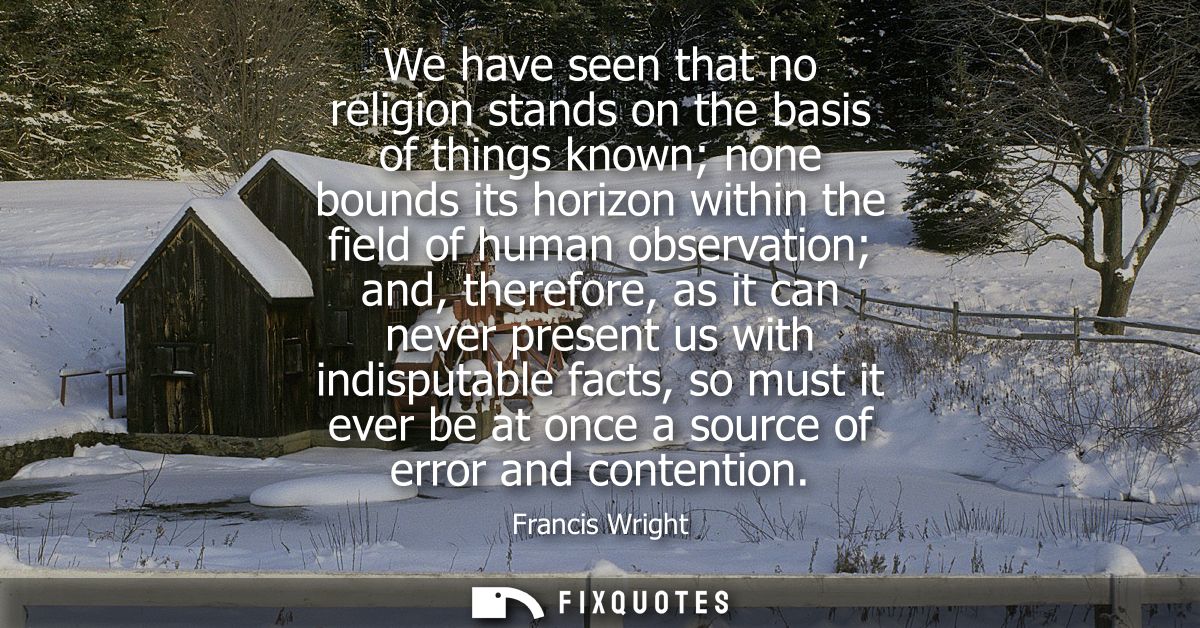
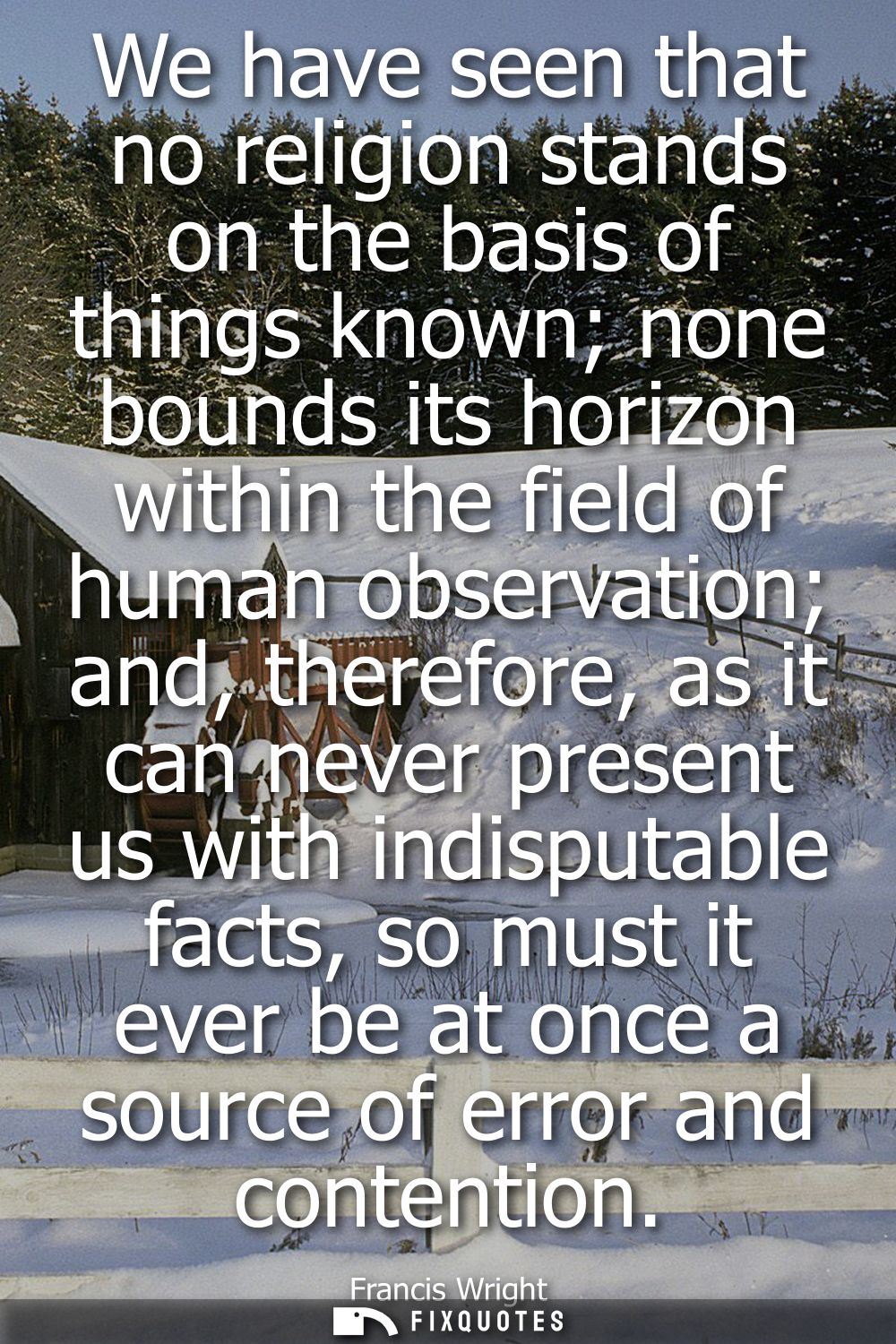
"We have seen that no religion stands on the basis of things known; none bounds its horizon within the field of human observation; and, therefore, as it can never present us with indisputable facts, so must it ever be at once a source of error and contention"
About this Quote
The sentence is engineered like a courtroom argument. “We have seen” implies the verdict is already in, inviting readers to feel they’re joining an enlightened jury. Then she stacks clauses with legal precision: religion exceeds “human observation,” therefore it cannot offer “indisputable facts,” therefore it becomes “a source of error and contention.” The chain makes her skepticism look less like attitude and more like deduction. Subtext: in a democracy, claims that can’t be tested shouldn’t get to govern the testable lives of citizens.
Calling religion “contention” is the sharpest blade here. Wright is writing in a moment when churches weren’t merely private consolations but civic engines: shaping education, gender roles, laws, and moral legitimacy. She casts religion as structurally predisposed to conflict because its claims can’t be settled by evidence, only by power, tradition, or coercion. That’s the activist tell: the target isn’t metaphysics; it’s social control.
There’s also a calculated provocation in “ever.” She’s not pleading for reform or tolerance; she’s arguing permanence. If religion’s foundation is unobservable, it will always generate error and division. The intent is to clear space for secular reasoning as the only stable common ground for public life.
Quote Details
| Topic | Reason & Logic |
|---|---|
| Source | Help us find the source |
| Cite |
Citation Formats
APA Style (7th ed.)
Wright, Francis. (2026, January 15). We have seen that no religion stands on the basis of things known; none bounds its horizon within the field of human observation; and, therefore, as it can never present us with indisputable facts, so must it ever be at once a source of error and contention. FixQuotes. https://fixquotes.com/quotes/we-have-seen-that-no-religion-stands-on-the-basis-149315/
Chicago Style
Wright, Francis. "We have seen that no religion stands on the basis of things known; none bounds its horizon within the field of human observation; and, therefore, as it can never present us with indisputable facts, so must it ever be at once a source of error and contention." FixQuotes. January 15, 2026. https://fixquotes.com/quotes/we-have-seen-that-no-religion-stands-on-the-basis-149315/.
MLA Style (9th ed.)
"We have seen that no religion stands on the basis of things known; none bounds its horizon within the field of human observation; and, therefore, as it can never present us with indisputable facts, so must it ever be at once a source of error and contention." FixQuotes, 15 Jan. 2026, https://fixquotes.com/quotes/we-have-seen-that-no-religion-stands-on-the-basis-149315/. Accessed 21 Mar. 2026.