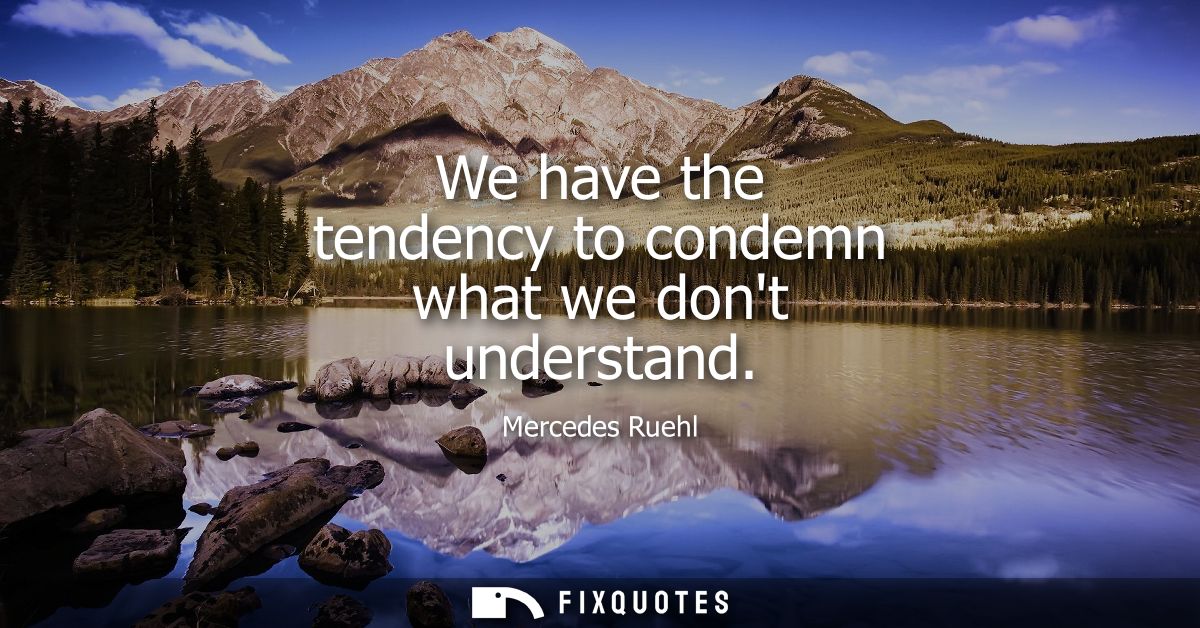
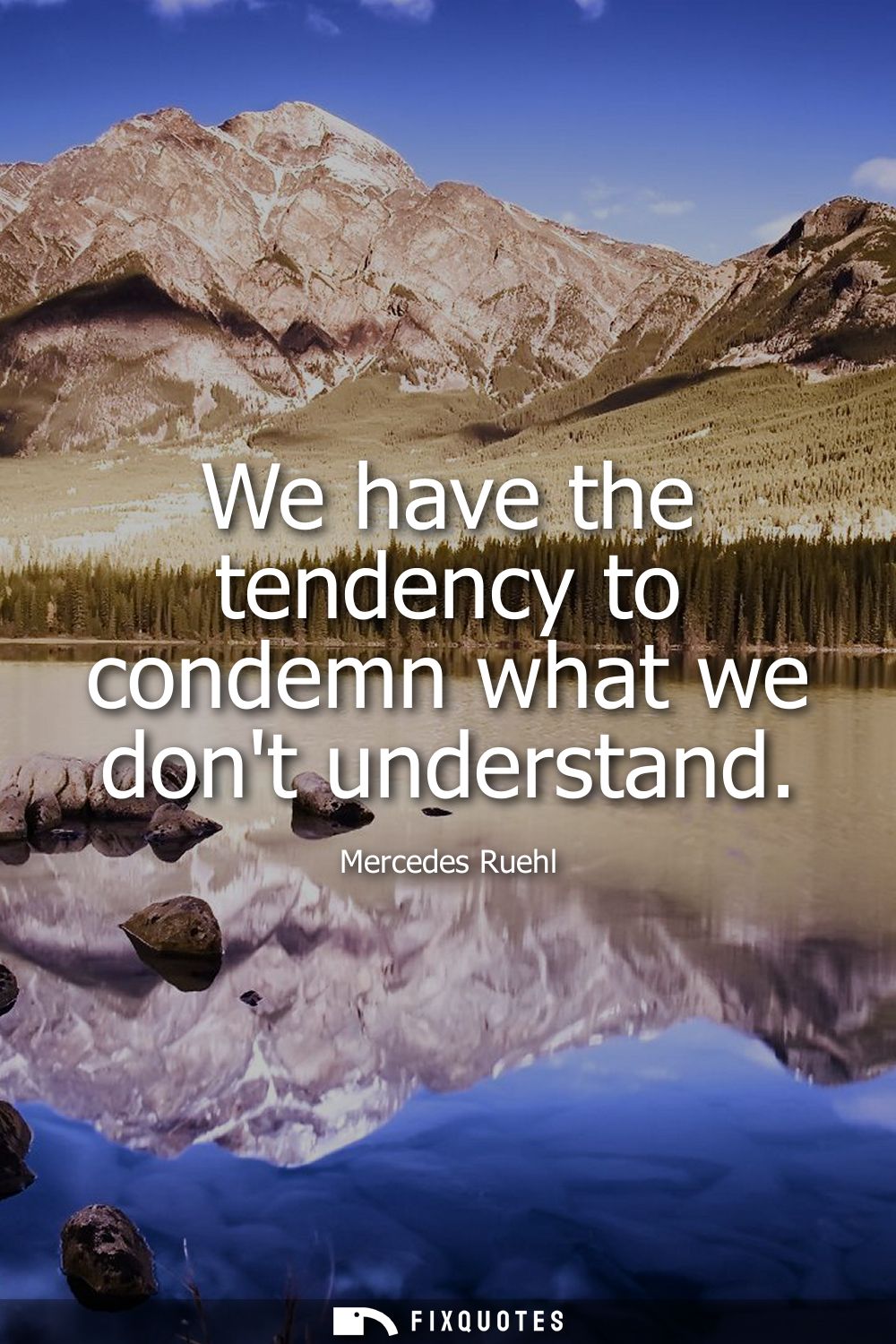
"We have the tendency to condemn what we don't understand"
About this Quote
Mercedes Ruehl’s line lands with the plainspoken authority of someone who’s spent a career watching audiences decide what’s “believable” in the two seconds before they decide what’s “acceptable.” “We have the tendency” is doing quiet work: it indicts without isolating, pulling the speaker into the same human flaw as the listener. The point isn’t that people judge; it’s that judgment often arrives as a shortcut for curiosity. Condemnation becomes a defense mechanism, not a moral conclusion.
The verb “condemn” is calibrated, too. It’s not “dislike” or “doubt” but a word with courtroom weight, implying punishment and social exile. Ruehl is naming a reflex that feels righteous precisely because it’s fast. What we don’t understand threatens status and identity: unfamiliar art, unfamiliar people, unfamiliar pain. So the mind reaches for a verdict that restores control. In that sense, the quote isn’t a plea for tolerance as a virtue badge; it’s a diagnosis of how fear dresses up as principle.
Coming from an actress, the subtext reads as industry-aware: performance is a constant negotiation with misunderstanding. Characters are reduced to tropes, women’s anger gets labeled “hysterical,” complexity gets read as inconsistency. Ruehl’s sentence also echoes a broader cultural moment where hot takes routinely replace comprehension. It’s a reminder that “I don’t get it” is a moment of vulnerability - and our culture often treats vulnerability as something to prosecute rather than sit with.
The verb “condemn” is calibrated, too. It’s not “dislike” or “doubt” but a word with courtroom weight, implying punishment and social exile. Ruehl is naming a reflex that feels righteous precisely because it’s fast. What we don’t understand threatens status and identity: unfamiliar art, unfamiliar people, unfamiliar pain. So the mind reaches for a verdict that restores control. In that sense, the quote isn’t a plea for tolerance as a virtue badge; it’s a diagnosis of how fear dresses up as principle.
Coming from an actress, the subtext reads as industry-aware: performance is a constant negotiation with misunderstanding. Characters are reduced to tropes, women’s anger gets labeled “hysterical,” complexity gets read as inconsistency. Ruehl’s sentence also echoes a broader cultural moment where hot takes routinely replace comprehension. It’s a reminder that “I don’t get it” is a moment of vulnerability - and our culture often treats vulnerability as something to prosecute rather than sit with.
Quote Details
| Topic | Respect |
|---|---|
| Source | Help us find the source |
| Cite |
Citation Formats
APA Style (7th ed.)
Ruehl, Mercedes. (2026, January 16). We have the tendency to condemn what we don't understand. FixQuotes. https://fixquotes.com/quotes/we-have-the-tendency-to-condemn-what-we-dont-88728/
Chicago Style
Ruehl, Mercedes. "We have the tendency to condemn what we don't understand." FixQuotes. January 16, 2026. https://fixquotes.com/quotes/we-have-the-tendency-to-condemn-what-we-dont-88728/.
MLA Style (9th ed.)
"We have the tendency to condemn what we don't understand." FixQuotes, 16 Jan. 2026, https://fixquotes.com/quotes/we-have-the-tendency-to-condemn-what-we-dont-88728/. Accessed 7 Feb. 2026.
More Quotes by Mercedes
Add to List