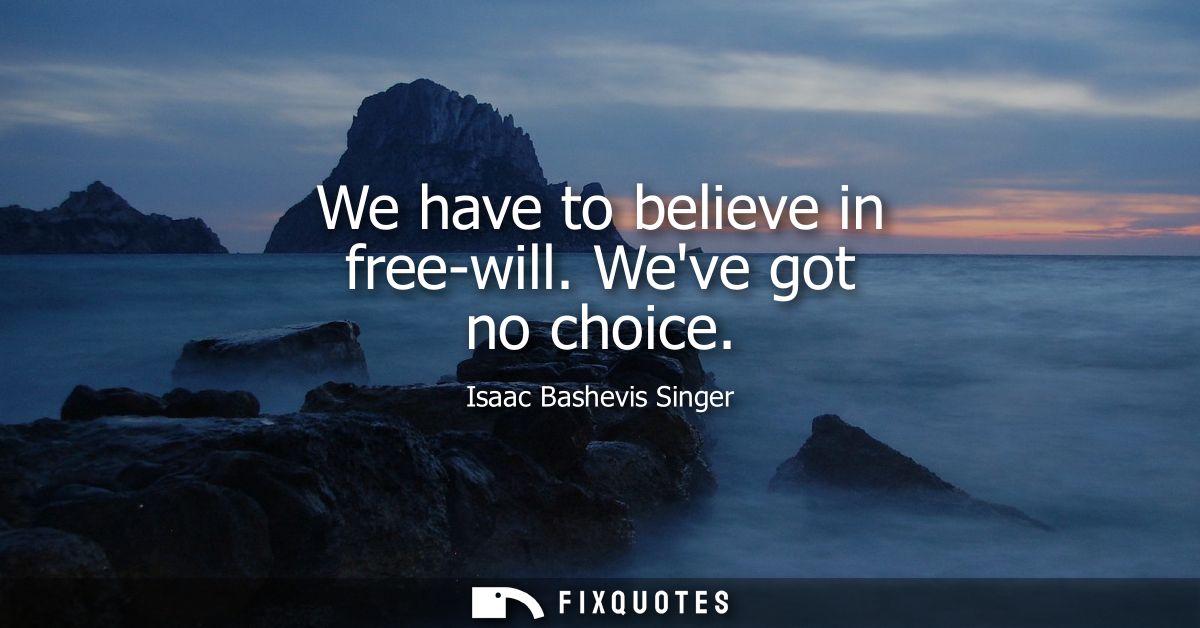
"We have to believe in free-will. We've got no choice"
About this Quote
Singer’s line lands like a philosophical pratfall: a command to believe in freedom delivered with the fatalistic click of a trap. “We have to” frames free will not as a metaphysical discovery but as a practical necessity, the kind of belief you adopt the way you adopt language or manners because life becomes unworkable without it. Then comes the kicker - “We’ve got no choice” - which performs the very contradiction it describes. The sentence is an ouroboros: autonomy justified by compulsion.
The intent isn’t to solve the free-will debate; it’s to expose the human bargain underneath it. In Singer’s fiction, people are rarely sleek rational agents. They’re tugged by appetite, memory, superstition, erotic obsession, family obligation, history. Yet his characters still make decisions that matter, and the moral temperature of his stories depends on that “as if.” The subtext is that responsibility is a social technology: without the presumption that someone could have done otherwise, guilt and forgiveness become theater, law becomes mere management, love becomes accident.
Context matters, too. A Yiddish novelist shaped by the ethical pressure of Jewish tradition and the catastrophic determinism of the 20th century, Singer writes after events that made “choice” feel both sacred and obscene. His irony isn’t glib; it’s survivalist. Free will here is less a doctrine than a stance: you keep acting like your actions count, even when history, psychology, and theology whisper that they don’t.
The intent isn’t to solve the free-will debate; it’s to expose the human bargain underneath it. In Singer’s fiction, people are rarely sleek rational agents. They’re tugged by appetite, memory, superstition, erotic obsession, family obligation, history. Yet his characters still make decisions that matter, and the moral temperature of his stories depends on that “as if.” The subtext is that responsibility is a social technology: without the presumption that someone could have done otherwise, guilt and forgiveness become theater, law becomes mere management, love becomes accident.
Context matters, too. A Yiddish novelist shaped by the ethical pressure of Jewish tradition and the catastrophic determinism of the 20th century, Singer writes after events that made “choice” feel both sacred and obscene. His irony isn’t glib; it’s survivalist. Free will here is less a doctrine than a stance: you keep acting like your actions count, even when history, psychology, and theology whisper that they don’t.
Quote Details
| Topic | Free Will & Fate |
|---|---|
| Source | Help us find the source |
| Cite |
Citation Formats
APA Style (7th ed.)
Singer, Isaac Bashevis. (2026, January 17). We have to believe in free-will. We've got no choice. FixQuotes. https://fixquotes.com/quotes/we-have-to-believe-in-free-will-weve-got-no-choice-61896/
Chicago Style
Singer, Isaac Bashevis. "We have to believe in free-will. We've got no choice." FixQuotes. January 17, 2026. https://fixquotes.com/quotes/we-have-to-believe-in-free-will-weve-got-no-choice-61896/.
MLA Style (9th ed.)
"We have to believe in free-will. We've got no choice." FixQuotes, 17 Jan. 2026, https://fixquotes.com/quotes/we-have-to-believe-in-free-will-weve-got-no-choice-61896/. Accessed 25 Mar. 2026.
More Quotes by Isaac
Add to List