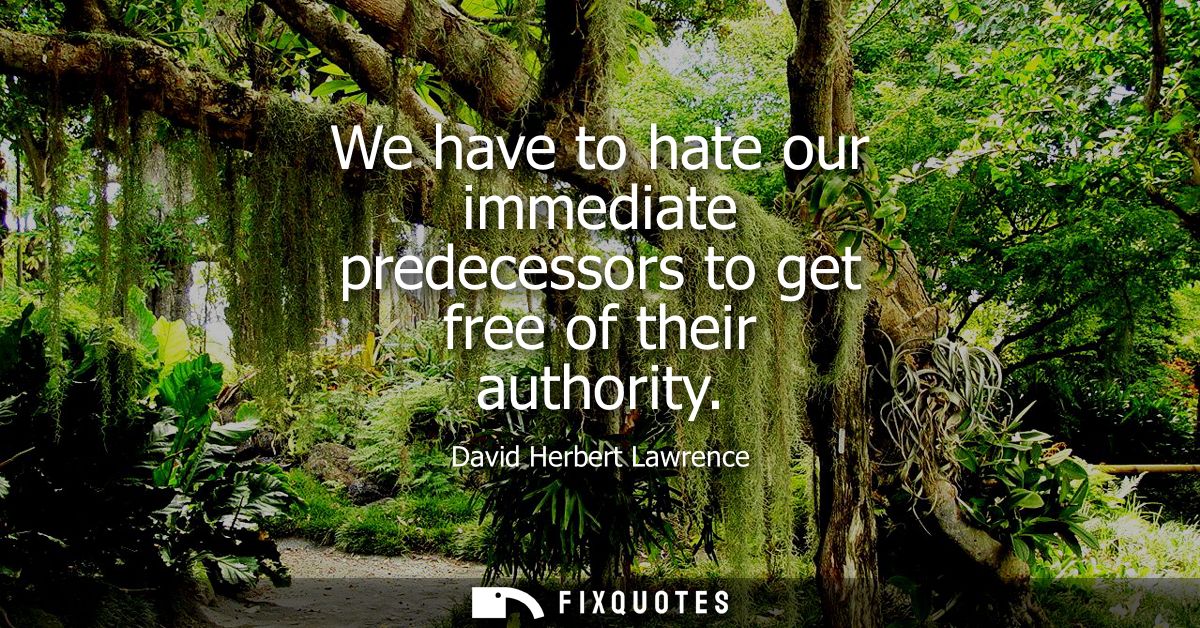
"We have to hate our immediate predecessors to get free of their authority"
About this Quote
The subtext is psychological as much as literary. Lawrence is talking about the Oedipal drama of culture: you don’t become yourself by politely negotiating with the parent generation; you become yourself by refusing them, exaggerating their faults, turning their certainties into suffocation. Hatred here is less about malice than about clarity. It’s the permission to see your forebears as contingent, fallible, provincial - not as the weather.
Context sharpens the blade. Lawrence wrote in the shadow of Victorian and Edwardian moral authority, with its prudery, industrial pieties, and social scripts, and he watched modernity wrench old forms loose. Modernism’s breakthrough wasn’t just new technique; it was a break in obedience. The line captures the uncomfortable truth that revolutions in art (and in life) often begin as personal vendettas against the most recent “normal.” Lawrence isn’t prescribing cruelty so much as naming the dirty engine of renewal: to make room for a new voice, you sometimes have to declare the old one intolerable.
Quote Details
| Topic | Freedom |
|---|---|
| Source | Help us find the source |
| Cite |
Citation Formats
APA Style (7th ed.)
Lawrence, David Herbert. (2026, January 18). We have to hate our immediate predecessors to get free of their authority. FixQuotes. https://fixquotes.com/quotes/we-have-to-hate-our-immediate-predecessors-to-get-12428/
Chicago Style
Lawrence, David Herbert. "We have to hate our immediate predecessors to get free of their authority." FixQuotes. January 18, 2026. https://fixquotes.com/quotes/we-have-to-hate-our-immediate-predecessors-to-get-12428/.
MLA Style (9th ed.)
"We have to hate our immediate predecessors to get free of their authority." FixQuotes, 18 Jan. 2026, https://fixquotes.com/quotes/we-have-to-hate-our-immediate-predecessors-to-get-12428/. Accessed 12 Feb. 2026.