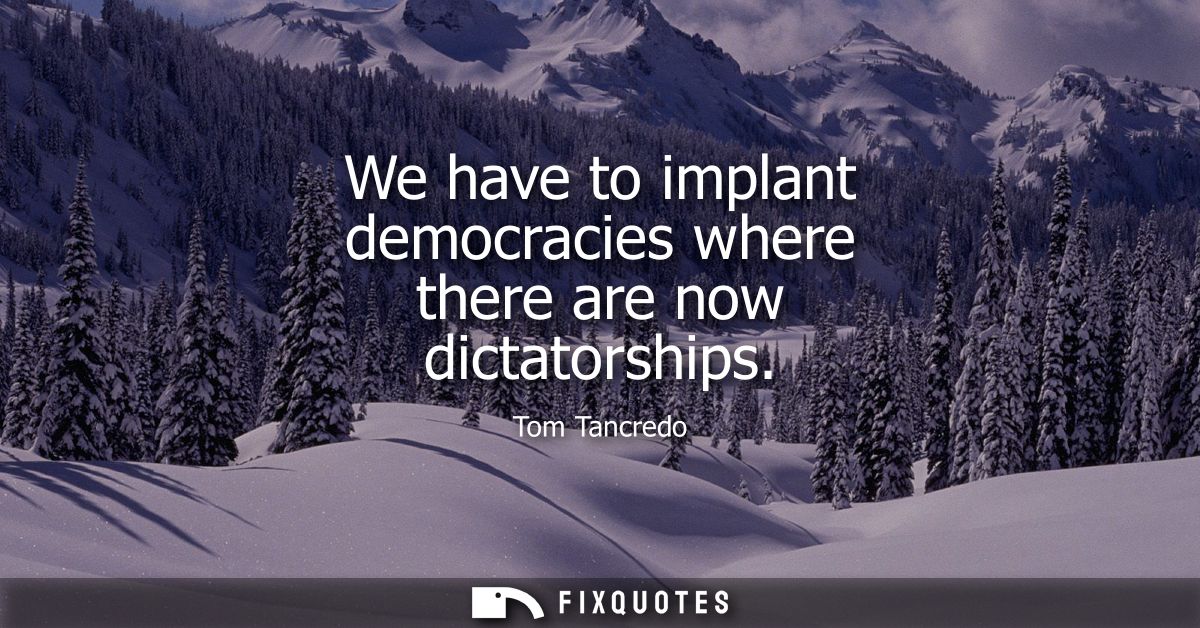
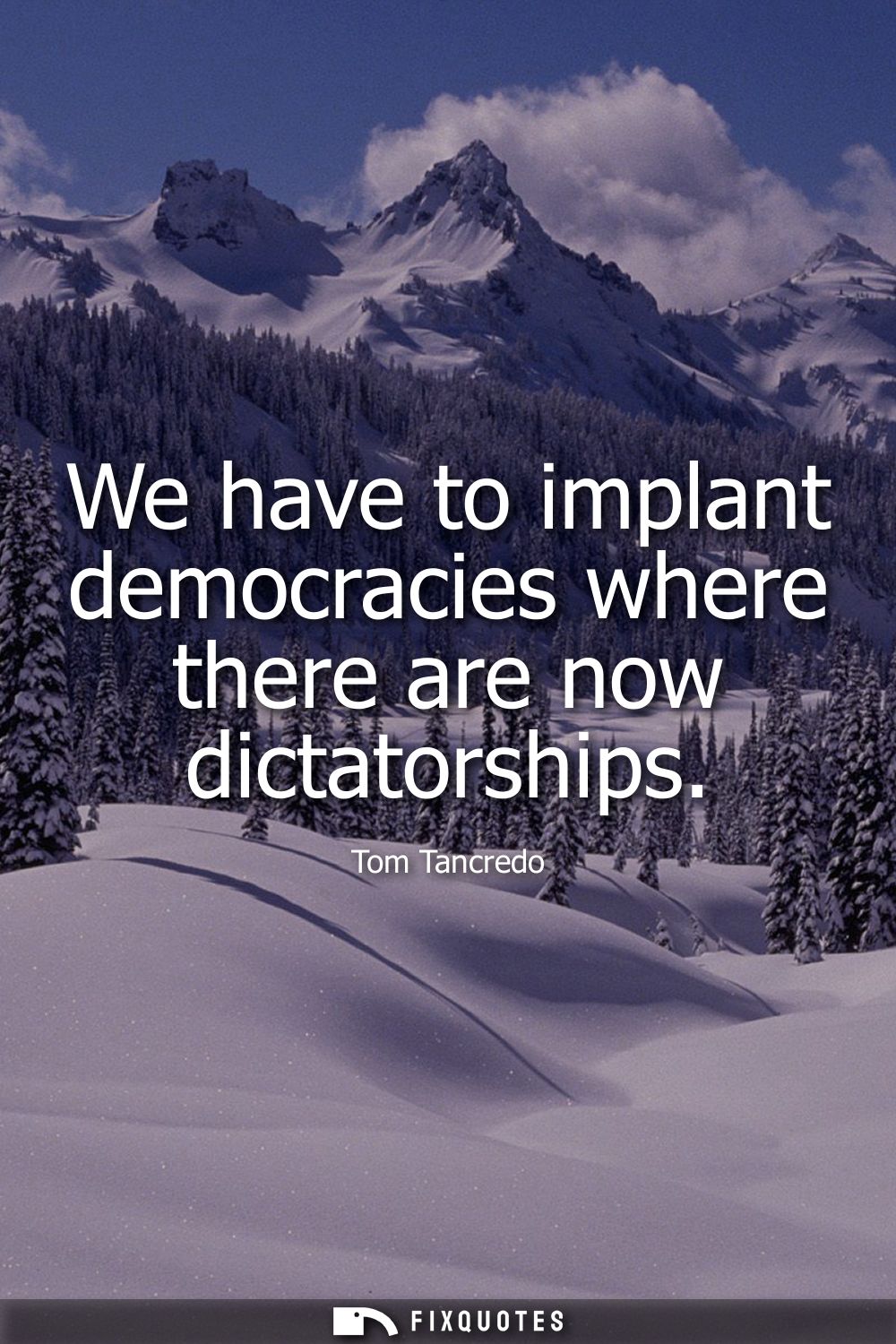
"We have to implant democracies where there are now dictatorships"
About this Quote
"Implant" is doing the heavy lifting here: it’s a medical metaphor that makes democracy sound like a clean, technical procedure rather than a messy political struggle. It frames authoritarianism as a disease and democratic governance as a foreign organ that can be inserted by outside expertise. That word choice quietly dodges the hardest question: who’s the surgeon, who’s the patient, and what happens when the body rejects the transplant?
Tancredo, a hardline conservative best known for immigration hawkishness, is speaking from a post-9/11 American political atmosphere where “democracy promotion” became a moral alibi for intervention. The phrase “where there are now dictatorships” invites a moral map of the world: zones of darkness awaiting American tools and tutelage. It’s the language of urgency and inevitability, the kind that compresses complex societies into a before-and-after storyline. Dictatorship is presented as a singular condition, not a spectrum with local histories, patrons, and institutions; democracy is presented as a product, not a culture of norms built over generations.
The subtext is confidence masquerading as obligation. “We have to” signals necessity, not preference, preempting debate about costs, sovereignty, or unintended consequences. It also launders agency: “we” becomes both the actor and the conscience, granting the speaker moral ownership of other people’s futures. The line works because it appeals to American self-conception as a force for good, while its vagueness leaves room for everything from aid and diplomacy to regime change. It’s aspirational language with imperial scaffolding.
Tancredo, a hardline conservative best known for immigration hawkishness, is speaking from a post-9/11 American political atmosphere where “democracy promotion” became a moral alibi for intervention. The phrase “where there are now dictatorships” invites a moral map of the world: zones of darkness awaiting American tools and tutelage. It’s the language of urgency and inevitability, the kind that compresses complex societies into a before-and-after storyline. Dictatorship is presented as a singular condition, not a spectrum with local histories, patrons, and institutions; democracy is presented as a product, not a culture of norms built over generations.
The subtext is confidence masquerading as obligation. “We have to” signals necessity, not preference, preempting debate about costs, sovereignty, or unintended consequences. It also launders agency: “we” becomes both the actor and the conscience, granting the speaker moral ownership of other people’s futures. The line works because it appeals to American self-conception as a force for good, while its vagueness leaves room for everything from aid and diplomacy to regime change. It’s aspirational language with imperial scaffolding.
Quote Details
| Topic | Freedom |
|---|---|
| Source | Help us find the source |
| Cite |
Citation Formats
APA Style (7th ed.)
Tancredo, Tom. (2026, January 16). We have to implant democracies where there are now dictatorships. FixQuotes. https://fixquotes.com/quotes/we-have-to-implant-democracies-where-there-are-84925/
Chicago Style
Tancredo, Tom. "We have to implant democracies where there are now dictatorships." FixQuotes. January 16, 2026. https://fixquotes.com/quotes/we-have-to-implant-democracies-where-there-are-84925/.
MLA Style (9th ed.)
"We have to implant democracies where there are now dictatorships." FixQuotes, 16 Jan. 2026, https://fixquotes.com/quotes/we-have-to-implant-democracies-where-there-are-84925/. Accessed 30 Mar. 2026.
More Quotes by Tom
Add to List