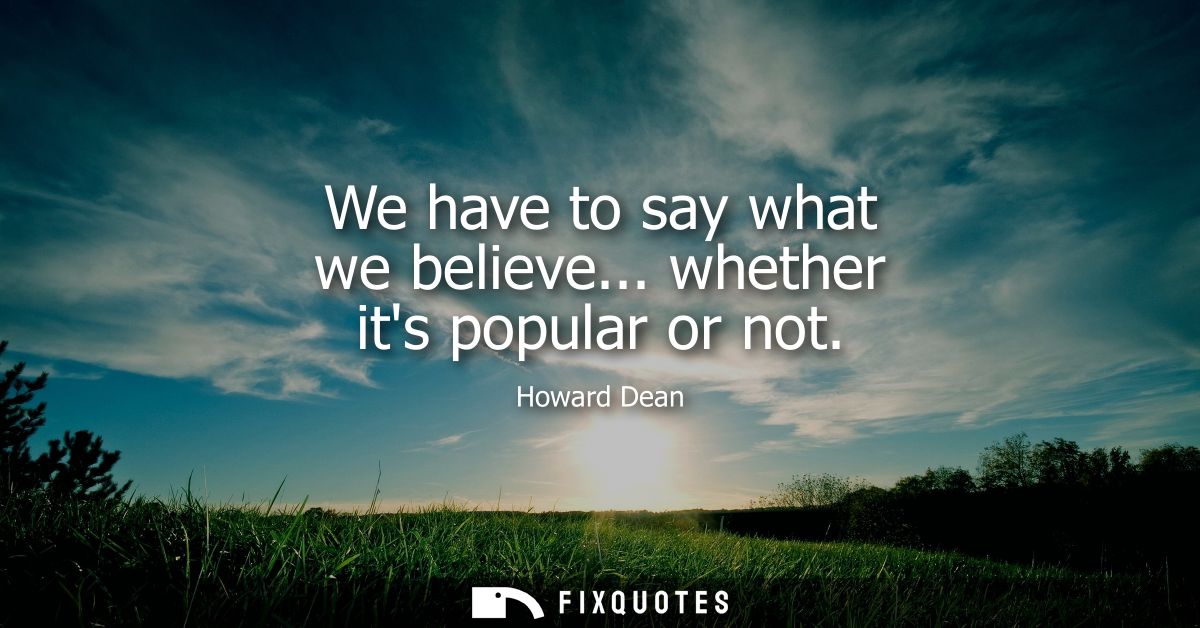
"We have to say what we believe... Whether it's popular or not"
About this Quote
Conviction is the oldest brand in politics, and Howard Dean is selling it here with a blunt, almost stubborn simplicity. "We have to say what we believe" frames speech as a duty, not a tactic. That "have to" matters: it casts candor as moral obligation, which conveniently elevates the speaker above the daily horse-trading most voters suspect is happening anyway. The ellipsis functions like a withheld breath, a pause that signals deliberation and sincerity, as if the next clause is too unfashionable to say quickly.
Then comes the dare: "whether it's popular or not". Dean isn’t just defending honesty; he’s preemptively insulating himself from the consequences of being out of step. It’s a strategic inoculation. If the message lands badly, the failure can be reinterpreted as proof of integrity rather than misjudgment. If it lands well, it reads as courage rewarded. Either way, the speaker wins a narrative advantage.
The deeper subtext is about a party and a media ecosystem addicted to triangulation: the impulse to shave off rough edges until every position is focus-group safe. Dean, associated with early-2000s insurgent energy and grassroots organizing, is implicitly arguing for a different political economy of speech: authenticity as mobilization. He’s speaking to supporters who are tired of politicians treating public opinion like a weather report and themselves like weathervanes.
What makes the line work is its moral theater. It turns disagreement into a test of character, and popularity into something faintly suspicious. In that framing, saying the "unpopular" thing isn’t a liability; it’s the point.
Then comes the dare: "whether it's popular or not". Dean isn’t just defending honesty; he’s preemptively insulating himself from the consequences of being out of step. It’s a strategic inoculation. If the message lands badly, the failure can be reinterpreted as proof of integrity rather than misjudgment. If it lands well, it reads as courage rewarded. Either way, the speaker wins a narrative advantage.
The deeper subtext is about a party and a media ecosystem addicted to triangulation: the impulse to shave off rough edges until every position is focus-group safe. Dean, associated with early-2000s insurgent energy and grassroots organizing, is implicitly arguing for a different political economy of speech: authenticity as mobilization. He’s speaking to supporters who are tired of politicians treating public opinion like a weather report and themselves like weathervanes.
What makes the line work is its moral theater. It turns disagreement into a test of character, and popularity into something faintly suspicious. In that framing, saying the "unpopular" thing isn’t a liability; it’s the point.
Quote Details
| Topic | Honesty & Integrity |
|---|---|
| Source | Help us find the source |
| Cite |
Citation Formats
APA Style (7th ed.)
Dean, Howard. (2026, February 18). We have to say what we believe... Whether it's popular or not. FixQuotes. https://fixquotes.com/quotes/we-have-to-say-what-we-believe-whether-its-64978/
Chicago Style
Dean, Howard. "We have to say what we believe... Whether it's popular or not." FixQuotes. February 18, 2026. https://fixquotes.com/quotes/we-have-to-say-what-we-believe-whether-its-64978/.
MLA Style (9th ed.)
"We have to say what we believe... Whether it's popular or not." FixQuotes, 18 Feb. 2026, https://fixquotes.com/quotes/we-have-to-say-what-we-believe-whether-its-64978/. Accessed 5 Apr. 2026.
More Quotes by Howard
Add to List