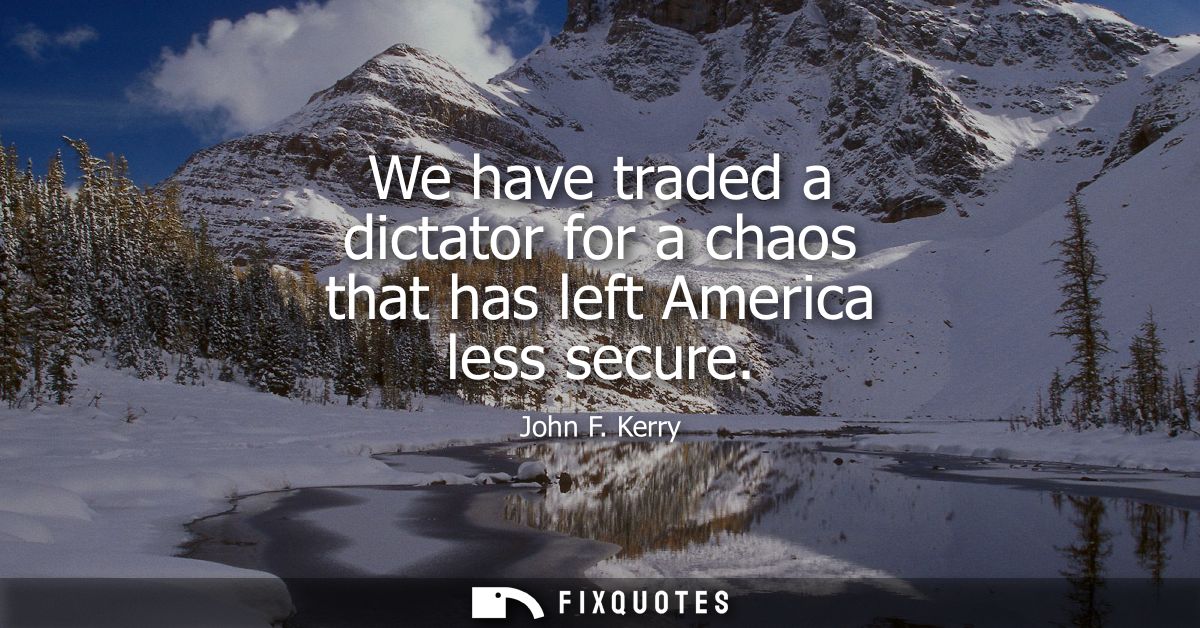
"We have traded a dictator for a chaos that has left America less secure"
About this Quote
There’s a neat rhetorical trap inside Kerry’s line: it denies the comfort of a clean moral arc. “Traded” is the key verb, borrowed from the language of markets and bargains, implying a transaction that can be judged by outcomes rather than intentions. It’s a rebuke to the post-9/11 habit of narrating foreign policy as a story of liberation where the ending is presumed righteous. Kerry compresses a whole doctrine into a grim ledger entry: whatever we felt about the dictator, the replacement regime is “chaos,” and chaos doesn’t just stay abroad.
The subtext is aimed as much at domestic politics as at the battlefield. By pairing “dictator” with “chaos,” Kerry sidesteps the easy caricature that critics of intervention are soft on strongmen. He concedes the ugliness of the old order while insisting the new order is strategically worse. It’s a way of attacking the architects of regime change on their preferred terrain: security. “Left America less secure” drags the argument back home, forcing listeners to measure foreign policy not by televised toppling statues but by blowback, insurgency, terrorism, and the slow erosion of credibility.
Contextually, it belongs to the long hangover of Iraq-era interventionism, when the promise of swift democratization collided with sectarian fracture and regional destabilization. Kerry’s intent is corrective and prosecutorial: to frame the war not as a noble miscalculation but as a bad deal, sold with certainty, paid for with disorder, and collected in risk.
The subtext is aimed as much at domestic politics as at the battlefield. By pairing “dictator” with “chaos,” Kerry sidesteps the easy caricature that critics of intervention are soft on strongmen. He concedes the ugliness of the old order while insisting the new order is strategically worse. It’s a way of attacking the architects of regime change on their preferred terrain: security. “Left America less secure” drags the argument back home, forcing listeners to measure foreign policy not by televised toppling statues but by blowback, insurgency, terrorism, and the slow erosion of credibility.
Contextually, it belongs to the long hangover of Iraq-era interventionism, when the promise of swift democratization collided with sectarian fracture and regional destabilization. Kerry’s intent is corrective and prosecutorial: to frame the war not as a noble miscalculation but as a bad deal, sold with certainty, paid for with disorder, and collected in risk.
Quote Details
| Topic | War |
|---|---|
| Source | Evidence:
BY KEVIN WHITELAW F or a supposedly im- promptu debate , this one has ... John Kerry walk onto the stage at the University of Miami in Coral Gables on ... We have traded a dictator for a chaos that has left America less secure ... |
| Cite |
Citation Formats
APA Style (7th ed.)
Kerry, John F. (2026, March 27). We have traded a dictator for a chaos that has left America less secure. FixQuotes. https://fixquotes.com/quotes/we-have-traded-a-dictator-for-a-chaos-that-has-91775/
Chicago Style
Kerry, John F. "We have traded a dictator for a chaos that has left America less secure." FixQuotes. March 27, 2026. https://fixquotes.com/quotes/we-have-traded-a-dictator-for-a-chaos-that-has-91775/.
MLA Style (9th ed.)
"We have traded a dictator for a chaos that has left America less secure." FixQuotes, 27 Mar. 2026, https://fixquotes.com/quotes/we-have-traded-a-dictator-for-a-chaos-that-has-91775/. Accessed 30 Mar. 2026.
More Quotes by John
Add to List