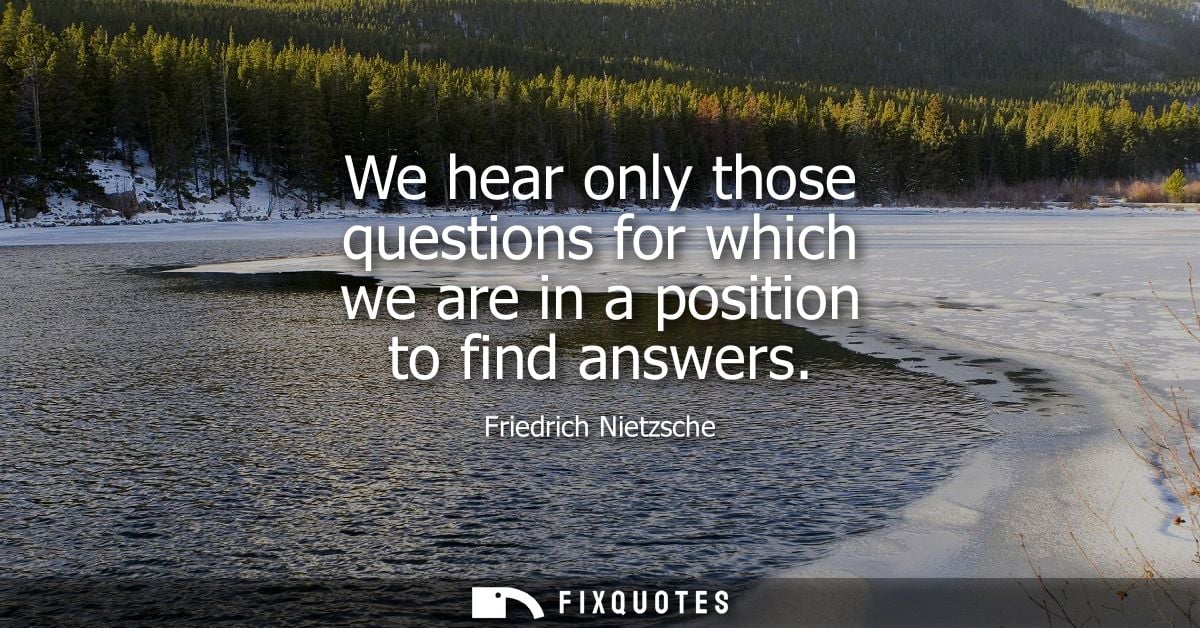
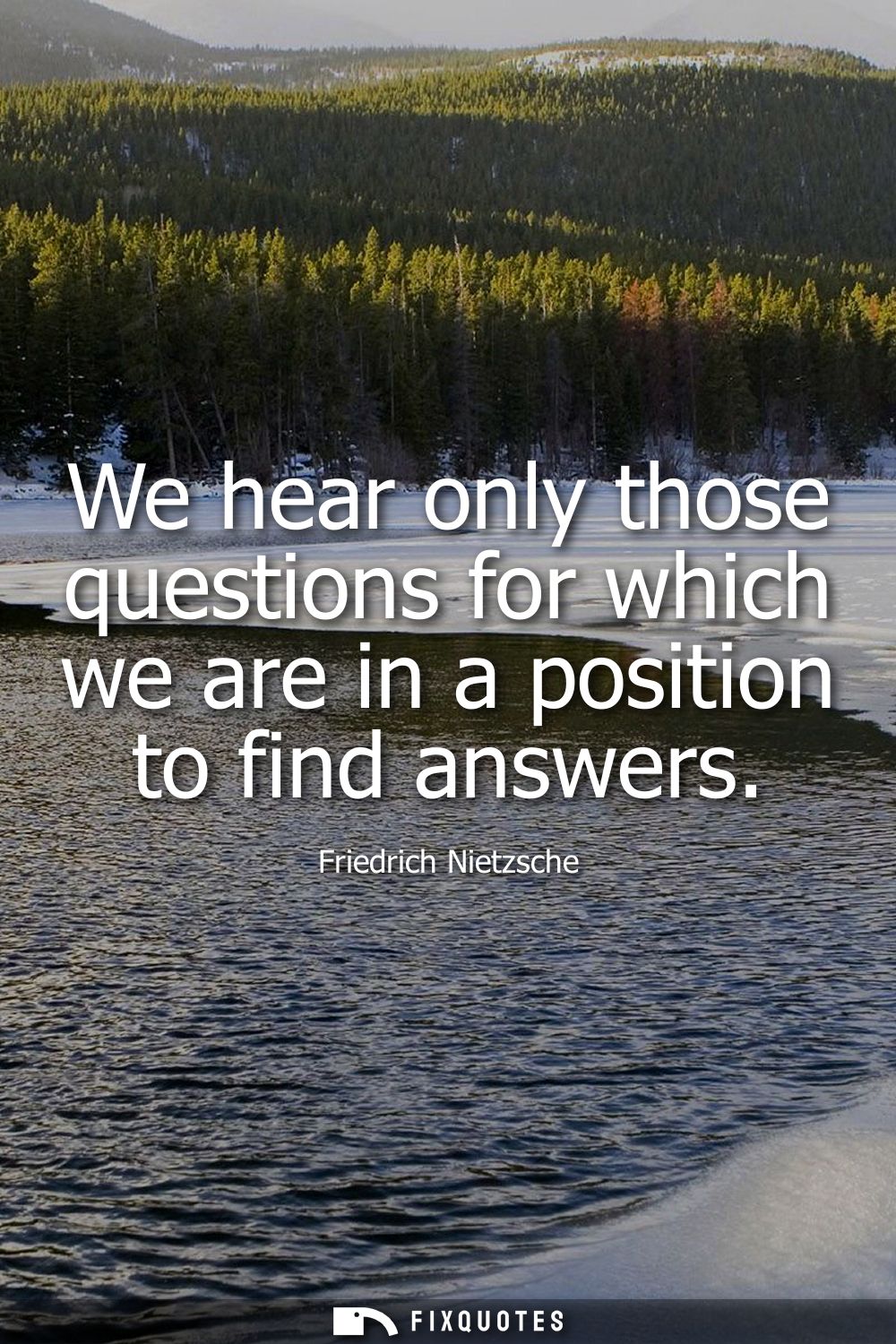
"We hear only those questions for which we are in a position to find answers"
About this Quote
The subtext is Nietzsche’s long war against the fantasy of disinterested inquiry. Philosophers who claim to “follow the argument wherever it leads” are, in his view, usually following temperament, training, and moral comfort. A culture saturated in Christianity and Kantian duty will reliably hear questions about guilt, obligation, and redemption; it will be half-deaf to questions about creating values, embracing contradiction, or living without metaphysical guarantees. Even skepticism can be a cozy room if it only asks what it already knows how to answer.
Context matters: Nietzsche writes in the wake of the “death of God,” when Europe’s inherited moral vocabulary is losing authority but still runs the show. This aphorism captures that transitional panic. If the old answers no longer hold, the first crisis isn’t finding new answers; it’s acquiring new ears. The provocation is harshly practical: expanding knowledge isn’t just adding information, it’s cultivating the strength to let unfamiliar questions count as real.
Quote Details
| Topic | Knowledge |
|---|---|
| Source | Verified source: The Gay Science (Friedrich Nietzsche, 1882)
Evidence: The Limits of our Sense of Hearing., We hear only the questions to which we are capable of finding an answer. (Book III, Aphorism 196). This line appears as a one-sentence aphorism in Friedrich Nietzsche’s Die fröhliche Wissenschaft (commonly translated as The Gay Science). Many modern quote sites paraphrase it as “We hear only those questions for which we are in a position to find answers,” but the closest standard English rendering is “We hear only the questions to which we are capable of finding an answer,” explicitly labeled as Aphorism 196 (“The Limits of our Sense of Hearing”) in Book III. The work was first published in 1882 (a second, expanded edition appeared in 1887, but the aphorism is widely cited from the earlier book structure/numbering). Other candidates (1) The Moves That Matter (Jonathan Rowson, 2019) compilation95.0% ... Friedrich Nietzsche saw more deeply into questions than most: 'We hear only those questions for which we are in a... |
| Cite |
Citation Formats
APA Style (7th ed.)
Nietzsche, Friedrich. (2026, February 8). We hear only those questions for which we are in a position to find answers. FixQuotes. https://fixquotes.com/quotes/we-hear-only-those-questions-for-which-we-are-in-313/
Chicago Style
Nietzsche, Friedrich. "We hear only those questions for which we are in a position to find answers." FixQuotes. February 8, 2026. https://fixquotes.com/quotes/we-hear-only-those-questions-for-which-we-are-in-313/.
MLA Style (9th ed.)
"We hear only those questions for which we are in a position to find answers." FixQuotes, 8 Feb. 2026, https://fixquotes.com/quotes/we-hear-only-those-questions-for-which-we-are-in-313/. Accessed 27 Mar. 2026.