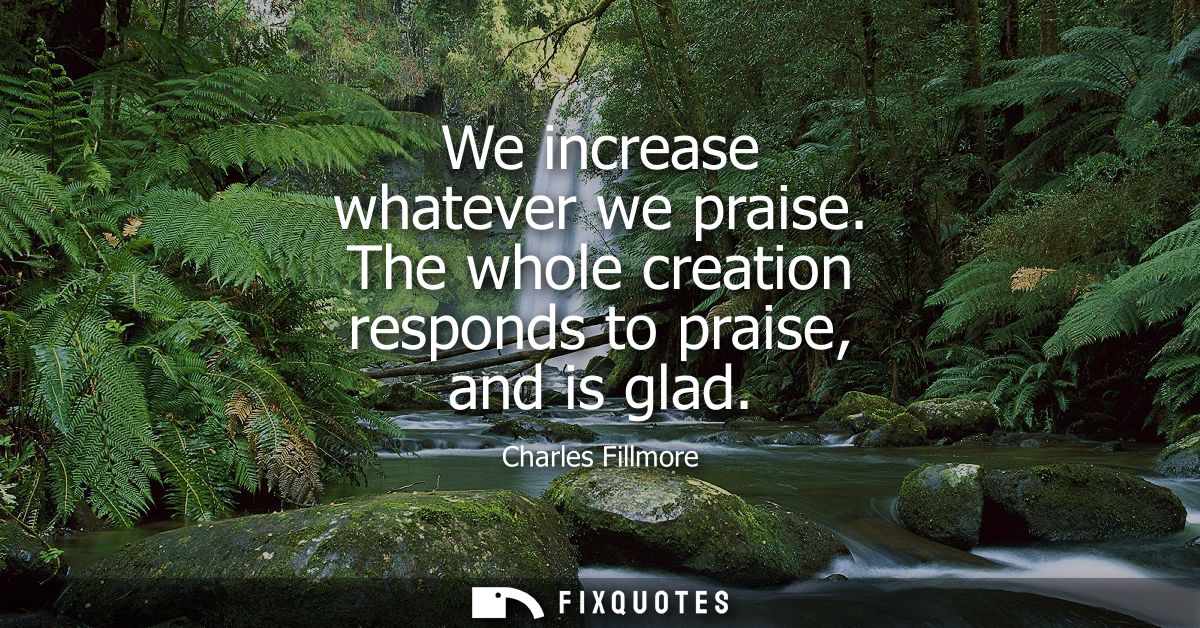
"We increase whatever we praise. The whole creation responds to praise, and is glad!"
About this Quote
The subtext is about agency. Fillmore, a major figure in the New Thought movement, lived in an era when American self-improvement culture was being industrialized: metaphysics packaged as method, spiritual practice translated into outcomes. In that context, praise becomes a discipline of perception. What you repeatedly name as good, you start to see more clearly; what you keep seeing, you start to cultivate. It's a loop that sounds like faith but behaves like habit formation.
"The whole creation responds to praise" is the boldest move. He's not just talking about children, students, or coworkers; he's expanding the audience to everything. That overreach is the point: it elevates a daily practice into a cosmic posture. The phrase "and is glad" softens the claim, giving the universe a gentle emotional temperature. It's hard to argue with, because it sidesteps proof and appeals to an felt sense many people recognize: life gets more livable when you train your attention on what deserves to grow.
Fillmore's intent is less to win a debate than to install a practice. Praise, here, is a technology of focus dressed up as spiritual truth.
Quote Details
| Topic | Gratitude |
|---|---|
| Source | Help us find the source |
| Cite |
Citation Formats
APA Style (7th ed.)
Fillmore, Charles. (2026, February 19). We increase whatever we praise. The whole creation responds to praise, and is glad! FixQuotes. https://fixquotes.com/quotes/we-increase-whatever-we-praise-the-whole-creation-42908/
Chicago Style
Fillmore, Charles. "We increase whatever we praise. The whole creation responds to praise, and is glad!" FixQuotes. February 19, 2026. https://fixquotes.com/quotes/we-increase-whatever-we-praise-the-whole-creation-42908/.
MLA Style (9th ed.)
"We increase whatever we praise. The whole creation responds to praise, and is glad!" FixQuotes, 19 Feb. 2026, https://fixquotes.com/quotes/we-increase-whatever-we-praise-the-whole-creation-42908/. Accessed 24 Mar. 2026.