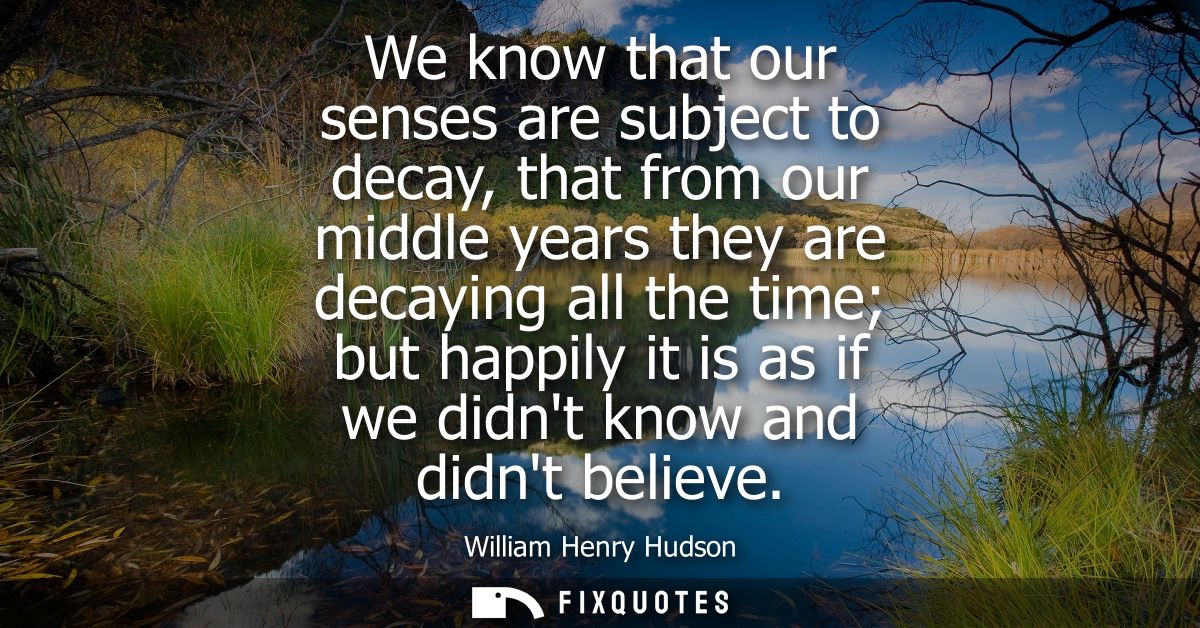
"We know that our senses are subject to decay, that from our middle years they are decaying all the time; but happily it is as if we didn't know and didn't believe"
About this Quote
Then comes the turn that makes the sentence sting and console at once: “happily it is as if we didn’t know and didn’t believe.” Hudson isn’t praising ignorance so much as identifying a built-in psychic anesthetic. We carry the knowledge abstractly, like a statistic, while living day-to-day as though perception were stable, renewable, guaranteed. That “as if” is doing heavy lifting: it suggests a deliberate performance of disbelief, a pragmatic self-deception that keeps experience vivid instead of constantly audited for loss.
The subtext is almost ecological, which fits Hudson’s reputation as a nature writer: humans are animals designed to keep moving, not to continually monitor their own wearing down. If you truly felt the steady dimming of sight, taste, hearing, you’d live in anticipatory grief, treating every sound and color like a dwindling resource. Hudson’s “happily” is quietly radical: consolation doesn’t come from reversing decay, but from the mind’s talent for inhabiting the present with enough conviction that it overwhelms the prognosis.
Contextually, it reads like late-19th/early-20th-century realism without the clenched despair: a modern sensibility that accepts decline as ordinary, then salvages joy through attention, habit, and the merciful unreliability of belief.
Quote Details
| Topic | Aging |
|---|---|
| Source | Help us find the source |
| Cite |
Citation Formats
APA Style (7th ed.)
Hudson, William Henry. (2026, January 15). We know that our senses are subject to decay, that from our middle years they are decaying all the time; but happily it is as if we didn't know and didn't believe. FixQuotes. https://fixquotes.com/quotes/we-know-that-our-senses-are-subject-to-decay-that-165998/
Chicago Style
Hudson, William Henry. "We know that our senses are subject to decay, that from our middle years they are decaying all the time; but happily it is as if we didn't know and didn't believe." FixQuotes. January 15, 2026. https://fixquotes.com/quotes/we-know-that-our-senses-are-subject-to-decay-that-165998/.
MLA Style (9th ed.)
"We know that our senses are subject to decay, that from our middle years they are decaying all the time; but happily it is as if we didn't know and didn't believe." FixQuotes, 15 Jan. 2026, https://fixquotes.com/quotes/we-know-that-our-senses-are-subject-to-decay-that-165998/. Accessed 5 Apr. 2026.