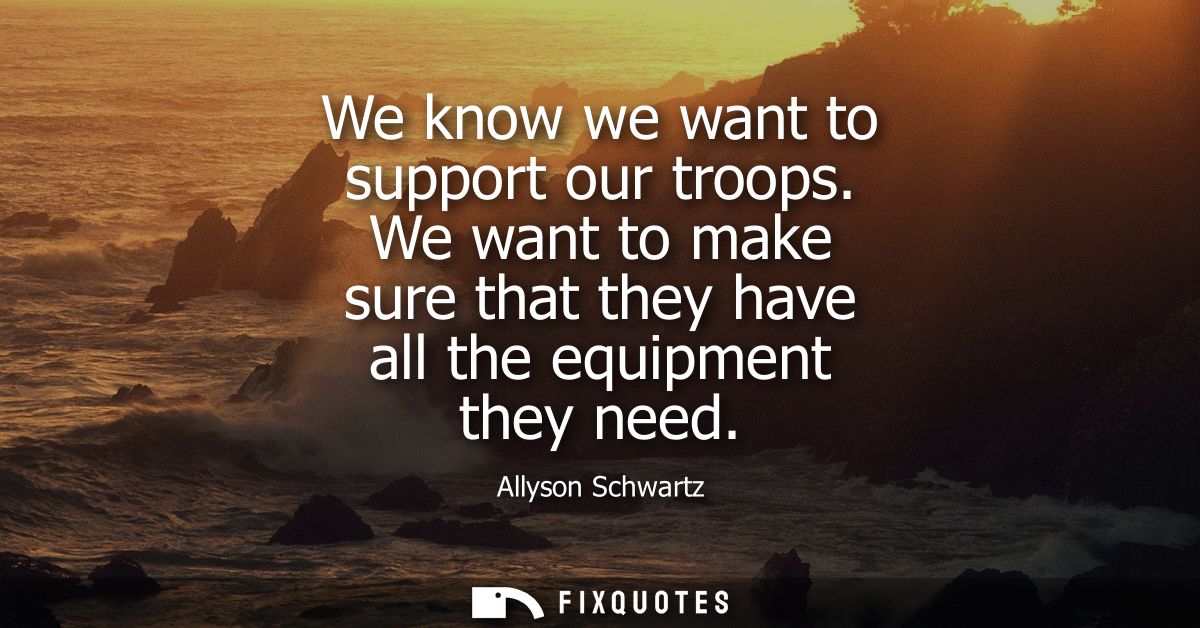
"We know we want to support our troops. We want to make sure that they have all the equipment they need"
About this Quote
Few lines in Washington are as politically consequence-free as “support our troops,” and Allyson Schwartz’s phrasing leans hard into that safe terrain. The sentence is built for bipartisan nodding: the “we” makes dissent feel antisocial, as if skepticism about a policy automatically becomes skepticism about the people asked to carry it out. It’s a rhetorical move that turns a complex argument about strategy, budgets, and accountability into a moral posture.
The genius, and the danger, sits in the ambiguity of “support.” Support can mean better body armor, faster VA claims processing, or simply approving the next supplemental appropriation with minimal scrutiny. By sliding quickly to “all the equipment they need,” Schwartz narrows the frame to procurement and readiness, the part of war policy that sounds like basic workplace responsibility. Who’s against giving employees the tools to do their jobs? That framing quietly preempts harder questions: Do they need to be there? What mission are they equipped for? Are we measuring “need” by commanders’ requests, contractors’ lobbying, or lawmakers’ political incentives?
Contextually, this is classic post-9/11 congressional language: an attempt to signal patriotism while avoiding association with either neglect or recklessness. The subtext is as much about domestic politics as military welfare. It reassures constituents and inoculates the speaker against attack ads, while implying that disagreement belongs only in the details, never in the premise. In that way, it’s less a policy statement than a permission slip for whichever defense spending package comes next.
The genius, and the danger, sits in the ambiguity of “support.” Support can mean better body armor, faster VA claims processing, or simply approving the next supplemental appropriation with minimal scrutiny. By sliding quickly to “all the equipment they need,” Schwartz narrows the frame to procurement and readiness, the part of war policy that sounds like basic workplace responsibility. Who’s against giving employees the tools to do their jobs? That framing quietly preempts harder questions: Do they need to be there? What mission are they equipped for? Are we measuring “need” by commanders’ requests, contractors’ lobbying, or lawmakers’ political incentives?
Contextually, this is classic post-9/11 congressional language: an attempt to signal patriotism while avoiding association with either neglect or recklessness. The subtext is as much about domestic politics as military welfare. It reassures constituents and inoculates the speaker against attack ads, while implying that disagreement belongs only in the details, never in the premise. In that way, it’s less a policy statement than a permission slip for whichever defense spending package comes next.
Quote Details
| Topic | Military & Soldier |
|---|---|
| Source | Help us find the source |
More Quotes by Allyson
Add to List