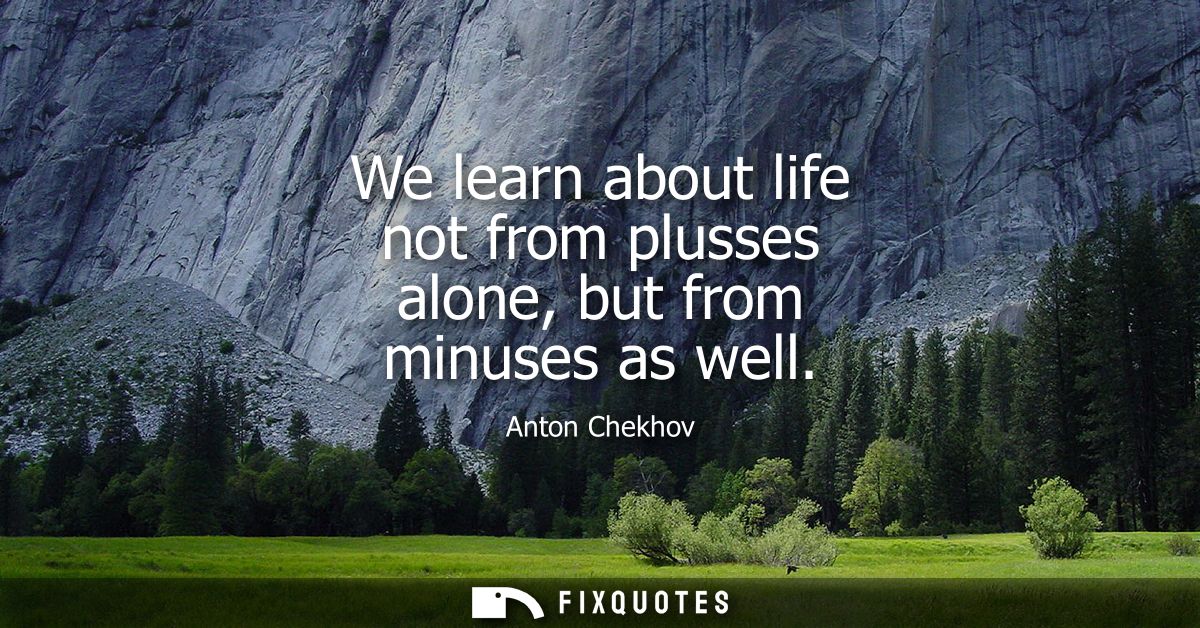
"We learn about life not from plusses alone, but from minuses as well"
About this Quote
Chekhov treats suffering like data: not romantic, not optional, just part of the sample size. “Plusses” and “minuses” is a deliberately unpoetic choice for a dramatist famous for emotional weather. He borrows the language of bookkeeping and arithmetic to puncture the habit of turning pain into a grand moral pageant. Life, in his view, doesn’t teach through inspirational highlights; it instructs through loss, boredom, failure, illness, and the slow grind of disappointment - the negative numbers most people try to hide from the ledger.
The intent is corrective. Chekhov is pushing back against the late-19th-century Russian appetite for edifying narratives: the idea that art (and life) should justify itself by delivering uplift, redemption, or clear lessons. His plays refuse those payoffs. Characters don’t “grow” so much as reveal themselves under pressure, and pressure often arrives as subtraction: a missed chance, a dwindling estate, a love that can’t land. The subtext is that “minus” experiences aren’t merely obstacles on the way to meaning; they are the conditions that make perception possible. Without deprivation, you don’t even know what you value.
Context matters: Chekhov was also a physician, trained to observe without melodrama and to recognize that symptoms are not the whole story. The line carries that clinical realism into his art. It’s a quiet manifesto for a modern sensibility: stop demanding that life be a motivational poster. Read the deficits. They’re where the plot actually is.
The intent is corrective. Chekhov is pushing back against the late-19th-century Russian appetite for edifying narratives: the idea that art (and life) should justify itself by delivering uplift, redemption, or clear lessons. His plays refuse those payoffs. Characters don’t “grow” so much as reveal themselves under pressure, and pressure often arrives as subtraction: a missed chance, a dwindling estate, a love that can’t land. The subtext is that “minus” experiences aren’t merely obstacles on the way to meaning; they are the conditions that make perception possible. Without deprivation, you don’t even know what you value.
Context matters: Chekhov was also a physician, trained to observe without melodrama and to recognize that symptoms are not the whole story. The line carries that clinical realism into his art. It’s a quiet manifesto for a modern sensibility: stop demanding that life be a motivational poster. Read the deficits. They’re where the plot actually is.
Quote Details
| Topic | Learning from Mistakes |
|---|---|
| Source | Help us find the source |
| Cite |
Citation Formats
APA Style (7th ed.)
Chekhov, Anton. (2026, January 17). We learn about life not from plusses alone, but from minuses as well. FixQuotes. https://fixquotes.com/quotes/we-learn-about-life-not-from-plusses-alone-but-42599/
Chicago Style
Chekhov, Anton. "We learn about life not from plusses alone, but from minuses as well." FixQuotes. January 17, 2026. https://fixquotes.com/quotes/we-learn-about-life-not-from-plusses-alone-but-42599/.
MLA Style (9th ed.)
"We learn about life not from plusses alone, but from minuses as well." FixQuotes, 17 Jan. 2026, https://fixquotes.com/quotes/we-learn-about-life-not-from-plusses-alone-but-42599/. Accessed 22 Mar. 2026.
More Quotes by Anton
Add to List