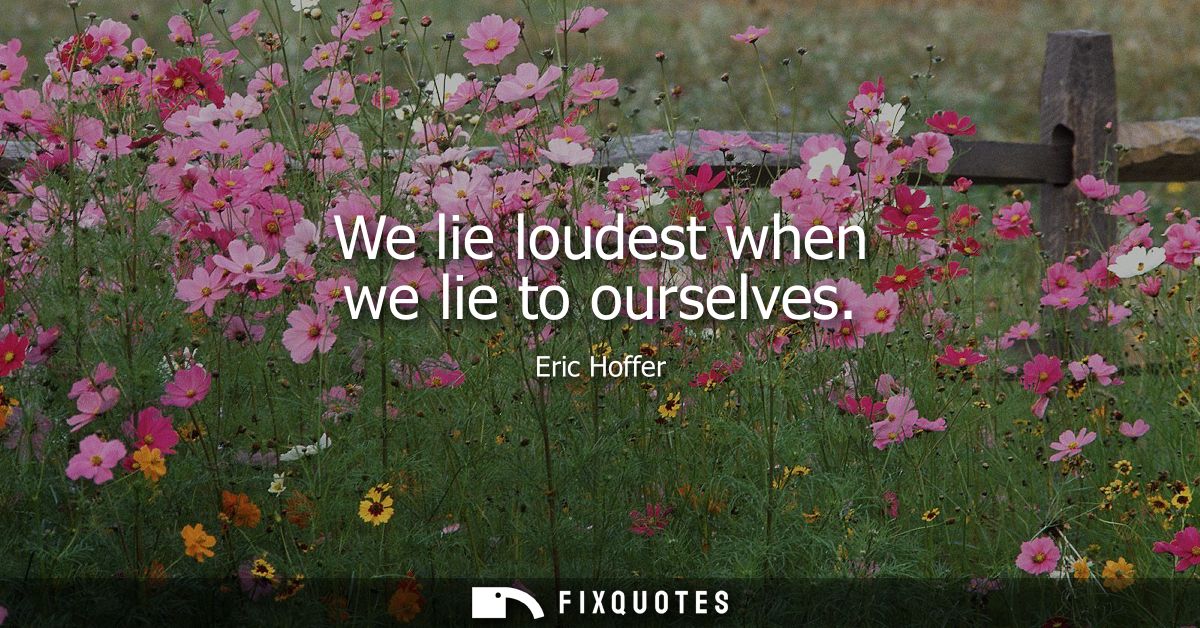
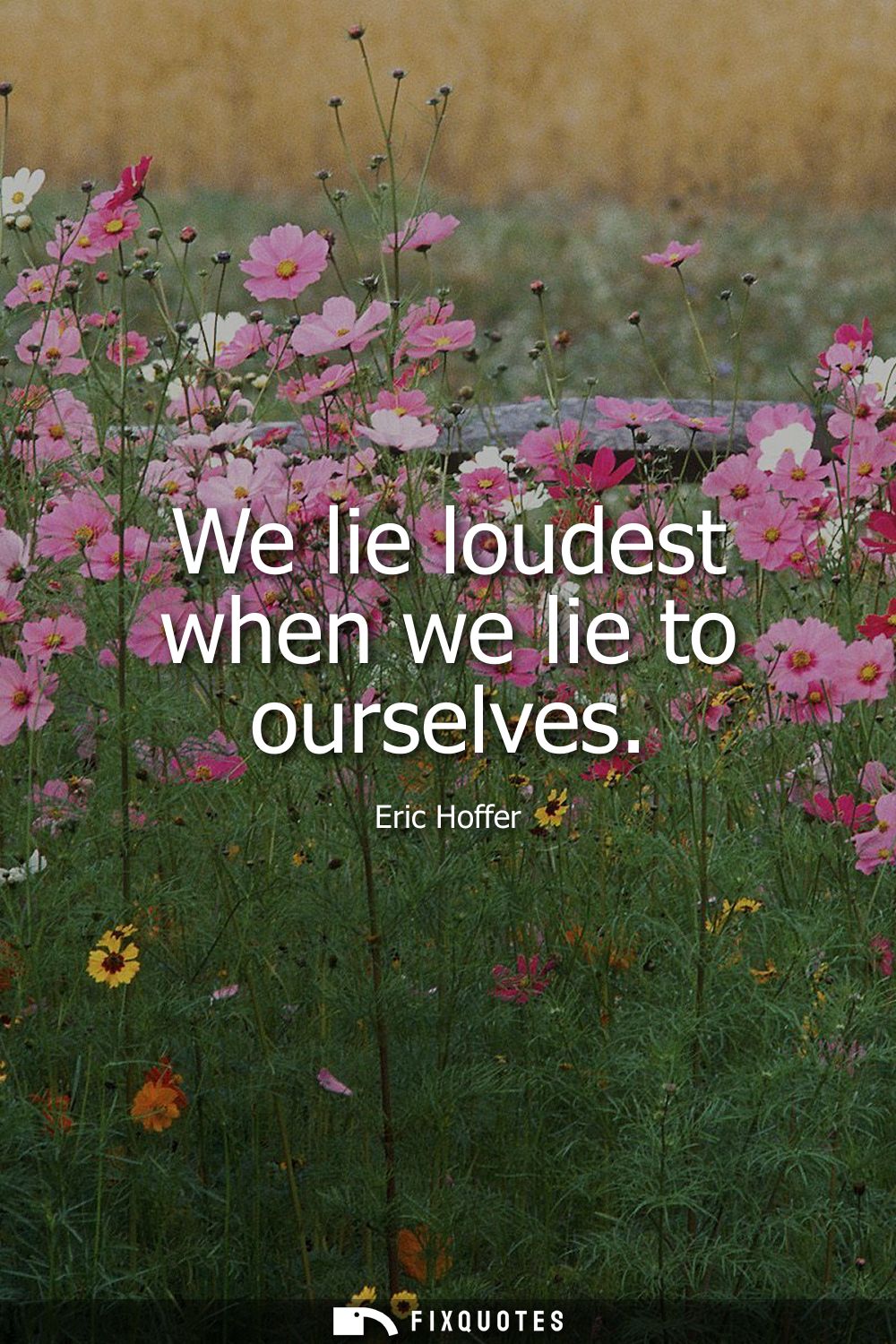
"We lie loudest when we lie to ourselves"
About this Quote
Hoffer’s line lands because it treats self-deception not as a quiet private flaw, but as a kind of overamplified performance. “Loudest” is the tell: when we lie to others, we calibrate. We hedge, we keep the story plausible, we watch their faces. Lying to ourselves, by contrast, doesn’t require evidence so much as volume. We repeat the story until it drowns out the inconvenient facts, turning inner speech into a propaganda machine with a captive audience.
The intent is moral but not sanctimonious. Hoffer is pointing at a mechanism: the psyche doesn’t just hide the truth; it compensates for its own doubt with extra force. The subtext is that the most persuasive lies are not the clever ones but the necessary ones, the narratives that protect identity. That’s why self-deception tends to come with certainty, righteousness, and sometimes anger. It isn’t confidence; it’s amplification.
Context matters here. Hoffer, a longshoreman-philosopher who wrote about mass movements, spent his career watching how personal insecurity scales into political fervor. Self-lying becomes the seed of collective delusion: the private insistence that “I’m fine, I’m right, I’m owed” can harden into public ideology. The quote’s edge is its implication that sincerity isn’t a guarantee of truth; it can be the symptom of the loudest lie of all.
The intent is moral but not sanctimonious. Hoffer is pointing at a mechanism: the psyche doesn’t just hide the truth; it compensates for its own doubt with extra force. The subtext is that the most persuasive lies are not the clever ones but the necessary ones, the narratives that protect identity. That’s why self-deception tends to come with certainty, righteousness, and sometimes anger. It isn’t confidence; it’s amplification.
Context matters here. Hoffer, a longshoreman-philosopher who wrote about mass movements, spent his career watching how personal insecurity scales into political fervor. Self-lying becomes the seed of collective delusion: the private insistence that “I’m fine, I’m right, I’m owed” can harden into public ideology. The quote’s edge is its implication that sincerity isn’t a guarantee of truth; it can be the symptom of the loudest lie of all.
Quote Details
| Topic | Honesty & Integrity |
|---|---|
| Source | Help us find the source |
| Cite |
Citation Formats
APA Style (7th ed.)
Hoffer, Eric. (2026, January 18). We lie loudest when we lie to ourselves. FixQuotes. https://fixquotes.com/quotes/we-lie-loudest-when-we-lie-to-ourselves-23520/
Chicago Style
Hoffer, Eric. "We lie loudest when we lie to ourselves." FixQuotes. January 18, 2026. https://fixquotes.com/quotes/we-lie-loudest-when-we-lie-to-ourselves-23520/.
MLA Style (9th ed.)
"We lie loudest when we lie to ourselves." FixQuotes, 18 Jan. 2026, https://fixquotes.com/quotes/we-lie-loudest-when-we-lie-to-ourselves-23520/. Accessed 30 Mar. 2026.
More Quotes by Eric
Add to List