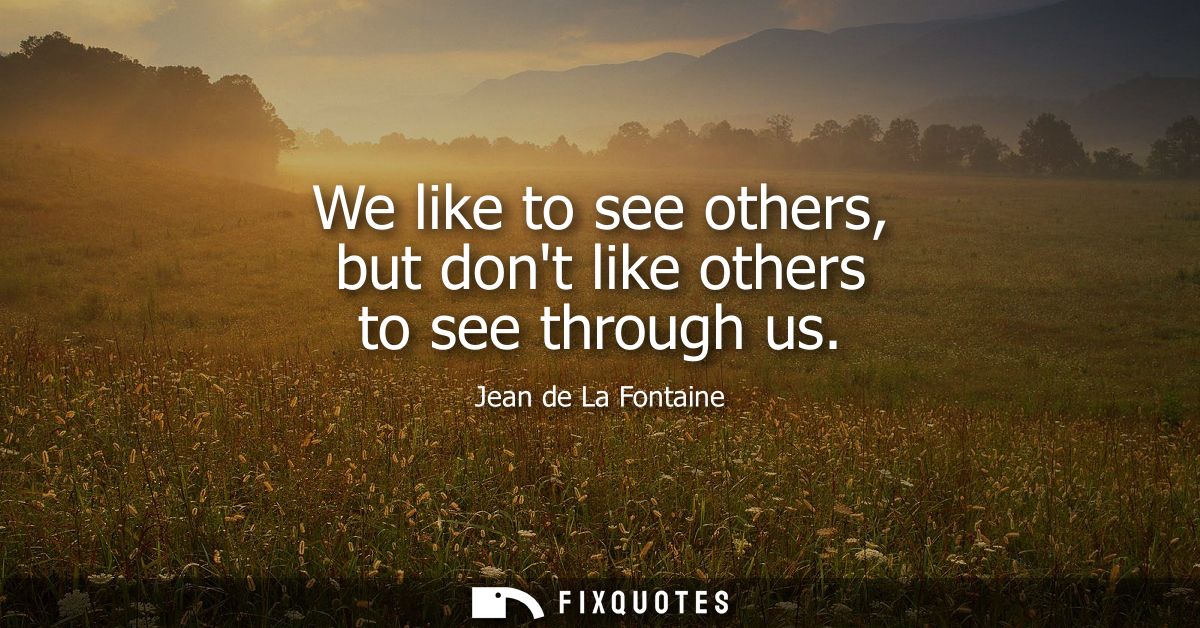
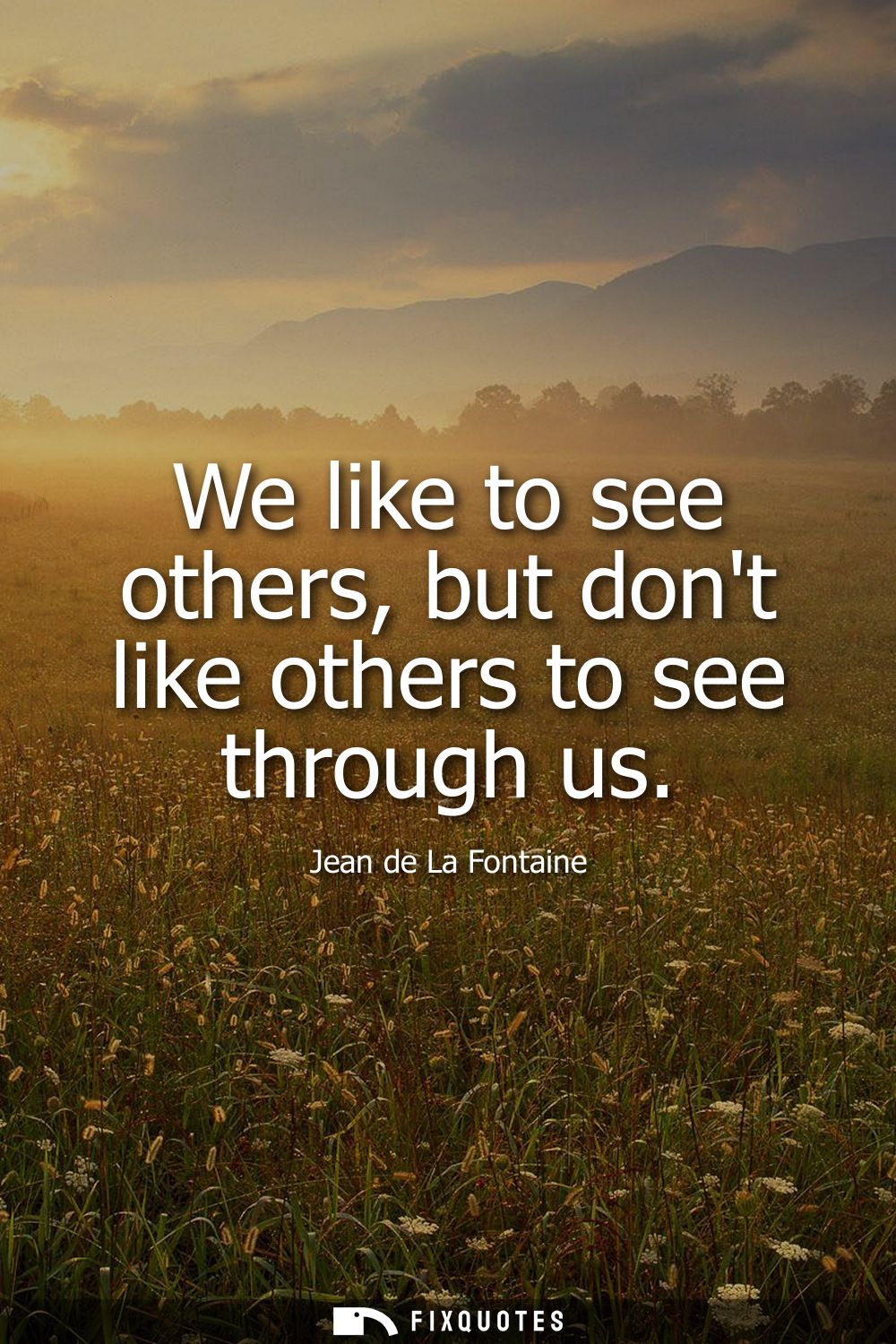
"We like to see others, but don't like others to see through us"
About this Quote
A neat little confession, dressed up as a proverb: we crave the pleasure of looking, but flinch at the risk of being understood. La Fontaine frames it as a social asymmetry, and the elegance is in how quickly it exposes the bargain beneath polite society. Seeing others feels like knowledge, even power; being “seen through” feels like loss of control, the sudden evaporation of our curated self.
The line turns on its double vision. “To see others” can sound harmless - curiosity, attention, even care. “To see through us,” though, is surgical. It implies that what we present is a surface, and that someone else might pierce it, finding vanity, weakness, or hypocrisy. La Fontaine isn’t simply diagnosing shyness; he’s sketching the moral economy of reputation. People want transparency in others because it reduces uncertainty. They want opacity for themselves because it preserves status.
Context matters: La Fontaine’s fables were written for a courtly world where survival depended on performance - wit, restraint, strategic silence. In that environment, observation is a sport and exposure is a penalty. The poet’s genius is to compress that entire theater into a single mirrored sentence, making the reader complicit. You don’t just recognize “human nature”; you recognize your own habits: scrolling, judging, decoding, while praying your motives remain un-decoded.
The sting is gentle but real. He suggests that our appetite for clarity is often less virtuous than we pretend, and our resistance to scrutiny is less accidental than we claim.
The line turns on its double vision. “To see others” can sound harmless - curiosity, attention, even care. “To see through us,” though, is surgical. It implies that what we present is a surface, and that someone else might pierce it, finding vanity, weakness, or hypocrisy. La Fontaine isn’t simply diagnosing shyness; he’s sketching the moral economy of reputation. People want transparency in others because it reduces uncertainty. They want opacity for themselves because it preserves status.
Context matters: La Fontaine’s fables were written for a courtly world where survival depended on performance - wit, restraint, strategic silence. In that environment, observation is a sport and exposure is a penalty. The poet’s genius is to compress that entire theater into a single mirrored sentence, making the reader complicit. You don’t just recognize “human nature”; you recognize your own habits: scrolling, judging, decoding, while praying your motives remain un-decoded.
The sting is gentle but real. He suggests that our appetite for clarity is often less virtuous than we pretend, and our resistance to scrutiny is less accidental than we claim.
Quote Details
| Topic | Honesty & Integrity |
|---|---|
| Source | Help us find the source |
| Cite |
Citation Formats
APA Style (7th ed.)
Fontaine, Jean de La. (2026, January 17). We like to see others, but don't like others to see through us. FixQuotes. https://fixquotes.com/quotes/we-like-to-see-others-but-dont-like-others-to-see-56061/
Chicago Style
Fontaine, Jean de La. "We like to see others, but don't like others to see through us." FixQuotes. January 17, 2026. https://fixquotes.com/quotes/we-like-to-see-others-but-dont-like-others-to-see-56061/.
MLA Style (9th ed.)
"We like to see others, but don't like others to see through us." FixQuotes, 17 Jan. 2026, https://fixquotes.com/quotes/we-like-to-see-others-but-dont-like-others-to-see-56061/. Accessed 27 Mar. 2026.
More Quotes by Jean
Add to List