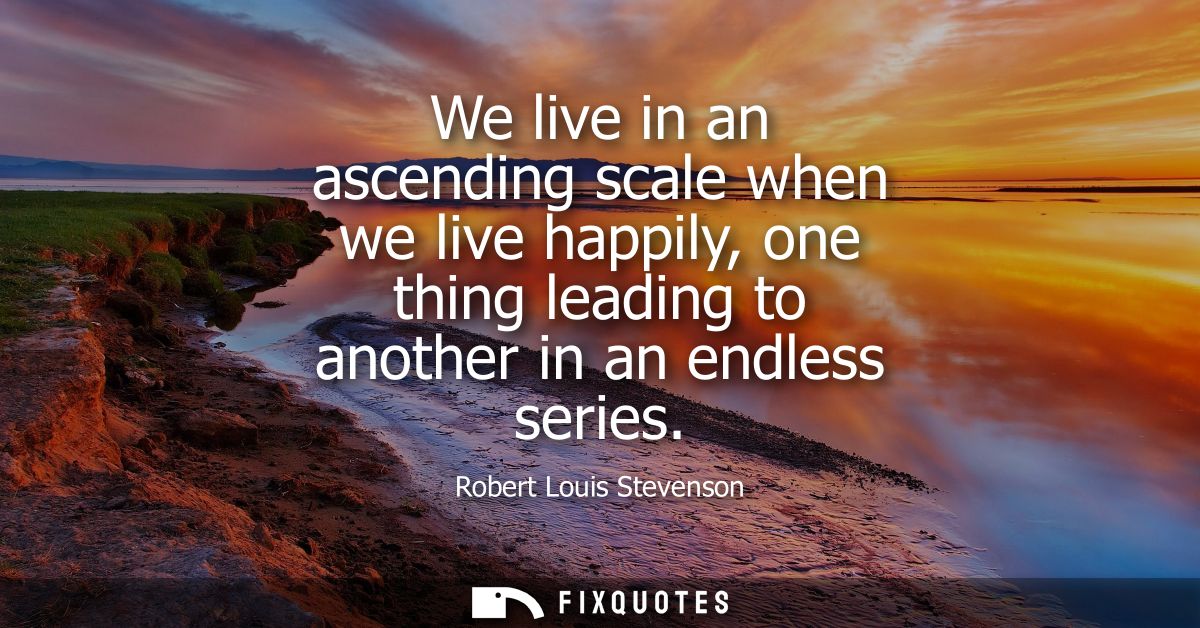
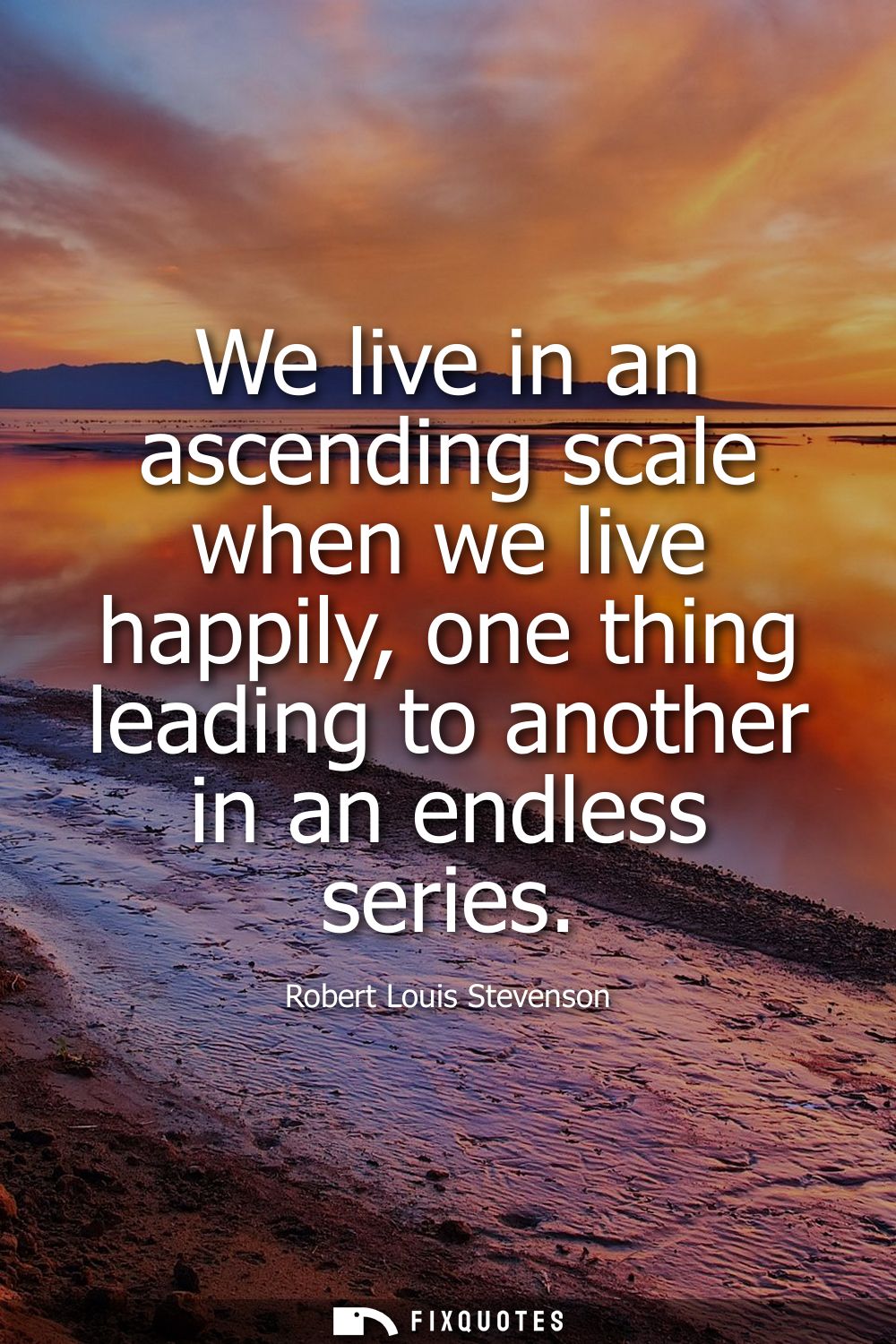
"We live in an ascending scale when we live happily, one thing leading to another in an endless series"
About this Quote
The subtext is quietly moral without sounding preachy. Stevenson isn’t preaching cheerfulness as a personality trait; he’s describing a practice of living that makes “endless series” plausible. The upward movement comes from engagement with the next thing: work that invites more work, companionship that opens into community, a walk that becomes a way of seeing. It’s also a subtle rebuke to stagnation. Misery often feels like a closed loop; happiness, here, is the opposite shape: a ladder.
Context matters. Stevenson lived with chronic illness and a restless, itinerant life, writing against physical limits and Victorian seriousness. That makes the “ascending scale” feel hard-won, not naive. He’s sketching a philosophy for imperfect bodies and unstable circumstances: happiness as continuity, not completion; as a sequence you can re-enter, even after interruption. The line’s optimism isn’t sentimental. It’s structural.
Quote Details
| Topic | Happiness |
|---|---|
| Source | Help us find the source |
| Cite |
Citation Formats
APA Style (7th ed.)
Stevenson, Robert Louis. (2026, January 18). We live in an ascending scale when we live happily, one thing leading to another in an endless series. FixQuotes. https://fixquotes.com/quotes/we-live-in-an-ascending-scale-when-we-live-20859/
Chicago Style
Stevenson, Robert Louis. "We live in an ascending scale when we live happily, one thing leading to another in an endless series." FixQuotes. January 18, 2026. https://fixquotes.com/quotes/we-live-in-an-ascending-scale-when-we-live-20859/.
MLA Style (9th ed.)
"We live in an ascending scale when we live happily, one thing leading to another in an endless series." FixQuotes, 18 Jan. 2026, https://fixquotes.com/quotes/we-live-in-an-ascending-scale-when-we-live-20859/. Accessed 30 Mar. 2026.