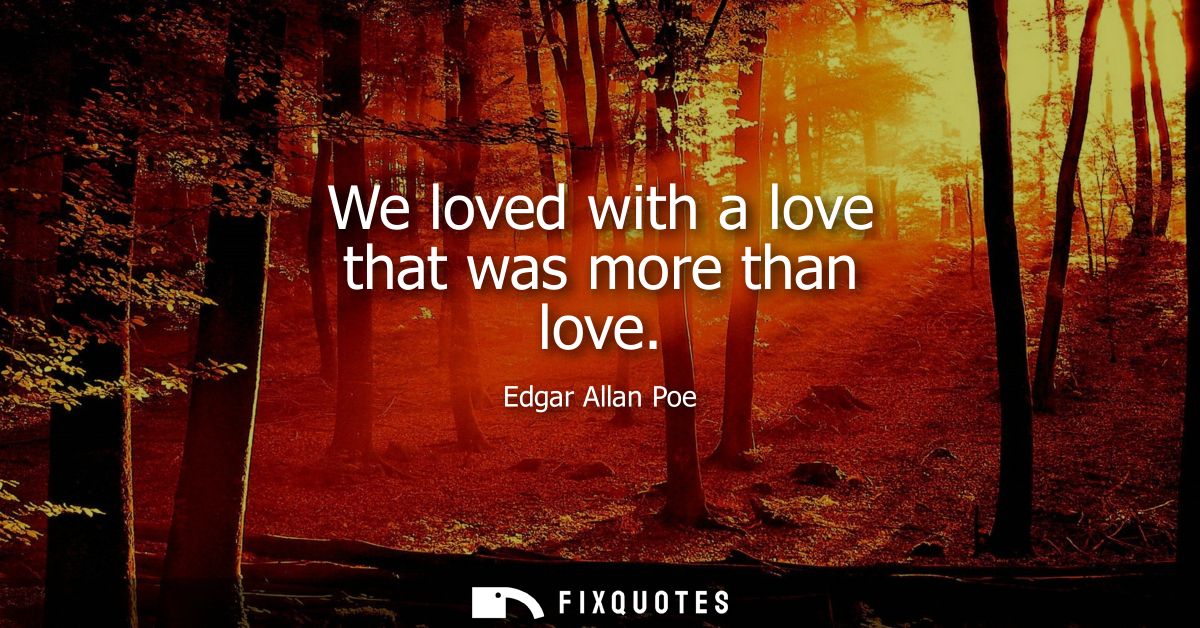
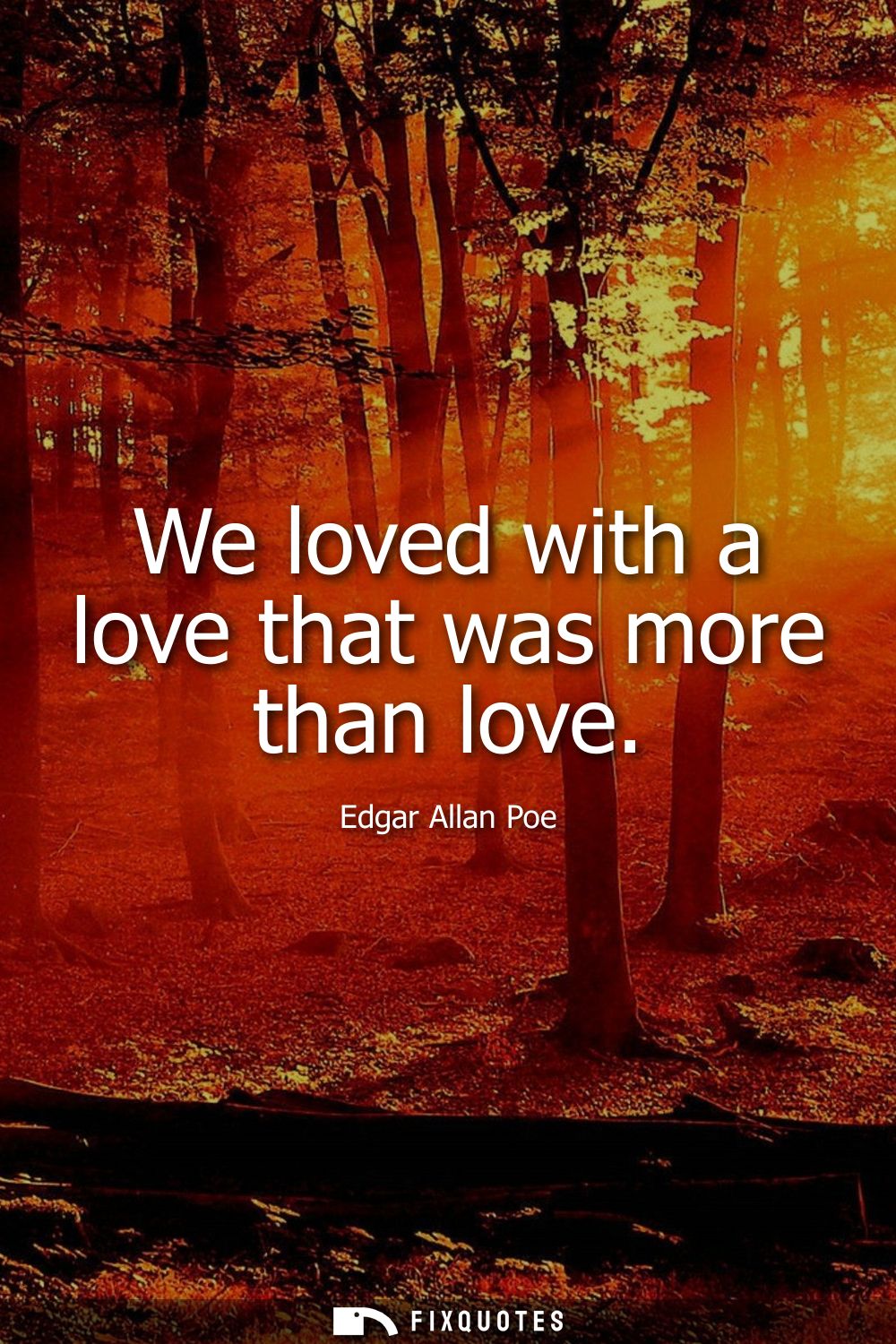
"We loved with a love that was more than love"
About this Quote
Poe’s line is a dare to language itself: if “love” is the biggest word we have, he’ll still insist it isn’t big enough. The repetition works like a funeral toll, forcing the reader to hear the word “love” not as sentiment but as obsession - an emotional absolute that refuses moderation. By claiming their bond was “more than love,” Poe doesn’t elevate romance so much as unmoor it from ordinary human scale. It’s devotion that has slipped its social leash, the kind that doesn’t negotiate with reality.
The subtext is grief with a lawyer’s precision. The speaker is trying to justify an attachment that the world would call excessive, even unhealthy. “More than love” hints at a fusion of identities: not two people choosing each other, but two people unable to exist separately. That’s why it’s persuasive and unsettling at once. The phrase performs what it describes: it exceeds the boundary of the word, then leaves you alone with the echo.
Context matters because Poe’s work repeatedly treats love as a force that death can’t cancel, only intensify. In “Annabel Lee,” the line sits inside a ballad of mourning where enemies aren’t rivals but “the angels,” jealous of mortal happiness. Poe turns bereavement into cosmic melodrama, not to be gaudy, but to capture how grief feels - irrational, grandeur-seeking, convinced the universe must have noticed. “More than love” is the mind refusing to accept an ordinary ending, because ordinary endings can’t explain extraordinary pain.
The subtext is grief with a lawyer’s precision. The speaker is trying to justify an attachment that the world would call excessive, even unhealthy. “More than love” hints at a fusion of identities: not two people choosing each other, but two people unable to exist separately. That’s why it’s persuasive and unsettling at once. The phrase performs what it describes: it exceeds the boundary of the word, then leaves you alone with the echo.
Context matters because Poe’s work repeatedly treats love as a force that death can’t cancel, only intensify. In “Annabel Lee,” the line sits inside a ballad of mourning where enemies aren’t rivals but “the angels,” jealous of mortal happiness. Poe turns bereavement into cosmic melodrama, not to be gaudy, but to capture how grief feels - irrational, grandeur-seeking, convinced the universe must have noticed. “More than love” is the mind refusing to accept an ordinary ending, because ordinary endings can’t explain extraordinary pain.
Quote Details
| Topic | Soulmate |
|---|---|
| Source | Annabel Lee (poem), Edgar Allan Poe, 1849 — final stanza contains the line cited. |
| Cite |
Citation Formats
APA Style (7th ed.)
Poe, Edgar Allan. (2026, January 15). We loved with a love that was more than love. FixQuotes. https://fixquotes.com/quotes/we-loved-with-a-love-that-was-more-than-love-28949/
Chicago Style
Poe, Edgar Allan. "We loved with a love that was more than love." FixQuotes. January 15, 2026. https://fixquotes.com/quotes/we-loved-with-a-love-that-was-more-than-love-28949/.
MLA Style (9th ed.)
"We loved with a love that was more than love." FixQuotes, 15 Jan. 2026, https://fixquotes.com/quotes/we-loved-with-a-love-that-was-more-than-love-28949/. Accessed 4 Apr. 2026.
More Quotes by Edgar
Add to List