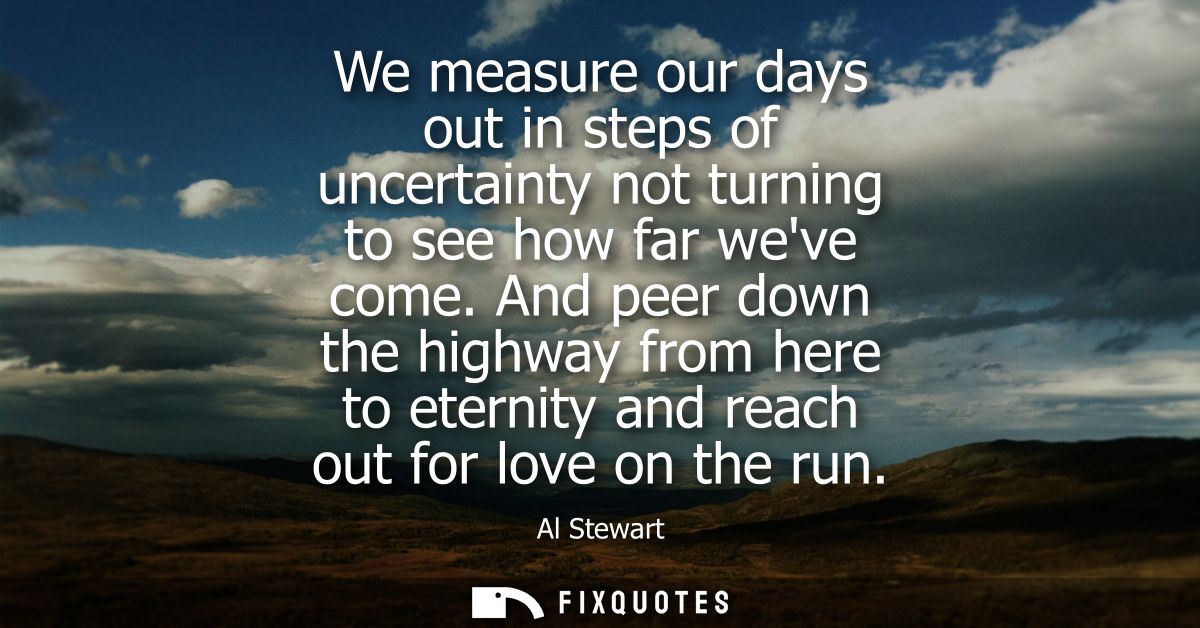
"We measure our days out in steps of uncertainty, not turning to see how far we've come. And peer down the highway from here to eternity and reach out for love on the run"
About this Quote
Stewart’s intent isn’t to romanticize restlessness; it’s to catch the way modern living makes reflection feel indulgent, even dangerous. If you stop, you might discover you’re farther from your earlier self than you can bear. “Peer down the highway from here to eternity” stretches the frame from personal anxiety to cosmic scale. It’s an old folk-rock move - the everyday image as metaphysical portal - but Stewart keeps it grounded by returning to human need: “reach out for love on the run.” Love isn’t a destination, it’s a drive-by. The subtext is brutal: in a life organized around momentum, even intimacy gets treated like something you snatch while speeding past.
Contextually, it fits Stewart’s songwriting persona: literate, rueful, fascinated by time and narrative. The line reads like a postcard from the touring life, too - always moving, always arriving, never staying long enough to feel arrived.
Quote Details
| Topic | Time |
|---|---|
| Source | Help us find the source |
| Cite |
Citation Formats
APA Style (7th ed.)
Stewart, Al. (2026, February 19). We measure our days out in steps of uncertainty, not turning to see how far we've come. And peer down the highway from here to eternity and reach out for love on the run. FixQuotes. https://fixquotes.com/quotes/we-measure-our-days-out-in-steps-of-uncertainty-43710/
Chicago Style
Stewart, Al. "We measure our days out in steps of uncertainty, not turning to see how far we've come. And peer down the highway from here to eternity and reach out for love on the run." FixQuotes. February 19, 2026. https://fixquotes.com/quotes/we-measure-our-days-out-in-steps-of-uncertainty-43710/.
MLA Style (9th ed.)
"We measure our days out in steps of uncertainty, not turning to see how far we've come. And peer down the highway from here to eternity and reach out for love on the run." FixQuotes, 19 Feb. 2026, https://fixquotes.com/quotes/we-measure-our-days-out-in-steps-of-uncertainty-43710/. Accessed 10 Mar. 2026.