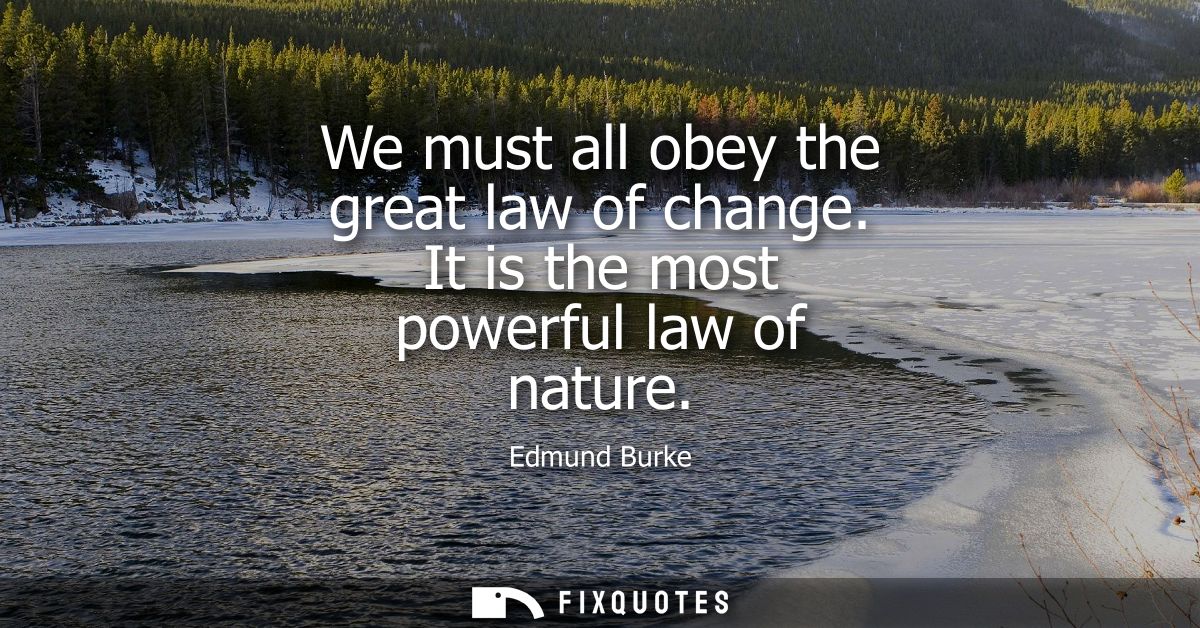
"We must all obey the great law of change. It is the most powerful law of nature"
About this Quote
That framing matters because Burke is often caricatured as the patron saint of resistance to reform. Yet his deeper move is subtler: he argues that the statesman’s job is not to freeze society in amber, but to manage transformation without pretending it can be abolished. The phrase “we must all obey” is deliberately democratic in its severity. Kings, crowds, and parliaments are equally subject to the same pressure. No one gets an exemption for tradition, charisma, or righteous fury.
The subtext is aimed at revolutionaries as much as reactionaries. In the 1790s, with the French Revolution detonating Europe’s political imagination, Burke feared change pursued as moral theater: remaking institutions overnight as if history were a bad draft you can delete. He accepts that systems evolve, but he distrusts the fantasy of total redesign, the idea that reason can outmuscle inheritance without costs.
Rhetorically, Burke borrows the authority of nature to discipline political appetite. Nature doesn’t negotiate; it punishes hubris. The line makes change unavoidable, but also morally neutral - which is precisely how it sharpens his point: the question isn’t whether society will change, it’s whether leaders will guide it with humility or gamble on catastrophe.
Quote Details
| Topic | Change |
|---|---|
| Source | Help us find the source |
| Cite |
Citation Formats
APA Style (7th ed.)
Burke, Edmund. (2026, January 15). We must all obey the great law of change. It is the most powerful law of nature. FixQuotes. https://fixquotes.com/quotes/we-must-all-obey-the-great-law-of-change-it-is-19220/
Chicago Style
Burke, Edmund. "We must all obey the great law of change. It is the most powerful law of nature." FixQuotes. January 15, 2026. https://fixquotes.com/quotes/we-must-all-obey-the-great-law-of-change-it-is-19220/.
MLA Style (9th ed.)
"We must all obey the great law of change. It is the most powerful law of nature." FixQuotes, 15 Jan. 2026, https://fixquotes.com/quotes/we-must-all-obey-the-great-law-of-change-it-is-19220/. Accessed 9 Feb. 2026.