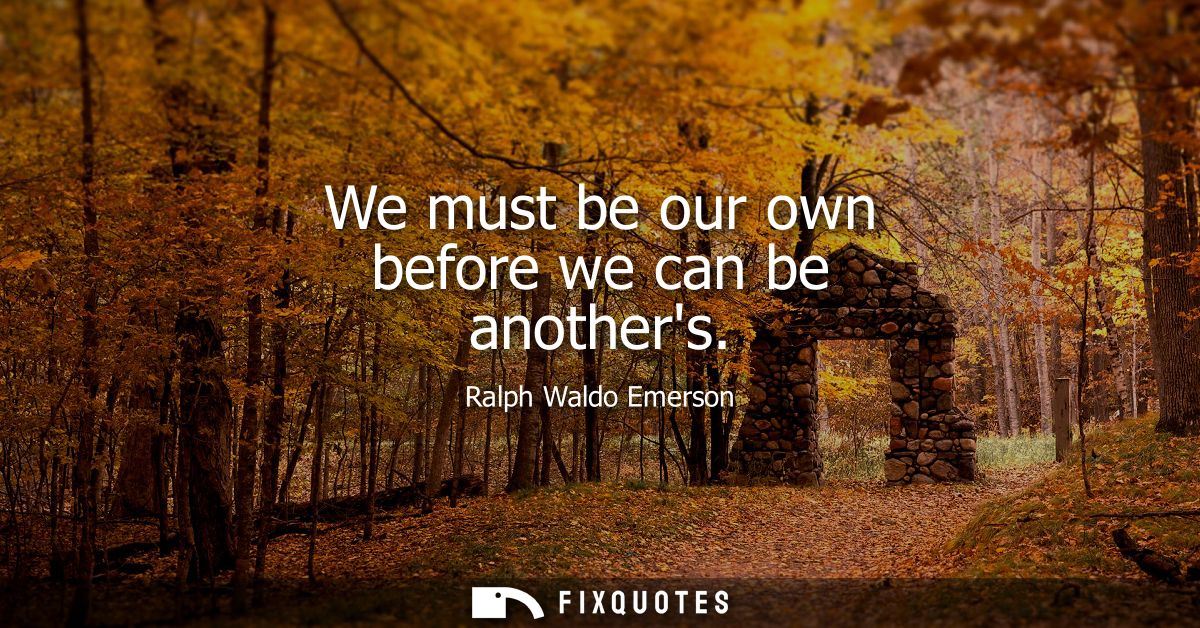
"We must be our own before we can be another's"
About this Quote
Emerson’s line lands like a polite refusal to be emotionally conscripted. “We must be our own before we can be another’s” reads, on the surface, like self-help; underneath, it’s a doctrine of moral independence aimed at a culture (and a religious tradition) that prized submission, duty, and borrowed authority. He isn’t praising solitude for its own sake. He’s insisting that any loyalty, love, or social commitment that isn’t grounded in self-possession is counterfeit - performed, not chosen.
The phrase “be our own” does a lot of work. It suggests ownership, yes, but also authorship: you have to write yourself before you can sign onto someone else’s script. Emerson’s Transcendentalist context matters here: the 19th-century American project of self-making, the suspicion of institutions, the faith that conscience outranks custom. In that light, “another’s” isn’t just romantic belonging; it’s the broader pressure to become a tool of family expectation, church doctrine, party politics, even reform movements that flatten the individual in the name of the cause.
The subtext is sharper than it looks: dependence masquerades as devotion. If you don’t know what you believe, your “yes” to others is just fear of isolation dressed up as virtue. Emerson’s rhetorical neatness - the mirror-like “our own / another’s” - turns a private ethic into a public standard: real commitment requires a self sturdy enough to risk disagreement. That’s not selfishness. It’s consent with a spine.
The phrase “be our own” does a lot of work. It suggests ownership, yes, but also authorship: you have to write yourself before you can sign onto someone else’s script. Emerson’s Transcendentalist context matters here: the 19th-century American project of self-making, the suspicion of institutions, the faith that conscience outranks custom. In that light, “another’s” isn’t just romantic belonging; it’s the broader pressure to become a tool of family expectation, church doctrine, party politics, even reform movements that flatten the individual in the name of the cause.
The subtext is sharper than it looks: dependence masquerades as devotion. If you don’t know what you believe, your “yes” to others is just fear of isolation dressed up as virtue. Emerson’s rhetorical neatness - the mirror-like “our own / another’s” - turns a private ethic into a public standard: real commitment requires a self sturdy enough to risk disagreement. That’s not selfishness. It’s consent with a spine.
Quote Details
| Topic | Self-Love |
|---|---|
| Source | Help us find the source |
| Cite |
Citation Formats
APA Style (7th ed.)
Emerson, Ralph Waldo. (2026, January 17). We must be our own before we can be another's. FixQuotes. https://fixquotes.com/quotes/we-must-be-our-own-before-we-can-be-anothers-33005/
Chicago Style
Emerson, Ralph Waldo. "We must be our own before we can be another's." FixQuotes. January 17, 2026. https://fixquotes.com/quotes/we-must-be-our-own-before-we-can-be-anothers-33005/.
MLA Style (9th ed.)
"We must be our own before we can be another's." FixQuotes, 17 Jan. 2026, https://fixquotes.com/quotes/we-must-be-our-own-before-we-can-be-anothers-33005/. Accessed 13 Feb. 2026.
More Quotes by Ralph
Add to List