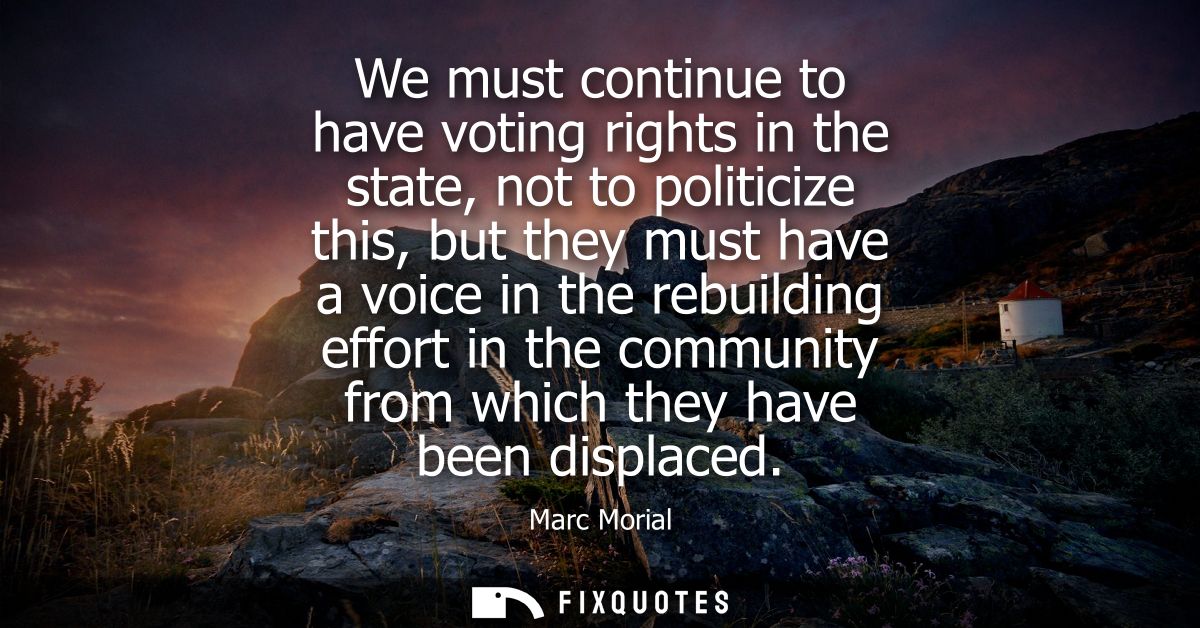
"We must continue to have voting rights in the state, not to politicize this, but they must have a voice in the rebuilding effort in the community from which they have been displaced"
About this Quote
The subtext is sharper than the civility suggests. “They must have a voice” implies that, absent legal protection, they won’t. The phrase “from which they have been displaced” is doing heavy moral work: displacement isn’t framed as a neutral side effect of disaster, but as a rupture with consequences that can be compounded by policy. Keeping voting rights “in the state” signals a specific fear: if displaced residents can’t vote where they’re registered, power shifts to those who stayed, those who benefit, or those positioned to capitalize on reconstruction. Rebuilding becomes a quiet form of disenfranchisement.
Context matters. Morial, tied to civil-rights advocacy and post-disaster urban politics, is speaking into the history of American “recovery” efforts that double as demographic and economic reordering. Displacement after hurricanes, floods, or redevelopment doesn’t just scatter people; it can thin out a constituency. His careful disclaimer is less naivete than a rhetorical shield, anticipating accusations of opportunism. He’s telling you the real opportunism happens when procedural barriers decide whose community gets rebuilt, and for whom.
Quote Details
| Topic | Human Rights |
|---|---|
| Source | Help us find the source |
| Cite |
Citation Formats
APA Style (7th ed.)
Morial, Marc. (2026, January 17). We must continue to have voting rights in the state, not to politicize this, but they must have a voice in the rebuilding effort in the community from which they have been displaced. FixQuotes. https://fixquotes.com/quotes/we-must-continue-to-have-voting-rights-in-the-76989/
Chicago Style
Morial, Marc. "We must continue to have voting rights in the state, not to politicize this, but they must have a voice in the rebuilding effort in the community from which they have been displaced." FixQuotes. January 17, 2026. https://fixquotes.com/quotes/we-must-continue-to-have-voting-rights-in-the-76989/.
MLA Style (9th ed.)
"We must continue to have voting rights in the state, not to politicize this, but they must have a voice in the rebuilding effort in the community from which they have been displaced." FixQuotes, 17 Jan. 2026, https://fixquotes.com/quotes/we-must-continue-to-have-voting-rights-in-the-76989/. Accessed 11 Mar. 2026.