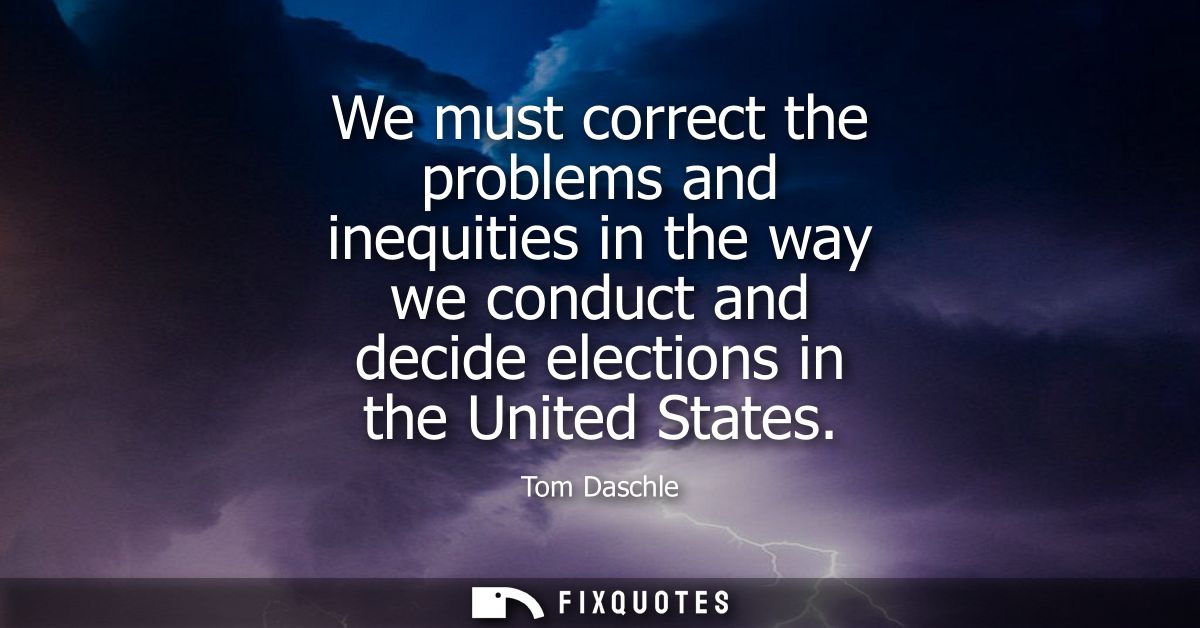
"We must correct the problems and inequities in the way we conduct and decide elections in the United States"
About this Quote
The verb choice matters, too. “Conduct and decide elections” spans the whole pipeline: access (registration, ID rules, polling locations, wait times) and outcomes (counting, recounts, adjudication). It’s a rhetorical umbrella that signals seriousness about both the front-end experience of voting and the back-end legitimacy of results. You can hear the post-2000 subtext: after a razor-thin presidential race decided by courts, not voters, Democrats in particular leaned into a language of procedural fairness that doubles as a legitimacy argument. If the system can be shown to be inequitable, then outcomes become politically contestable without sounding like sour grapes.
Daschle, a Senate leader during an era of tight margins, is also speaking to institutional power. “Correct” implies technocratic repair work, not revolution, which reassures moderates while still opening the door to structural changes: federal standards, voting technology upgrades, expanded access, or tighter oversight. The line’s genius is its ambiguity: it invites listeners to supply their own “inequities,” then enrolls them in a shared imperative to fix them.
Quote Details
| Topic | Equality |
|---|---|
| Source | Help us find the source |
| Cite |
Citation Formats
APA Style (7th ed.)
Daschle, Tom. (2026, January 16). We must correct the problems and inequities in the way we conduct and decide elections in the United States. FixQuotes. https://fixquotes.com/quotes/we-must-correct-the-problems-and-inequities-in-93969/
Chicago Style
Daschle, Tom. "We must correct the problems and inequities in the way we conduct and decide elections in the United States." FixQuotes. January 16, 2026. https://fixquotes.com/quotes/we-must-correct-the-problems-and-inequities-in-93969/.
MLA Style (9th ed.)
"We must correct the problems and inequities in the way we conduct and decide elections in the United States." FixQuotes, 16 Jan. 2026, https://fixquotes.com/quotes/we-must-correct-the-problems-and-inequities-in-93969/. Accessed 30 Mar. 2026.