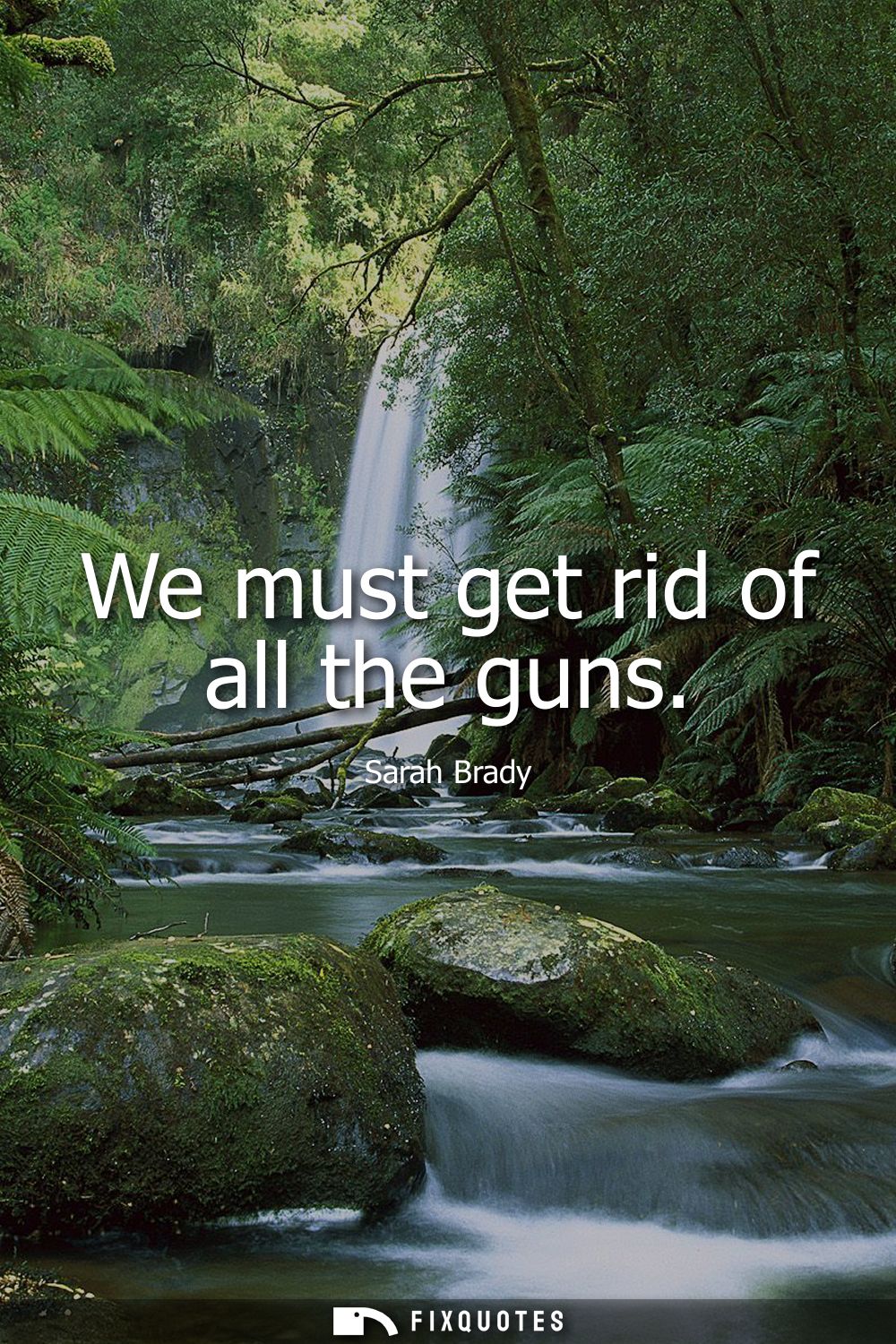
"We must get rid of all the guns"
About this Quote
A blunt sentence like this is designed to be misquoted, and Sarah Brady knew it. “We must get rid of all the guns” refuses the comfortable wiggle room of policy-speak; it’s not “reduce,” “regulate,” or “balance.” It’s totalizing on purpose, a line meant to drag the argument out of its usual swamp of exemptions and edge cases and into a moral binary: either you accept civilian gun prevalence as normal, or you don’t.
The intent is agenda-setting. Brady wasn’t merely proposing a bill; she was trying to reset the default assumptions of American life, where guns are treated as everyday consumer goods rather than exceptional instruments. The subtext is that half measures are structurally doomed: as long as guns remain widely available, the cycle of shootings, fear, and political paralysis continues. In that sense, the sentence functions less like legislation and more like an organizing slogan: clarifying the destination so incremental steps (background checks, waiting periods, licensing) can be defended as part of a coherent endgame.
Context matters because Brady’s public identity was forged in catastrophe. After her husband, James Brady, was shot during the 1981 assassination attempt on Ronald Reagan, she became the face of a movement that helped pass the Brady Handgun Violence Prevention Act. The absolutism reads as grief transmuted into strategy: when personal trauma meets Washington’s slow grind, maximal clarity can feel like the only honest language. It also courts backlash, because it confirms opponents’ favorite suspicion: that “commonsense reform” is a staircase to confiscation. Brady’s line works precisely because it risks that fight rather than dodging it.
The intent is agenda-setting. Brady wasn’t merely proposing a bill; she was trying to reset the default assumptions of American life, where guns are treated as everyday consumer goods rather than exceptional instruments. The subtext is that half measures are structurally doomed: as long as guns remain widely available, the cycle of shootings, fear, and political paralysis continues. In that sense, the sentence functions less like legislation and more like an organizing slogan: clarifying the destination so incremental steps (background checks, waiting periods, licensing) can be defended as part of a coherent endgame.
Context matters because Brady’s public identity was forged in catastrophe. After her husband, James Brady, was shot during the 1981 assassination attempt on Ronald Reagan, she became the face of a movement that helped pass the Brady Handgun Violence Prevention Act. The absolutism reads as grief transmuted into strategy: when personal trauma meets Washington’s slow grind, maximal clarity can feel like the only honest language. It also courts backlash, because it confirms opponents’ favorite suspicion: that “commonsense reform” is a staircase to confiscation. Brady’s line works precisely because it risks that fight rather than dodging it.
Quote Details
| Topic | Peace |
|---|---|
| Source | Help us find the source |
| Cite |
Citation Formats
APA Style (7th ed.)
Brady, Sarah. (2026, January 16). We must get rid of all the guns. FixQuotes. https://fixquotes.com/quotes/we-must-get-rid-of-all-the-guns-98860/
Chicago Style
Brady, Sarah. "We must get rid of all the guns." FixQuotes. January 16, 2026. https://fixquotes.com/quotes/we-must-get-rid-of-all-the-guns-98860/.
MLA Style (9th ed.)
"We must get rid of all the guns." FixQuotes, 16 Jan. 2026, https://fixquotes.com/quotes/we-must-get-rid-of-all-the-guns-98860/. Accessed 28 Mar. 2026.
More Quotes by Sarah
Add to List