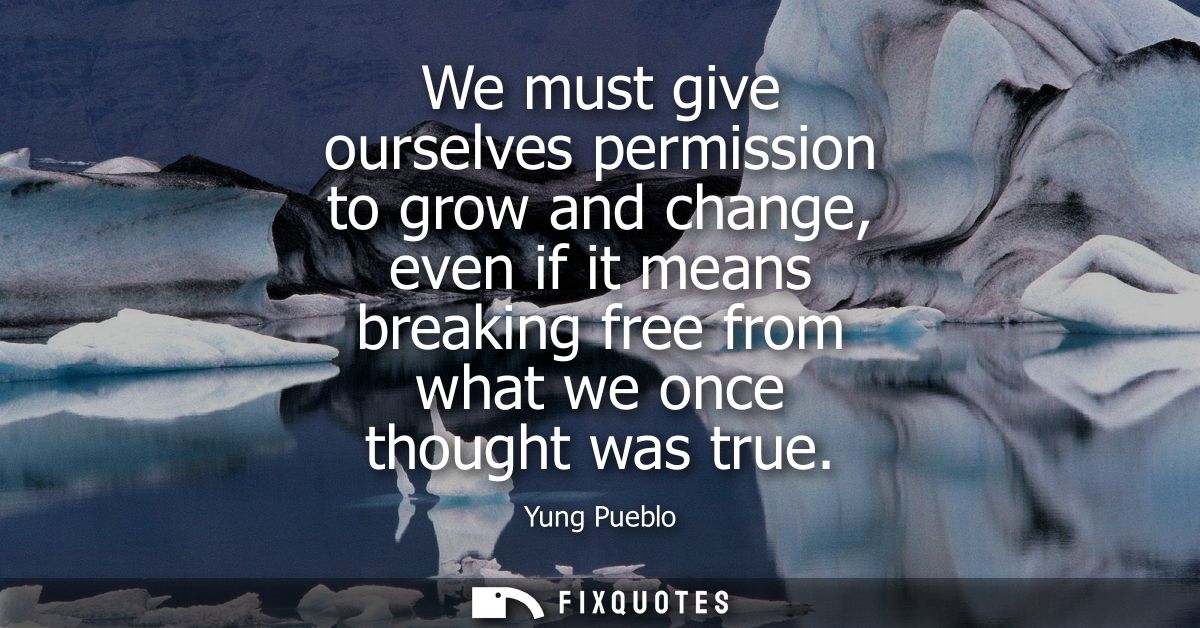
"We must give ourselves permission to grow and change, even if it means breaking free from what we once thought was true"
About this Quote
The subtext is a rebuke to certainty-as-character. “What we once thought was true” isn’t just mistaken facts; it’s beliefs that became social glue: the relationship you defended, the worldview you built community around, the story you told to make suffering make sense. By locating the obstacle in “what we once thought,” he avoids blaming the past self. The earlier version of you was acting on the best available map. Now the map is outdated.
Context matters: Yung Pueblo is a writer whose work lives at the intersection of mindfulness culture and internet brevity, where authority often comes from personal evolution rather than institutional credentials. The intent is motivational, but it’s also protective. If change requires “permission,” then shame is the gatekeeper. His sentence offers a counter-ritual: you are allowed to contradict yourself, and the cost of that contradiction may be freedom.
Quote Details
| Topic | Embrace Change |
|---|---|
| Source | Help us find the source |
| Cite |
Citation Formats
APA Style (7th ed.)
Pueblo, Yung. (2026, January 15). We must give ourselves permission to grow and change, even if it means breaking free from what we once thought was true. FixQuotes. https://fixquotes.com/quotes/we-must-give-ourselves-permission-to-grow-and-172032/
Chicago Style
Pueblo, Yung. "We must give ourselves permission to grow and change, even if it means breaking free from what we once thought was true." FixQuotes. January 15, 2026. https://fixquotes.com/quotes/we-must-give-ourselves-permission-to-grow-and-172032/.
MLA Style (9th ed.)
"We must give ourselves permission to grow and change, even if it means breaking free from what we once thought was true." FixQuotes, 15 Jan. 2026, https://fixquotes.com/quotes/we-must-give-ourselves-permission-to-grow-and-172032/. Accessed 7 Apr. 2026.