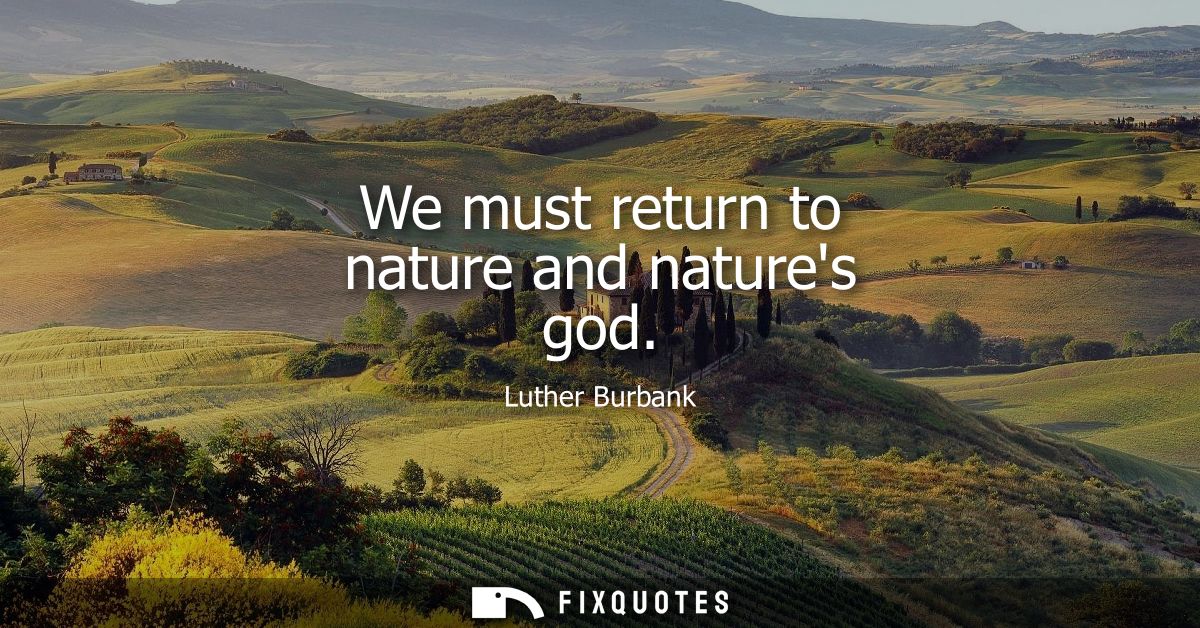
"We must return to nature and nature's God"
About this Quote
The line lands like a rallying cry disguised as a prayer: part botanical common sense, part moral ultimatum. Burbank was a plant breeder who spent his life proving that “nature” isn’t a museum piece but a system you can collaborate with if you actually pay attention. So “return to nature” reads less like pastoral nostalgia and more like a rebuke of a culture sprinting into industrial modernity with the arrogance of someone who thinks steel and chemistry have repealed biology.
The second half does the sharper work. “Nature’s god” borrows the lofty Deist phrasing of the American founding era, smuggling authority into what might otherwise sound like a hobbyist’s manifesto. It’s a rhetorical power move: if you can’t be persuaded by evidence, maybe you’ll be chastened by something that feels sacred. In an age when Darwin had unsettled traditional religion and factories were reshaping landscapes, Burbank threads the needle. He doesn’t demand church; he demands reverence. Nature becomes the stand-in for a higher law - not sentimental, not optional, and not forgiving.
The subtext is political without sounding partisan: stop treating land, soil, and living systems as inert “resources” and start acting like your survival depends on them, because it does. It’s also an attempt to unify audiences who distrust each other: the scientifically minded, the spiritually inclined, the progress-obsessed. By framing ecology as ethics, Burbank turns environmental stewardship from a preference into a duty.
The second half does the sharper work. “Nature’s god” borrows the lofty Deist phrasing of the American founding era, smuggling authority into what might otherwise sound like a hobbyist’s manifesto. It’s a rhetorical power move: if you can’t be persuaded by evidence, maybe you’ll be chastened by something that feels sacred. In an age when Darwin had unsettled traditional religion and factories were reshaping landscapes, Burbank threads the needle. He doesn’t demand church; he demands reverence. Nature becomes the stand-in for a higher law - not sentimental, not optional, and not forgiving.
The subtext is political without sounding partisan: stop treating land, soil, and living systems as inert “resources” and start acting like your survival depends on them, because it does. It’s also an attempt to unify audiences who distrust each other: the scientifically minded, the spiritually inclined, the progress-obsessed. By framing ecology as ethics, Burbank turns environmental stewardship from a preference into a duty.
Quote Details
| Topic | Nature |
|---|---|
| Source | Help us find the source |
| Cite |
Citation Formats
APA Style (7th ed.)
Burbank, Luther. (2026, February 20). We must return to nature and nature's God. FixQuotes. https://fixquotes.com/quotes/we-must-return-to-nature-and-natures-god-8244/
Chicago Style
Burbank, Luther. "We must return to nature and nature's God." FixQuotes. February 20, 2026. https://fixquotes.com/quotes/we-must-return-to-nature-and-natures-god-8244/.
MLA Style (9th ed.)
"We must return to nature and nature's God." FixQuotes, 20 Feb. 2026, https://fixquotes.com/quotes/we-must-return-to-nature-and-natures-god-8244/. Accessed 5 Mar. 2026.
More Quotes by Luther
Add to List