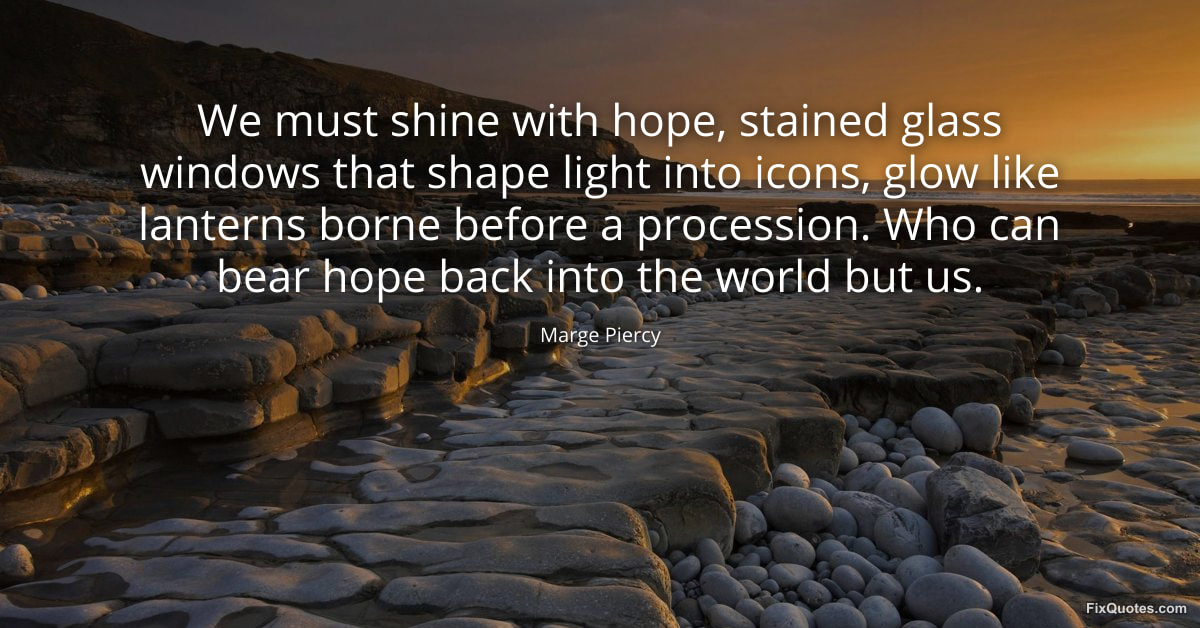
"We must shine with hope, stained glass windows that shape light into icons, glow like lanterns borne before a procession. Who can bear hope back into the world but us"
About this Quote
Piercy doesn’t offer hope as a mood; she frames it as craft, labor, and public duty. “Shine with hope” sounds inspirational until the metaphor sharpens: stained glass doesn’t generate light. It receives it, filters it, rearranges it into meaning. Hope here is not a private candle but a communal technology - a way of shaping whatever raw illumination the world still provides into “icons,” images people can rally around when language fails.
The stained-glass reference pulls in a whole history of institutions: churches, civic spaces, sanctioned stories. Piercy’s sly move is to borrow that aesthetic authority without submitting to its passivity. Stained glass is beautiful because it is constrained; the lead lines are limits that create form. That’s the subtext: hope isn’t pure, free-floating optimism. It’s structured, disciplined, maybe even “stained” by the very world it’s trying to answer.
Then she pivots to the street. “Glow like lanterns borne before a procession” turns hope into something portable and collective, a light carried by bodies moving together - protest, pilgrimage, funeral march, strike line. The image refuses solitary heroics. Hope travels when people do.
The final question lands like a dare: “Who can bear hope back into the world but us.” Piercy collapses the distance between poet and reader, believer and skeptic. No savior arrives; no institution will reliably do the job. The intent is mobilizing, but not naïve: hope is heavy, it must be borne, and the “us” is the only infrastructure she trusts.
The stained-glass reference pulls in a whole history of institutions: churches, civic spaces, sanctioned stories. Piercy’s sly move is to borrow that aesthetic authority without submitting to its passivity. Stained glass is beautiful because it is constrained; the lead lines are limits that create form. That’s the subtext: hope isn’t pure, free-floating optimism. It’s structured, disciplined, maybe even “stained” by the very world it’s trying to answer.
Then she pivots to the street. “Glow like lanterns borne before a procession” turns hope into something portable and collective, a light carried by bodies moving together - protest, pilgrimage, funeral march, strike line. The image refuses solitary heroics. Hope travels when people do.
The final question lands like a dare: “Who can bear hope back into the world but us.” Piercy collapses the distance between poet and reader, believer and skeptic. No savior arrives; no institution will reliably do the job. The intent is mobilizing, but not naïve: hope is heavy, it must be borne, and the “us” is the only infrastructure she trusts.
Quote Details
| Topic | Hope |
|---|
More Quotes by Marge
Add to List