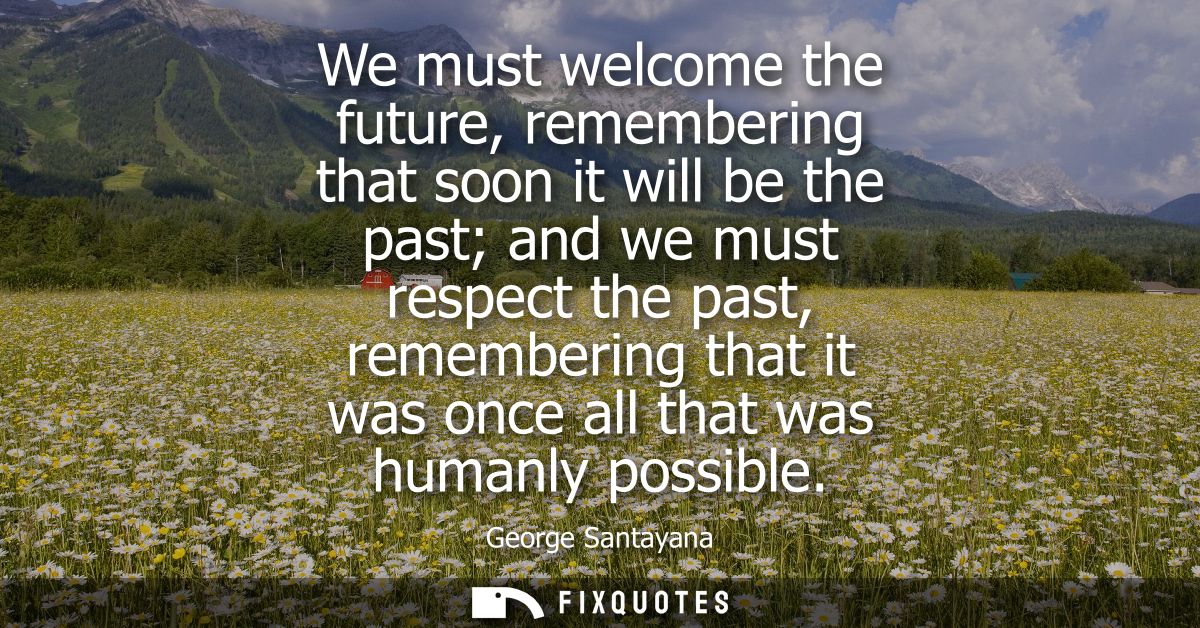
"We must welcome the future, remembering that soon it will be the past; and we must respect the past, remembering that it was once all that was humanly possible"
About this Quote
Santayana is doing that rare philosophical trick: sounding humane without sounding naive. The line welcomes the future, then instantly punctures future-worship by reminding you how fast novelty turns into artifact. “Soon it will be the past” is a quiet slap at progress-talk that treats history as a disposable draft. If the future’s main guarantee is that it ages, then our reverence for “the new” starts to look like a short-term crush.
The second clause flips the usual moralizing about tradition. He doesn’t ask us to respect the past because it was purer, wiser, or nobler. He asks for respect because it was once the limit of what could be done. That’s a subtle, almost charitable standard: people acted inside the constraints of their tools, knowledge, and social imagination. The subtext is anti-snobbery. It’s an argument against the smug present tense, the habit of treating earlier eras as if they had simply refused to be enlightened.
Context matters: Santayana writes from the long shadow of 19th-century “progress” and into the churn of modernity, where the future is marketed as destiny and the past is either canonized or canceled. He’s resisting both reflexes. The sentence builds a symmetrical ethic: forward motion without amnesia, historical judgment without contempt. It’s less a call to nostalgia than a warning that any era, including ours, is just someone else’s “once all that was humanly possible.”
The second clause flips the usual moralizing about tradition. He doesn’t ask us to respect the past because it was purer, wiser, or nobler. He asks for respect because it was once the limit of what could be done. That’s a subtle, almost charitable standard: people acted inside the constraints of their tools, knowledge, and social imagination. The subtext is anti-snobbery. It’s an argument against the smug present tense, the habit of treating earlier eras as if they had simply refused to be enlightened.
Context matters: Santayana writes from the long shadow of 19th-century “progress” and into the churn of modernity, where the future is marketed as destiny and the past is either canonized or canceled. He’s resisting both reflexes. The sentence builds a symmetrical ethic: forward motion without amnesia, historical judgment without contempt. It’s less a call to nostalgia than a warning that any era, including ours, is just someone else’s “once all that was humanly possible.”
Quote Details
| Topic | Time |
|---|
More Quotes by George
Add to List