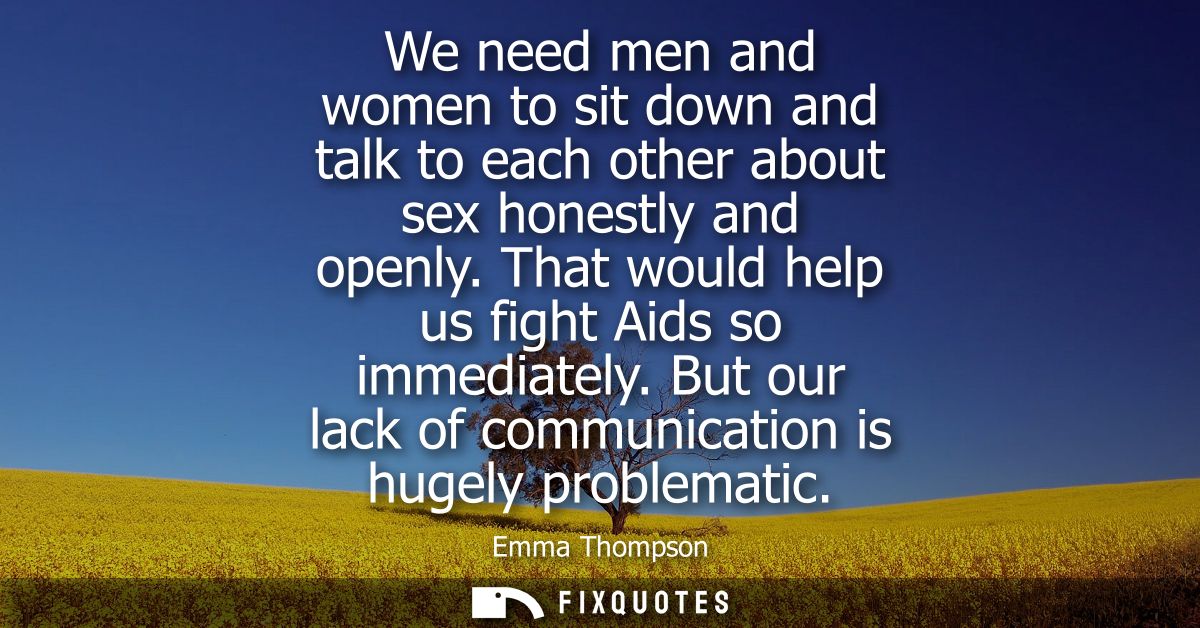
"We need men and women to sit down and talk to each other about sex honestly and openly. That would help us fight AIDS so immediately. But our lack of communication is hugely problematic"
About this Quote
The rhetorical move is strategic. “Sit down and talk” is domestic, almost boring; it shrinks AIDS from an abstract catastrophe to something addressable in kitchens, classrooms, clinics. “So immediately” is the emotional lever: communication is framed as the fastest intervention available, the kind that doesn’t wait on budgets, patents, or politics. It also needles institutions that hide behind complexity. If words could save lives this quickly, then silence starts to look like negligence.
The subtext is aimed at the way sex education is often treated as contamination rather than information. Thompson isn’t only advocating openness; she’s indicting a culture that confuses discomfort with virtue. Her final clause, “hugely problematic,” is deliberately plainspoken, almost British in its understatement, which makes the accusation sharper: we’re not failing because we don’t know better, but because we refuse to say what we know out loud. In the AIDS era’s shadow, that refusal isn’t just prudish. It’s deadly.
Quote Details
| Topic | Health |
|---|---|
| Source | Help us find the source |
| Cite |
Citation Formats
APA Style (7th ed.)
Thompson, Emma. (2026, February 16). We need men and women to sit down and talk to each other about sex honestly and openly. That would help us fight AIDS so immediately. But our lack of communication is hugely problematic. FixQuotes. https://fixquotes.com/quotes/we-need-men-and-women-to-sit-down-and-talk-to-141326/
Chicago Style
Thompson, Emma. "We need men and women to sit down and talk to each other about sex honestly and openly. That would help us fight AIDS so immediately. But our lack of communication is hugely problematic." FixQuotes. February 16, 2026. https://fixquotes.com/quotes/we-need-men-and-women-to-sit-down-and-talk-to-141326/.
MLA Style (9th ed.)
"We need men and women to sit down and talk to each other about sex honestly and openly. That would help us fight AIDS so immediately. But our lack of communication is hugely problematic." FixQuotes, 16 Feb. 2026, https://fixquotes.com/quotes/we-need-men-and-women-to-sit-down-and-talk-to-141326/. Accessed 2 Apr. 2026.