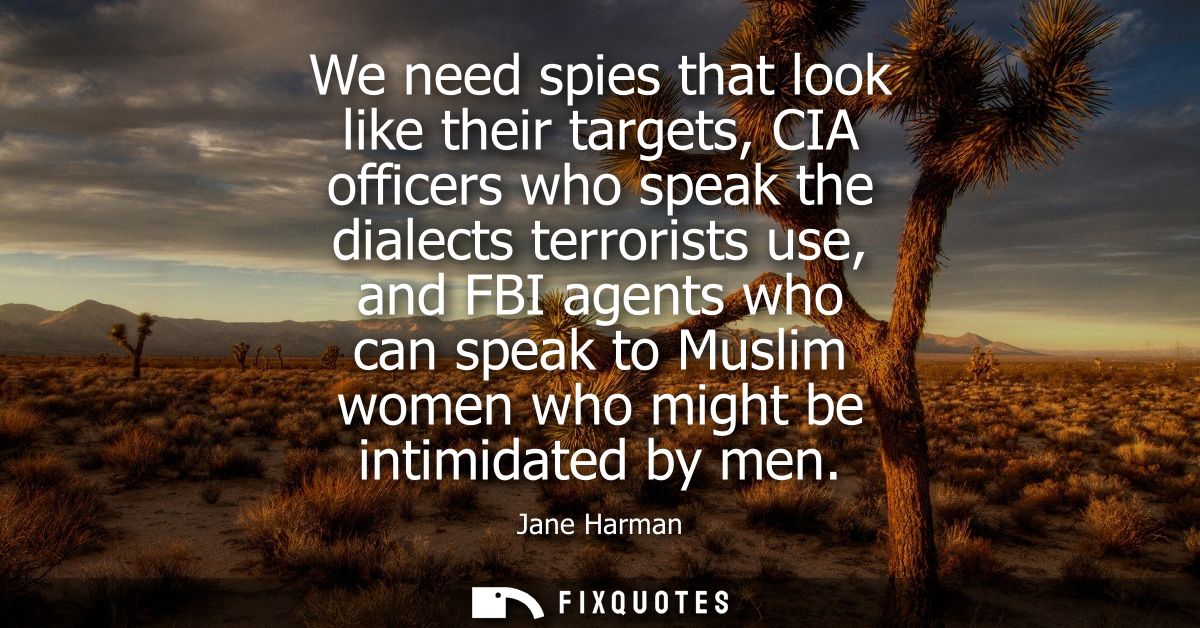
"We need spies that look like their targets, CIA officers who speak the dialects terrorists use, and FBI agents who can speak to Muslim women who might be intimidated by men"
About this Quote
The phrase “spies that look like their targets” is doing a lot of work. On the surface it’s an argument for cover and credibility. Underneath, it’s an admission that American intelligence has historically been too white, too male, too monolingual to penetrate communities it wants to understand. Harman frames difference not as representation for its own sake, but as operational necessity: identity as a tool, not a virtue. That’s why the diction stays clinical (“targets,” “dialects”) even when it touches intimate social realities.
The most revealing clause is the last one: “Muslim women who might be intimidated by men.” It signals awareness of gendered gatekeeping in investigations and interviews, but it also flirts with a paternalistic trope - Muslim women as inherently inaccessible without special handling. The subtext is both empathetic and instrumental: respect cultural norms so you can extract information. Contextually, this sits in an era when “cultural competence” became a national security buzzword, and when agencies began defending diversity hiring not primarily on equity grounds, but on mission grounds. It’s a pragmatic argument, sharpened by fear, that reframes inclusion as intelligence.
Quote Details
| Topic | Police & Firefighter |
|---|---|
| Source | Help us find the source |
| Cite |
Citation Formats
APA Style (7th ed.)
Harman, Jane. (2026, January 17). We need spies that look like their targets, CIA officers who speak the dialects terrorists use, and FBI agents who can speak to Muslim women who might be intimidated by men. FixQuotes. https://fixquotes.com/quotes/we-need-spies-that-look-like-their-targets-cia-69140/
Chicago Style
Harman, Jane. "We need spies that look like their targets, CIA officers who speak the dialects terrorists use, and FBI agents who can speak to Muslim women who might be intimidated by men." FixQuotes. January 17, 2026. https://fixquotes.com/quotes/we-need-spies-that-look-like-their-targets-cia-69140/.
MLA Style (9th ed.)
"We need spies that look like their targets, CIA officers who speak the dialects terrorists use, and FBI agents who can speak to Muslim women who might be intimidated by men." FixQuotes, 17 Jan. 2026, https://fixquotes.com/quotes/we-need-spies-that-look-like-their-targets-cia-69140/. Accessed 5 Apr. 2026.