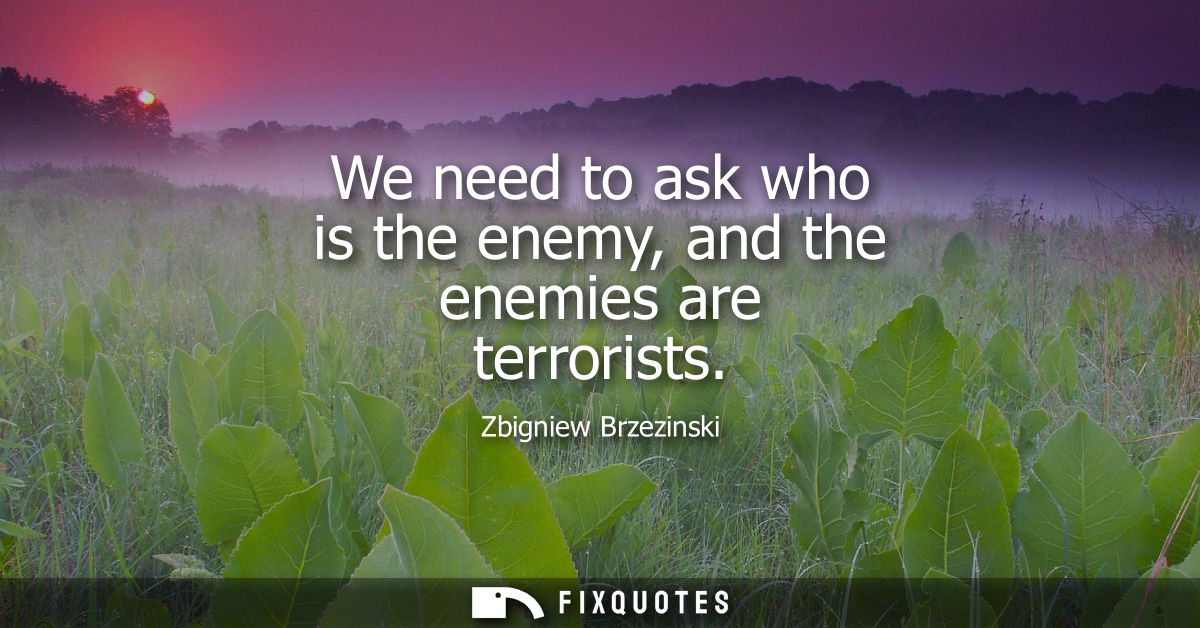
"We need to ask who is the enemy, and the enemies are terrorists"
About this Quote
Brzezinski’s line performs a neat bit of political stagecraft: it pretends to clarify, while quietly narrowing the universe of acceptable answers. “We need to ask who is the enemy” flatters the listener with the language of deliberation, as if the state is pausing to think. Then it snaps shut: “the enemies are terrorists.” The open-ended question is revealed as a rhetorical vestibule leading to a single sanctioned conclusion.
The intent is less about identifying a foe than about disciplining debate. “Terrorists” is not a country, a doctrine, or even a stable category; it’s a moral label that travels easily and sticks to whomever policy needs it to stick to. By defining the enemy as a tactic rather than an actor, the statement expands the battlefield without admitting it. If the enemy is “terrorism,” the conflict can migrate across borders, timelines, and legal regimes. That’s the subtext: strategic flexibility packaged as moral certainty.
Context matters. Brzezinski, a Cold War strategist with a hard-nosed view of power, understood how threat narratives organize publics. Post-1970s and especially post-9/11, Western politics leaned on the language of existential danger to justify surveillance, intervention, and emergency governance. This sentence fits that groove: it offers a crisp villain to unify a coalition and preempt messier questions about causes, blowback, or state violence.
Its effectiveness comes from its simplicity. It supplies a clean “us versus them” frame while sidestepping the uncomfortable reality that “terrorist” is often a contested designation, shaped as much by politics as by behavior.
The intent is less about identifying a foe than about disciplining debate. “Terrorists” is not a country, a doctrine, or even a stable category; it’s a moral label that travels easily and sticks to whomever policy needs it to stick to. By defining the enemy as a tactic rather than an actor, the statement expands the battlefield without admitting it. If the enemy is “terrorism,” the conflict can migrate across borders, timelines, and legal regimes. That’s the subtext: strategic flexibility packaged as moral certainty.
Context matters. Brzezinski, a Cold War strategist with a hard-nosed view of power, understood how threat narratives organize publics. Post-1970s and especially post-9/11, Western politics leaned on the language of existential danger to justify surveillance, intervention, and emergency governance. This sentence fits that groove: it offers a crisp villain to unify a coalition and preempt messier questions about causes, blowback, or state violence.
Its effectiveness comes from its simplicity. It supplies a clean “us versus them” frame while sidestepping the uncomfortable reality that “terrorist” is often a contested designation, shaped as much by politics as by behavior.
Quote Details
| Topic | War |
|---|---|
| Source | Help us find the source |
| Cite |
Citation Formats
APA Style (7th ed.)
Brzezinski, Zbigniew. (2026, January 16). We need to ask who is the enemy, and the enemies are terrorists. FixQuotes. https://fixquotes.com/quotes/we-need-to-ask-who-is-the-enemy-and-the-enemies-105867/
Chicago Style
Brzezinski, Zbigniew. "We need to ask who is the enemy, and the enemies are terrorists." FixQuotes. January 16, 2026. https://fixquotes.com/quotes/we-need-to-ask-who-is-the-enemy-and-the-enemies-105867/.
MLA Style (9th ed.)
"We need to ask who is the enemy, and the enemies are terrorists." FixQuotes, 16 Jan. 2026, https://fixquotes.com/quotes/we-need-to-ask-who-is-the-enemy-and-the-enemies-105867/. Accessed 15 Feb. 2026.
More Quotes by Zbigniew
Add to List